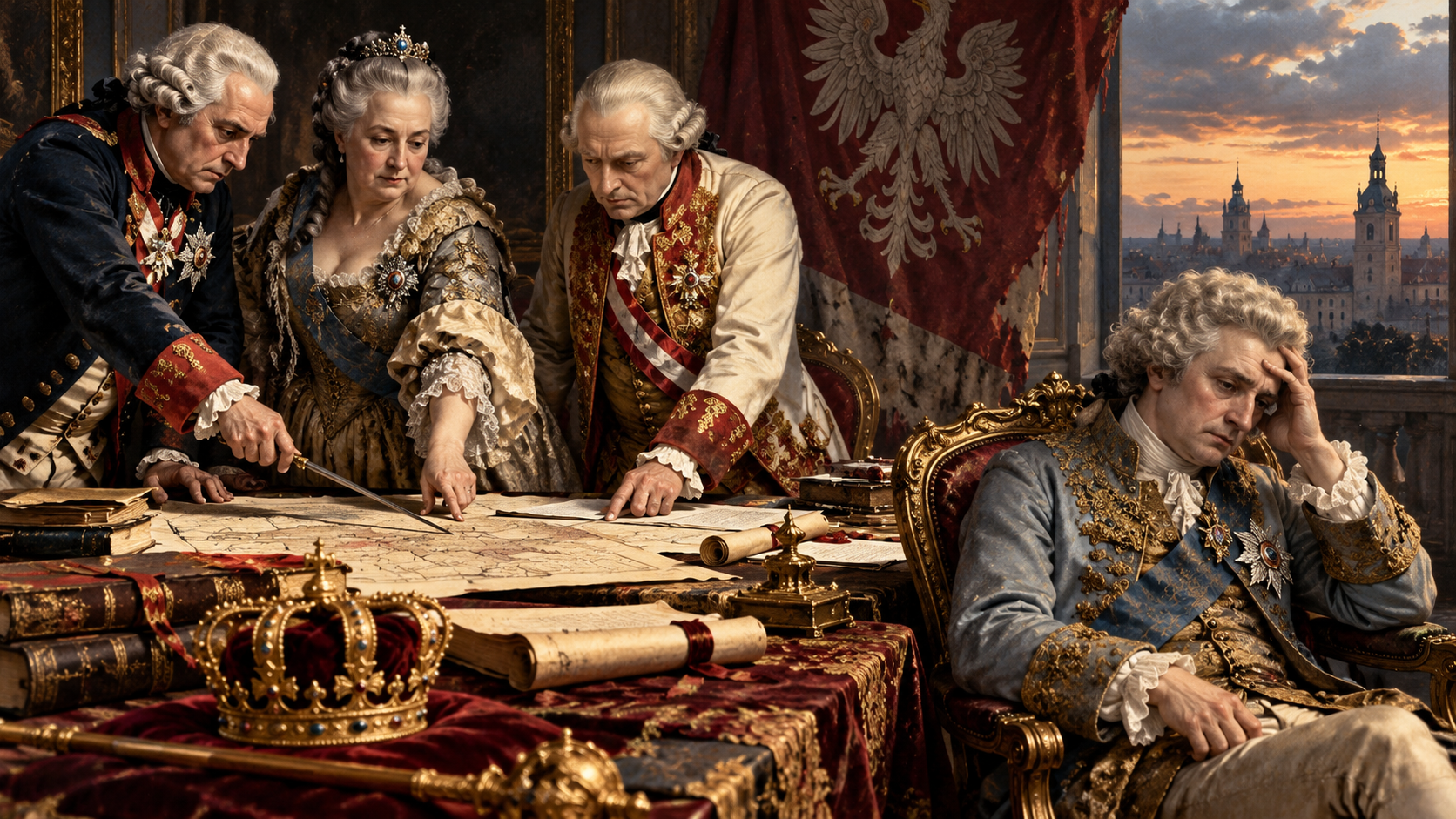
On 24 October 1795, Prussia acceded to the final partition settlement that completed the destruction of the Polish-Lithuanian Commonwealth.
For Poland, the date marks one of the bleakest turning points in its history.
Within weeks, King Stanisław August Poniatowski would abdicate, and the Commonwealth — once one of Europe’s largest states — would vanish from the political map. It would not re-emerge as an independent country for 123 years.
- Find more news from Poland on our Homepage .
The end came after two earlier partitions
The Third Partition did not come out of nowhere.
The Commonwealth had already been weakened by the First Partition of 1772 and the Second Partition of 1793, when its neighbours — Russia, Prussia and Austria — seized large areas of territory.
Those losses reflected both the military strength of the partitioning powers and the internal weakness of the Commonwealth itself. By the late 18th century, the state had long struggled with political paralysis, foreign interference and an outdated constitutional system that made decisive reform difficult.
Yet the Commonwealth did try to save itself.
The most famous effort came with the Constitution of 3 May 1791, one of Europe’s landmark reforming constitutions. It attempted to strengthen central government and modernise the state. But the reform programme provoked fierce opposition from conservative magnates and alarmed neighbouring powers, especially Russia.
Kościuszko’s defeat opened the way
The immediate background to the Third Partition was the failure of the Kościuszko Uprising of 1794.
Led by Tadeusz Kościuszko, the insurrection was a last attempt to defend the Commonwealth’s independence after the Second Partition. It mobilised soldiers, townspeople and, in some regions, peasants, and remains one of the defining episodes of Poland’s struggle for sovereignty.
But the uprising was defeated by the combined power of Russia and Prussia.
Kościuszko was captured after the Battle of Maciejowice in October 1794. In November, Russian forces stormed Praga, then a suburb of Warsaw, carrying out a massacre that helped break organised resistance. Once the uprising had collapsed, the partitioning powers were free to decide what remained of the Polish state.
A process, not one single act
The final destruction of the Commonwealth unfolded in stages.
On 3 January 1795, Russia and Austria concluded a treaty in St Petersburg sanctioning the Third Partition. According to the historical calendar published by Dzieje.pl, Prussia joined that treaty on 24 October 1795, completing the three-power settlement.
That is why 24 October is so important.
It was the date on which the final territorial agreement acquired its complete form among all three partitioning powers. The Polish state’s disappearance should therefore be understood as a process, not as one isolated act carried out on a single day.
The remaining lands of the Commonwealth were divided between the three neighbouring monarchies. Russia took the largest share, Prussia expanded west and north, and Austria consolidated its hold in the south.
The king’s abdication and the disappearance of the state
The political consequences followed quickly.
On 25 November 1795, Stanisław August Poniatowski abdicated. With that act, the already partitioned Commonwealth formally lost its monarch as well as its territory.
For contemporaries, this was more than a diplomatic rearrangement of borders.

A state with centuries of history — a Commonwealth that had once stretched from the Baltic deep into Eastern Europe — had ceased to exist.
The disappearance of Poland from the map did not mean the disappearance of the Polish nation, culture or political idea. But it did mean that Poles would have to preserve those things without an independent state of their own.
What 123 years without a state meant
The consequences of the Third Partition shaped all of 19th-century Polish history.
Poles now lived under three different empires, each with its own laws, administrative structures and policies. Daily life in Russian-controlled territory differed from life under Prussian or Austrian rule. That mattered politically, socially and culturally.
At the same time, the loss of statehood helped create a powerful modern independence tradition.
Successive generations tried to recover sovereignty through conspiracy, culture, education, religion, diplomacy and armed struggle. Major uprisings followed in 1830–31 and 1863–64, while large numbers of émigrés carried the Polish cause abroad.
This period also shaped the idea of Poland as a nation that could survive even without a state — a theme deeply embedded in Polish literature, music and political thought.
Why the Third Partition still matters
The Third Partition matters because it explains why Poland’s return in 1918 was experienced not simply as the birth of a new country, but as the restoration of a statehood that had been destroyed.
It also explains why the loss of independence occupies such a central place in Polish historical memory.
The Commonwealth was not erased because its people had ceased to exist. It was erased because stronger neighbours chose to divide it after defeating its final attempt at self-defence.
That is the significance of 24 October 1795.
It marks the final stage in the partition process that removed Poland from Europe’s political map — and began the long 123-year struggle to return.