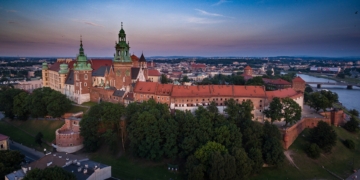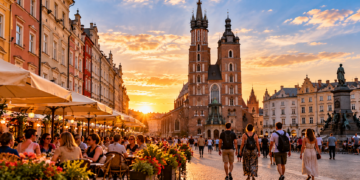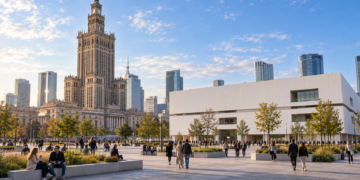


Kraków, Warsaw and Gdańsk have long been the Polish names international travellers recognise first.
Simon Calder chose somewhere else.
When The Independent travel desk selected its favourite trips from around the world, Britain’s veteran travel journalist picked Łódź — a city whose transformation from industrial powerhouse to creative destination remains considerably less familiar outside Poland.
- Find more news from Poland on our Homepage .
Calder summed up part of the attraction in one memorable phrase: “Poland is the land of luxury for less.”
His experience centred partly on the restored Grand Hotel on Piotrkowska Street, where he highlighted the grand staircase, large rooms and ballroom-like breakfast setting.
The praise is significant because Łódź represents a different strand of Polish tourism.
It is not a preserved medieval city.
Much of what makes it interesting comes from the architecture of Poland’s 19th-century industrial revolution: enormous textile factories, red-brick mills, manufacturers’ palaces and workers’ districts that tell the story of one of Central Europe’s fastest-growing industrial cities.
The Grand Hotel belongs to that history.
Łódź’s official tourism organisation describes it as the city’s oldest major hotel, established more than a century ago and occupying a prime position on Piotrkowska Street. Following an extensive restoration, it reopened as the city’s first five-star hotel.
But Calder also draws attention to the project that perhaps best explains modern Łódź: Manufaktura.
The immense former textile complex of industrialist Izrael Poznański has been converted into museums, restaurants, shops, entertainment venues and public space.
According to Łódź’s official tourism portal, restoring the weaving mill, power plant and other factory buildings became Poland’s first industrial-space revitalisation project carried out on such a scale.
That is exactly what makes Calder’s enthusiasm for the city interesting.
Łódź does not succeed by pretending its industrial past never happened.
It has increasingly learned how to use it.
The city’s old factories now house hotels, galleries, apartments, restaurants, cultural venues and businesses. Piotrkowska Street remains the spine running through the centre, while courtyards and formerly neglected buildings have been repurposed rather than erased.
There is also a more difficult history to encounter.
Calder specifically mentions Łódź’s Jewish cemetery, one of the most important surviving traces of a Jewish community that played a central role in the city before the Holocaust.
A visit therefore combines very different versions of the same place: industrial wealth, architectural decline, wartime catastrophe, post-industrial transition and ambitious regeneration.
You May Also Be Interested In
That is a much more complicated proposition than the conventional postcard city break.
It may also explain why Łódź is increasingly rewarding travellers who arrive without fixed expectations.
Calder’s recommendation matters not because one journalist enjoyed a comfortable hotel.
It matters because he placed Łódź alongside destinations across Europe, Africa, Asia, the Caribbean and the Pacific among his travel highlights of the year.
For a city still regularly overlooked even by visitors to Poland, that is precisely the kind of attention its transformation has begun to earn.