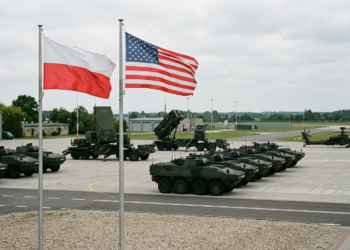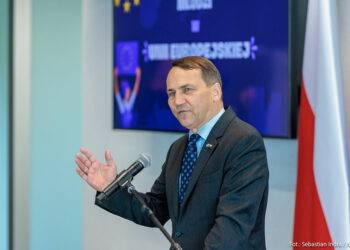

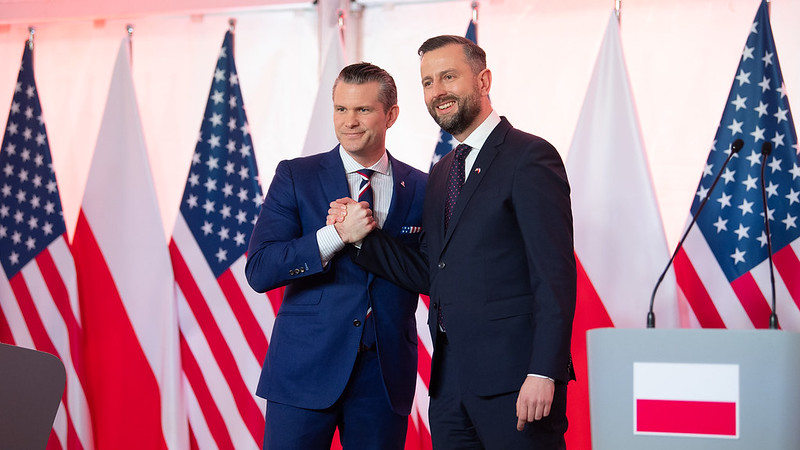
Poland is prepared to spend between 15 and 17 billion zloty on infrastructure for a permanent United States military presence on its soil, Defence Minister Władysław Kosiniak-Kamysz confirmed on Friday. Speaking in Bircza in the Podkarpacie region, the minister described the outlay as “the best investment in security” and said negotiations with Washington have entered their final phase.
The figure covers far more than barracks. A permanent base would accommodate American soldiers together with their families – potentially thousands of additional people requiring housing, schools, sports facilities, cultural amenities and supporting infrastructure. Kosiniak-Kamysz emphasised that this is not simply an expansion of the current rotational presence of roughly 10,000 US troops. “This is not the arrival of soldiers alone – we already have those in Poland – but of families on a permanent basis,” he said. “Schools, places for rest, sports activity, culture – all of that must be secured.”
Talks currently centre on one primary base, which need not be confined to a single geographic location. Possible sites under discussion in recent months have included areas near Poznań and Wrocław, both offering proximity to major cities and transport links. A US delegation visited Poland this week to inspect candidate locations. Ultimate approval rests with the American president, but Polish officials report that the process has moved into the decisive stage after months of formal exchanges, including a positive response from the US side to Poland’s official proposal.
Poland has long sought a permanent American footprint as a stronger deterrent on NATO’s eastern flank. The current arrangement, governed largely by the 2020 Enhanced Defence Cooperation Agreement, relies heavily on rotational forces. A fixed base would provide continuity, deeper integration with Polish units and a clearer signal of long-term commitment. Kosiniak-Kamysz noted that successive Polish governments have pursued this goal; the present coalition has accelerated it amid heightened Russian hybrid and conventional threats.
The cost estimate of 15–17 billion zloty (approximately €3.5–4 billion) is higher than earlier unofficial ranges of 10–12 billion zloty. Officials stress that the investment will be borne primarily by the Polish side, consistent with host-nation support practices. Poland already spends significantly on enabling US forces – fuel, logistics, infrastructure upgrades under the EDCA framework – and views the permanent base as a logical next step given its defence spending, which remains among the highest in NATO as a share of GDP.
The announcement comes against a backdrop of intensified Polish rearmament. At the MSPO defence exhibition in Kielce earlier this week, Prime Minister Donald Tusk unveiled the name of a new heavy infantry fighting vehicle – Niedźwiedź (Bear) – developed by the Polish Armaments Group and Huta Stalowa Wola in just twelve months. He also launched cooperation with ICEYE aimed at building sovereign satellite communications capabilities, explicitly framing the project as the foundation for a “Polish Starlink.” These initiatives underscore Warsaw’s dual track: deepening the alliance with the United States while expanding domestic industrial capacity.
Security considerations dominate the calculation. Russian drone and missile activity near and across Ukrainian borders, repeated hybrid incidents, and intelligence warnings about possible provocations on NATO’s eastern flank have sharpened the case for permanent allied presence. Kosiniak-Kamysz and other officials have repeatedly linked the base project to credible deterrence. A fixed American garrison, complete with family infrastructure, signals that the United States intends to remain engaged for the long term rather than rotating forces in and out.
Practical questions remain. The precise number of additional troops, the mix of units, and the exact footprint will be settled in the coming weeks or months. Construction timelines are measured in years rather than months. Polish authorities are already examining legislative tools, including the possible use of special legislation, to accelerate permitting and building. Financing will be arranged through the state budget and defence funds; the government has signalled that security spending will be protected.
For ordinary Poles the numbers are large, yet the strategic logic is straightforward. Poland sits on the front line of European security. A permanent US base multiplies deterrence, strengthens collective defence, and anchors the American commitment that has underpinned Polish security policy since 1989. At 15–17 billion zloty the price is substantial, but successive defence ministers and the current government judge it a necessary and worthwhile outlay.
Kosiniak-Kamysz’s Friday remarks mark the clearest public costing of the project to date. With American inspectors on the ground and political will on both sides, the long-sought permanent presence is closer than at any previous point. Poland is ready to pay the bill. The remaining decisions now lie primarily in Washington – and the clock is running.