

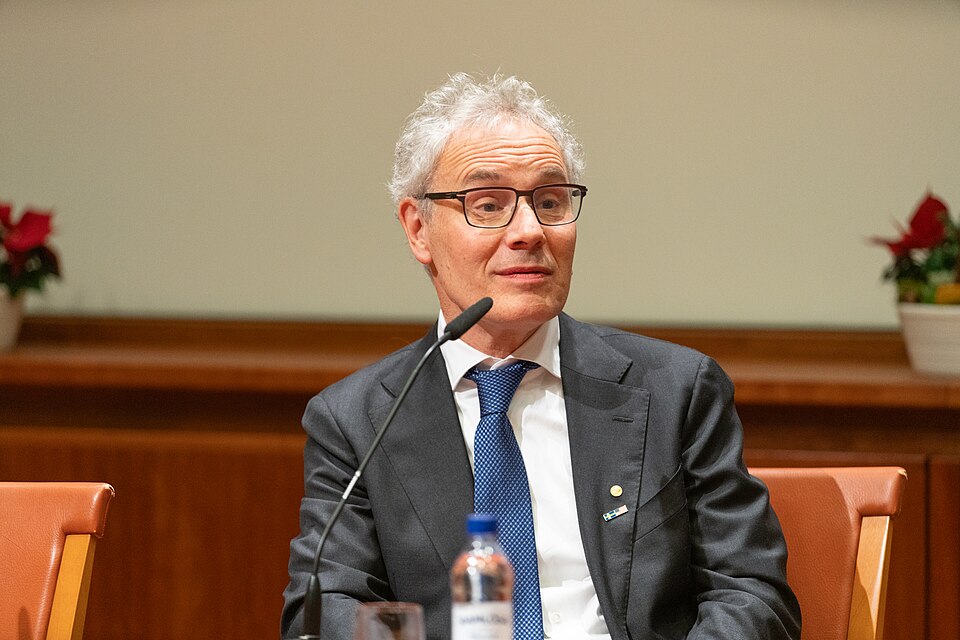
American Nobel Prize-winning scientist Victor Ambros has been formally confirmed as a Polish citizen, adding a new chapter to a family history that stretches from pre-war Poland and Nazi forced labour to the United States and one of modern biology’s most important discoveries.
Prime Minister Donald Tusk personally told Ambros the news during a video call published by the Polish government this week.
The legal position is slightly more unusual than a straightforward grant of citizenship. On 14 September, the governor of Mazowieckie province issued a decision confirming that Ambros has been a Polish citizen from birth, because of citizenship inherited through his father.
- Find more news from Poland on our Homepage .
The government nevertheless presented the decision as the culmination of Ambros’s effort to formally establish his Polish nationality.
Ambros, who holds American citizenship, told the Polish Press Agency that he hoped his new formal status would strengthen his links with Polish researchers and help him promote the country’s biomedical science internationally.
“I am very grateful to Prime Minister Tusk and to Poles,” Ambros told PAP, adding that he hoped his American and Polish citizenship would honour both his father’s Polish roots and the opportunities the United States had given his family.
Nobel Prize for discovery of microRNA
Ambros is one of the world’s best-known molecular biologists.
He shared the 2024 Nobel Prize in Physiology or Medicine with American scientist Gary Ruvkun for the discovery of microRNA and its role in post-transcriptional gene regulation.
Their work revealed an entirely new mechanism through which cells control the activity of genes.
MicroRNAs are tiny RNA molecules that can regulate whether particular genetic instructions are translated into proteins. The discovery helped explain how cells containing the same DNA can nevertheless develop very different functions and characteristics.
The Nobel Assembly described the work as uncovering a fundamental principle of gene regulation essential to multicellular organisms, including humans.
Ambros, born in New Hampshire in 1953, is a professor at UMass Chan Medical School in Massachusetts.
But his connection with Poland has become increasingly visible in recent years.
Already closely involved with Polish science
Ambros already plays a direct role in Poland’s scientific community.
He chairs the international Scientific Board of the International Institute of Molecular Mechanisms and Machines of the Polish Academy of Sciences, known as IMol, in Warsaw.
The institute focuses on molecular biology and biomedicine, with research spanning areas including genetics, cell biology, biotechnology and disease mechanisms. IMol says almost half of its researchers come from outside Poland and that Ambros’s international board helps oversee the quality of its scientific work.
Ambros has said he hopes Polish citizenship will create further opportunities to support Polish science, particularly biomedical research, and strengthen its international profile.
The Polish government says he is expected to return to the country next year to meet academics and researchers.
Tusk’s office also said the two share an ambition to help Poland attract outstanding young scientists from around the world.
A family history rooted in pre-war Poland
Ambros’s claim to Polish citizenship comes through his father, Longin Ambros.


Records held by Poland’s Institute of National Remembrance, or IPN, show that Longin was born in 1923 in Dordziszki, then located in the Wilno region of the Second Polish Republic.
The area’s borders changed dramatically after the Second World War and the places associated with the family now lie outside present-day Poland.
During the German occupation, Longin Ambros was deported to Nazi Germany and used as a forced labourer. IPN records show that he worked in Hesse from 1942.
After the war, he emigrated to the United States.
Victor Ambros has previously spoken about seeking recognition of his Polish citizenship partly as a tribute to his father and other relatives whose lives were shaped by the war.
During a visit to Poland earlier this year, he said acquiring formal confirmation of his Polish nationality would be a way of honouring his family and contributing, even in a small way, to the development of Polish science.
From family connection to active scientific relationship
Ambros’s ties with Poland are therefore no longer limited to ancestry.
His position at IMol places him directly inside one of the institutions attempting to strengthen Poland’s international biomedical research network.
In 2025, he was also awarded an honorary doctorate by the Silesian University of Technology, the first such distinction he received after winning the Nobel Prize, according to IPN.
His citizenship confirmation gives that relationship another dimension.
Rather than being naturalised as a foreign scientist, the Mazowieckie governor’s decision formally recognises that Ambros inherited Polish citizenship through his family and has, in legal terms, been Polish since birth.
For Ambros, the significance appears to be both personal and professional: reconnecting with the country his father left after the Second World War while using his international scientific standing to strengthen the institutions now operating there.