

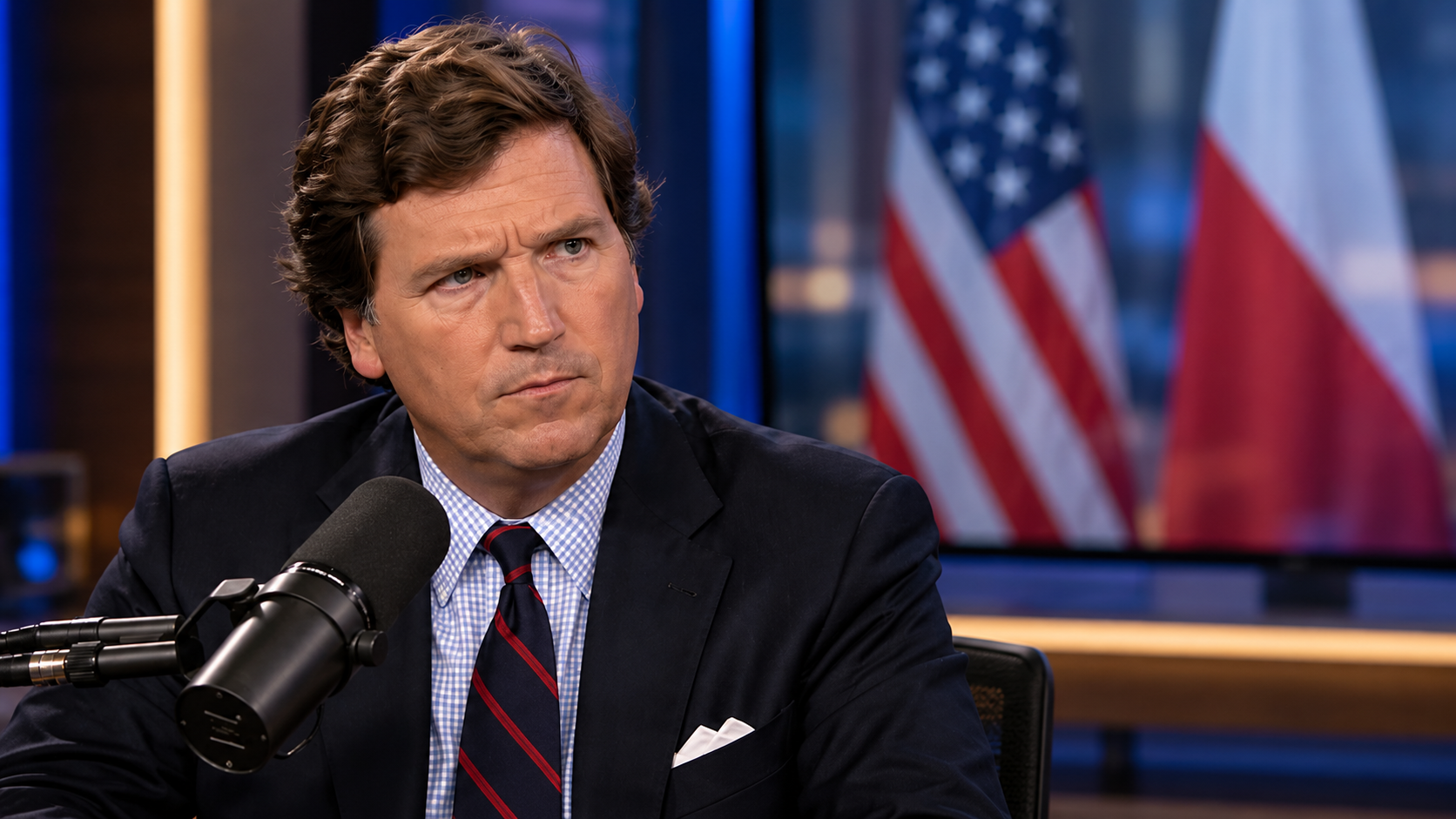
US Ambassador to Poland Tom Rose has launched an unusually direct attack on Tucker Carlson over the American commentator’s remarks about Nazi Germany’s invasion of Poland, calling him a “historical illiterate” and accusing him of deliberately distorting the moral and historical record of the Second World War. Polish Foreign Minister Radosław Sikorski responded publicly by thanking the ambassador.
Rose intervened on Tuesday, 6 October, four days after Carlson published an interview with former British cabinet minister Sir Jacob Rees-Mogg in which the pair argued over Britain’s decision to fight Nazi Germany and the circumstances surrounding the invasion of Poland.
According to Rose’s statement, reproduced by Rzeczpospolita, the interview demonstrated why he regarded Carlson as the “most dangerous demagogue in America”. He also described him as a “historical illiterate” presenting himself as a modern-day Herodotus.
- Find more news from Poland on our Homepage .
Rose argued that Carlson’s approach went beyond ignorance or contrarianism. In his view, repeatedly questioning established historical facts served to erase distinctions between aggressors and victims and turn what he described as settled history into a series of supposedly unresolved questions.
The ambassador specifically rejected any framing in which Nazi Germany could be portrayed as the victim of events surrounding the outbreak of war while Poland was presented as responsible for German aggression. He called such an inversion a “grotesque insult” to Poland and accused Carlson of deliberately undermining historical truth.
Sikorski then shared Rose’s intervention on X and replied simply: “Thank you, @USAmbPoland.” The foreign minister’s response gave the controversy an additional official Polish dimension after the government and Poland’s diplomatic mission in Washington had already criticised Carlson.
Government spokesman Adam Szłapka had earlier called Carlson’s remarks scandalous and pointed to the response from Bogdan Klich, Poland’s chargé d’affaires in Washington.
Klich had written to Carlson on 5 October demanding an immediate public retraction and apology. He accused the commentator of falsifying the historical record and said his remarks insulted the victims of Nazism, including American servicemen who fought in Europe.
The dispute began with Carlson’s 2 October interview with Rees-Mogg. During their exchange, Carlson questioned why Britain had entered the Second World War and rejected the idea that Hitler had invaded Poland without a reason.
Carlson referred to territories transferred from Germany following the First World War and argued that Germany had territorial grievances arising from the Treaty of Versailles. He also questioned whether defending Poland had been Britain’s concern.
Rees-Mogg repeatedly challenged him. At one point, the former Conservative minister accused Carlson of “verging on defending Hitler”. Carlson rejected that characterisation and said he was examining whether Britain had benefited from entering the war.
The territorial background Carlson referred to was real, but it represents only part of the events leading to September 1939.
The Versailles settlement transferred areas previously controlled by Germany to the restored Polish state, while the Free City of Danzig — now Gdańsk — was placed under League of Nations protection with special Polish rights. Hitler later demanded Danzig’s incorporation into Germany and an extraterritorial transport corridor across Polish territory.
Those demands, however, formed part of a much broader German policy towards Poland. In August 1939, Nazi Germany and the Soviet Union signed the Molotov-Ribbentrop Pact, whose secret arrangements envisaged dividing Poland and other territories in Eastern Europe into German and Soviet spheres of influence.
Germany invaded Poland on 1 September. Soviet forces entered Poland from the east on 17 September.
Nazi Germany also used propaganda and manufactured incidents to portray itself as acting defensively. The best-known example was the staged attack on the Gleiwitz radio station shortly before the invasion.
Britain and France declared war on Germany on 3 September after Germany attacked Poland.
Rose’s intervention therefore represents more than another Polish objection to Carlson’s comments. The serving US ambassador in Warsaw has now publicly aligned himself with Poland’s rejection of Carlson’s historical framing, while Poland’s foreign minister has endorsed that response.
The controversy has consequently developed into a transatlantic diplomatic row involving Poland’s representative in Washington, the US ambassador in Warsaw and Poland’s foreign minister — all responding to remarks made by one of America’s most prominent political commentators.