

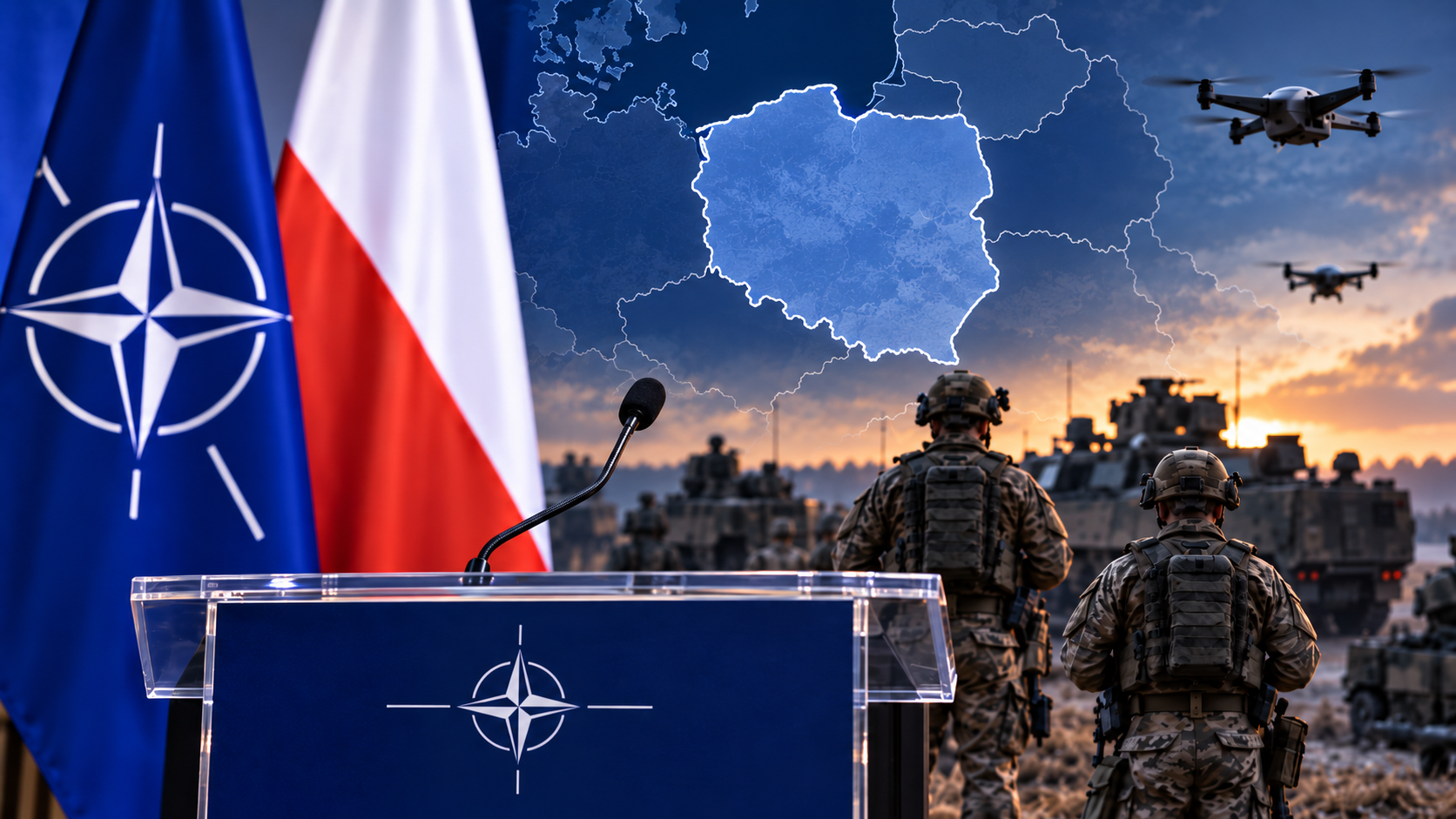
NATO’s top military commander will publicly present his new “Theory of Victory” in Warsaw next week, setting out how allied forces could defeat a potential attack on NATO’s eastern flank by combining conventional military power with drones, autonomous systems and artificial intelligence. General Alexus Grynkewich, Supreme Allied Commander Europe, is due to present the concept in Poland on 12 October.
Grynkewich is expected to make the presentation during the Warsaw Security Forum, which takes place in the Polish capital on 12–13 October. Organisers describe it as the first public presentation of a concept that has previously been discussed at senior levels within NATO’s military structures.
Polish Defence Minister Władysław Kosiniak-Kamysz confirmed that the general would visit Poland and said he had already seen the document prepared by Grynkewich. He described the general’s preparation and proposals positively, according to reporting based on an interview with the Polish Press Agency.
- Find more news from Poland on our Homepage .
The phrase “Theory of Victory” does not mean NATO has announced plans to initiate a war with Russia. Grynkewich’s spokesman, Colonel Martin O’Donnell, has described the concept as entirely defensive, with the central objective of maintaining NATO’s military advantage so that aggression can first be deterred and, if deterrence fails, defeated.
That distinction is significant. The document is best understood as a military framework being developed by NATO’s Supreme Allied Commander Europe rather than a newly announced political doctrine formally adopted by all 32 allies.
Reporting on an unclassified version of the document says the concept begins with stopping an incursion using allied land forces and then exploiting newer technologies to counter an adversary’s numerical strength and momentum.
Those capabilities would include large numbers of comparatively inexpensive drones, minimally crewed or autonomous platforms and artificial-intelligence systems capable of assisting with target detection and battlefield decision-making. NATO has already been experimenting with many of those technologies through its Eastern Flank Deterrence Initiative.
In June, for example, NATO tested drones, counter-drone systems, robotic vehicles and next-generation communications with allied troops in Slovakia. NATO says the initiative is designed to integrate scalable, battle-tested technologies rapidly into forces defending the eastern flank.
Under the reported Theory of Victory concept, once an attack had been contained and allied forces had gained freedom of manoeuvre, NATO would seek to disable the opponent’s command, control, communications, intelligence, surveillance and targeting architecture using both kinetic and digital means. Conventional air and missile firepower would remain available if required.
The emphasis reflects lessons from Russia’s full-scale invasion of Ukraine, where inexpensive drones, electronic warfare, rapid targeting and artificial intelligence have become increasingly important alongside tanks, artillery and aircraft.
NATO has already been reshaping its eastern-flank posture in response to Russia’s war. The alliance currently maintains multinational land forces from the Baltic region to the Black Sea and has increased its ability to reinforce threatened members rapidly. NATO describes Russia’s invasion of Ukraine as the gravest threat to Euro-Atlantic security in decades.
Poland occupies a particularly important position in that system. It hosts a NATO multinational battlegroup, substantial American forces and infrastructure used to reinforce the eastern flank, while also serving as a major logistical hub for military assistance to Ukraine.
Warsaw is therefore a symbolically significant location for the first public presentation of Grynkewich’s concept. The Warsaw Security Forum says the general’s appearance will form part of a broader debate about preparing European and North American forces for a possible future high-intensity conflict.
The forum’s organisers have also identified 2029 as an important planning horizon within discussions surrounding Grynkewich’s strategy. Warsaw Security Forum chair Katarzyna Pisarska said the general is expected to explain publicly why that year matters for European and American military preparedness. That timeline comes from the forum organisers and has not yet been independently set out by NATO in a public version of the strategy.
Senior NATO figures including Deputy Secretary General Radmila Shekerinska and NATO Military Committee chairman Admiral Giuseppe Cavo Dragone are also scheduled to attend the Warsaw gathering, alongside senior Polish government officials.
NATO continues to stress that its posture is defensive and designed primarily to make an attack unattractive in the first place. But Grynkewich’s “Theory of Victory” reflects a parallel argument: deterrence is credible only if an adversary believes the alliance possesses both the forces and the operational plan required to win should deterrence fail.