

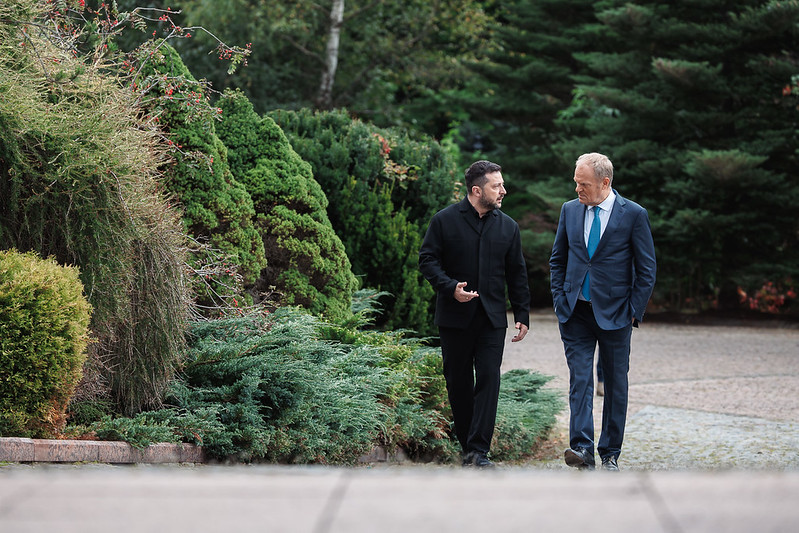
Polish Prime Minister Donald Tusk has used a visit to Ukraine to reaffirm Warsaw’s military and political support for Kyiv, telling Ukrainians “you are not alone” as Poland moved to join a European coalition developing new defences against ballistic missiles.
Tusk met President Volodymyr Zelenskyy in western Ukraine on Friday, a day after warning the Polish parliament that the coming months could bring an intensification of Russian attacks and possible hybrid drone and missile incidents affecting countries supporting Ukraine.
The Polish prime minister travelled to the Ivano-Frankivsk region for talks with Zelenskyy and the inaugural summit of the new Carpathian Eight regional format.
- Find more news from Poland on our Homepage .
But the visit produced more immediate Polish-Ukrainian security developments than the launch of the C8 itself.
Tusk announced that Poland had prepared new support packages for Ukraine, while Zelenskyy confirmed that Warsaw would participate in the emerging European anti-ballistic missile initiative. The two leaders also discussed bilateral relations and Ukraine’s future integration with the European Union.
‘You are not alone’
Tusk placed security at the centre of his message in Ukraine.
“We are all here today to demonstrate our solidarity with you, with Ukraine,” he told the summit, adding that such solidarity was more important than ever in the region.
He then made the connection with Poland explicit.
“Your sovereignty and your security also mean sovereignty and security for Poland.”
Tusk said Ukraine was fighting the immediate war but that other countries in the region also had to prepare for possible future scenarios.
“You are not alone,” he told his Ukrainian hosts.
The language echoed Tusk’s security warning in Warsaw a day earlier, when he said intelligence assessments indicated that late autumn and winter could become an especially difficult phase of the war.
His office said assessments available to Poland included the possibility of hybrid drone or missile strikes against countries supporting Ukraine, including Poland. Tusk presented that as a potential scenario rather than a certainty.
Russian attacks on western Ukraine have repeatedly triggered Polish military responses in recent days, including fighter deployments, heightened air-defence readiness and temporary restrictions at Rzeszów and Lublin airports.
Poland to join anti-ballistic coalition
One of the most concrete outcomes of Tusk’s visit concerned the Integrated Anti-Ballistic Missile Coalition, a European initiative intended to develop new capabilities against ballistic threats.
The coalition was launched in Paris in July by Ukraine, the United Kingdom, France, Germany, Italy, Spain, the Netherlands, Denmark, Norway and Sweden. Poland was not among its original signatories.
That is now changing.
Speaking alongside Zelenskyy on Friday, Tusk said it was clear that Poland would also become part of the initiative. Zelenskyy said the two countries would work as partners and indicated that Ukraine was prepared to share relevant technology with Poland.
The Ukrainian president was unusually emphatic about the project’s ambitions.
“We will create a European missile defense system. I am 100% certain of this.”
You May Also Be Interested In

Zelenskyy said further details would be discussed with Tusk.
The coalition is linked to the FREYJA programme, under which participating states and defence companies are seeking to create an integrated European capability that can supplement existing missile-defence systems.
Ukraine has argued that its combat experience and defence industry can contribute technology and expertise, while European partners provide components, financing, sensors and industrial capacity.
New Polish support packages for Ukraine
Tusk also disclosed that Warsaw had prepared further assistance for Ukraine.
“Poland has prepared new, quite significant aid packages for Ukraine,” he said, adding that he had informed Zelenskyy about the details.
The exact composition and value of the packages were not immediately detailed publicly.
Tusk described the assistance as a signal that Poland and Ukraine remain close partners despite periodic political disagreements between Warsaw and Kyiv.
His announcement comes as Ukraine faces another difficult winter and sustained Russian attacks on energy, transport and industrial infrastructure.
A day before travelling, Tusk told the Sejm that Russia appeared to be pursuing a strategy aimed at damaging Ukraine’s economy and logistics on a large scale.
“Russia has decided on a new strategy for conducting the war,” he said, predicting continued attacks on major Ukrainian cities.
Border attacks give visit additional urgency
The security discussions carry particular weight for Poland because Russian strikes are increasingly taking place close to Polish territory.
Warsaw has reinforced military protection at several border crossings and expanded air-defence and radar coverage after repeated Russian attacks in western Ukraine.
Tusk said on Thursday that Poland had deployed air-defence protection to six border crossings and strengthened command and radar capabilities in the area.
The Polish government has also become increasingly concerned about Russia’s growing use of faster jet-powered drones.
Those threats help explain why participation in the anti-ballistic initiative has moved higher up Warsaw’s agenda.
In July, Tusk had said Poland could join if Polish defence companies developed an industrial offer allowing them to contribute. Friday’s discussions with Zelenskyy indicate that the political decision has now advanced beyond that earlier conditional position.
Tusk uses visit to back Ukraine’s EU path
Security was not the only issue.
Tusk also endorsed the newly created Carpathian Eight, which brings Ukraine together with Poland, Romania, Serbia, Slovakia, Czechia, Austria and Hungary in a regional cooperation framework.
Zelenskyy says the format will concentrate on security, energy, transport, logistics, investment and cross-border economic links.
Tusk argued that such cooperation could help Ukraine move towards European Union membership.
“The Carpathian format can indeed help you on your path to the European Union,” he said, pointing to Poland’s own experience of regional cooperation during its integration with the bloc.
He also acknowledged that relations between Poland and Ukraine contain difficult issues, particularly around their shared history, and said those questions still needed to be discussed.
That combination — strategic support alongside open acknowledgement of bilateral disputes — has increasingly characterised Tusk’s approach to Kyiv.
From Warsaw warning to Ukraine talks
The timing of Friday’s visit is therefore particularly significant.
Less than 24 hours earlier, Tusk was standing in the Sejm warning MPs that Russia could seek to weaken NATO cohesion through provocations and ambiguous incidents.
By Friday, he was in Ukraine discussing missile defence directly with Zelenskyy, announcing further Polish assistance and joining a new regional political format.
Tusk told the Polish parliament before leaving that NATO’s Article 5 and allied loyalty had to remain credible.
“All our partners must know that Poland can always be counted on,” he said. “Then we will not be left alone either.”
His visit to Ukraine turned that argument into a diplomatic message: Warsaw regards Ukraine’s ability to withstand Russia not simply as a question of support for a neighbour, but as part of Poland’s own security policy.