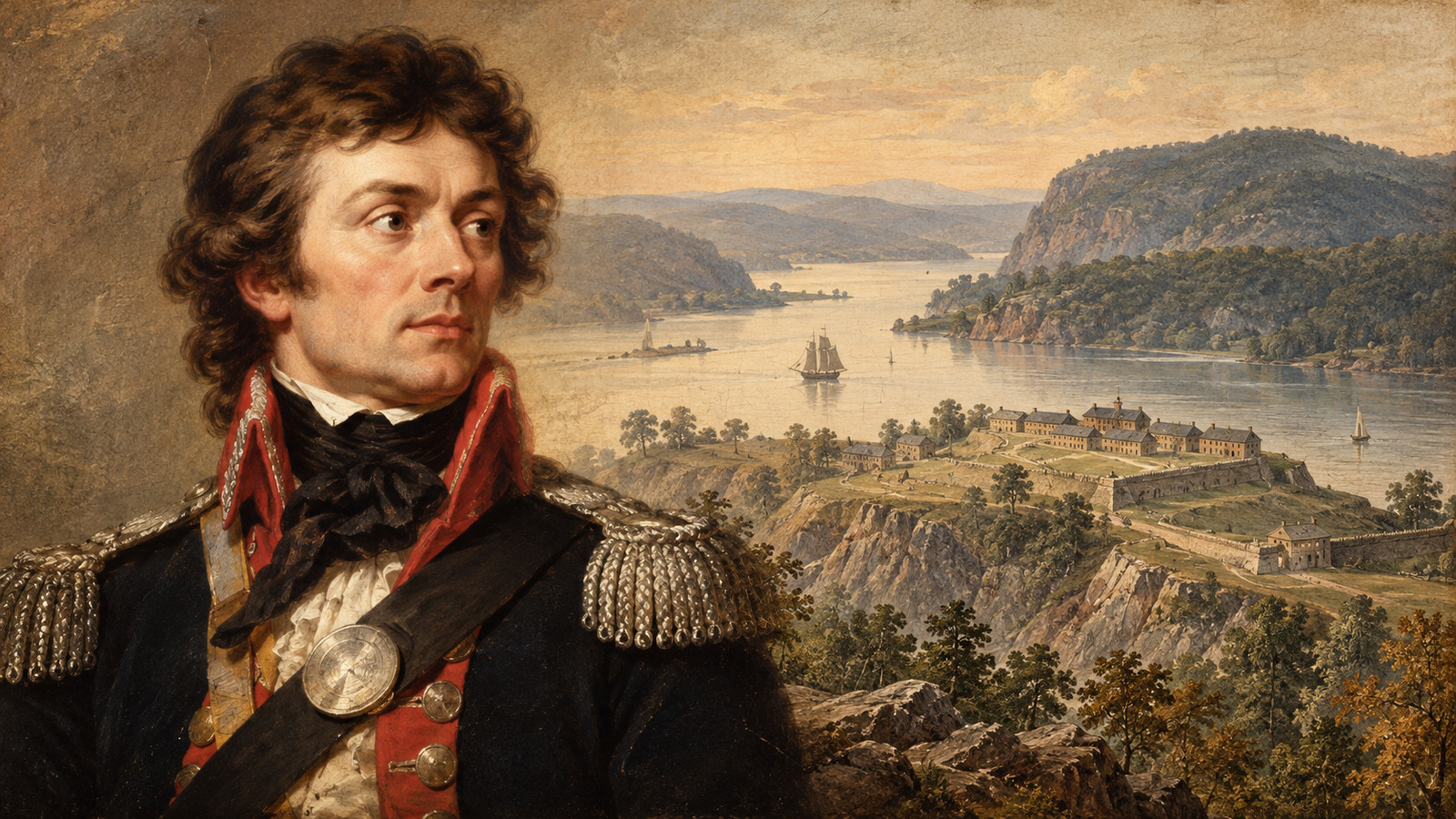
On 15 October 1817, a Polish general who had helped America win its independence died in a Swiss town, far from the homeland he had spent much of his life fighting to free.
His name was Tadeusz Kościuszko.
Today, 209 years after his death, he remains one of the most remarkable figures connecting Polish and American history: a military engineer whose work helped secure important victories in the American Revolutionary War, a leader of Poland’s struggle for independence and an advocate of liberty whose beliefs extended beyond the battlefield.
- Find more news from Poland on our Homepage .
Kościuszko was 71 when he died in Solothurn, Switzerland. By then, he had witnessed the birth of the United States and the disappearance of his own country from Europe’s political map.
Yet the achievements of a man who fought for freedom on two continents would outlive him.
The Polish engineer who helped defend America
Born in 1746 in the Polish-Lithuanian Commonwealth, in a region now part of Belarus, Kościuszko received military education in Warsaw before studying in France.
In 1776, he travelled to North America, where Britain’s thirteen colonies were fighting for independence.
He joined the Continental Army as a military engineer, bringing expertise that would prove valuable to George Washington’s revolutionary forces.
One of his most significant contributions came during the Saratoga campaign in 1777.
Kościuszko helped design the American defensive positions at Bemis Heights, using the landscape overlooking the Hudson River to strengthen the army’s position against advancing British troops.
The American victory at Saratoga became a turning point in the Revolutionary War, helping convince France to enter the conflict as an American ally.
Kościuszko’s contribution was important, although the victory resulted from the efforts of numerous commanders, soldiers and allies.
His next major assignment would leave an equally lasting mark.
Beginning in 1778, Kościuszko worked on the fortifications at West Point, New York, overseeing defensive works that helped protect a strategically important stretch of the Hudson River.
Those defences became part of the system guarding a vital route through the American colonies.
According to the US National Park Service’s biography of Kościuszko, he later served in the southern campaigns under General Nathanael Greene, helping the army navigate difficult terrain, cross rivers and organise defensive positions.
He remained in American service until the closing stages of the war.
America had gained its independence. Kościuszko would soon face a very different struggle at home.
A hero returns to fight for Poland
Kościuszko returned to the Polish-Lithuanian Commonwealth in 1784, where growing pressure from neighbouring powers threatened the country’s independence.
After fighting against Russian forces in 1792, he became the leader of the national uprising launched in Kraków on 24 March 1794.

The insurrection sought to resist foreign domination and defend what remained of the Commonwealth following successive territorial partitions.
One of its most memorable victories came at Racławice on 4 April 1794, where Kościuszko’s forces defeated a Russian army with the participation of peasant volunteers armed with modified agricultural scythes.
But his ambitions went beyond military resistance.
In May 1794, Kościuszko issued the Proclamation of Połaniec, which granted peasants personal freedom, reduced certain feudal labour obligations and offered limited protections against abuses by landowners.
These measures did not abolish the entire system of serfdom, and their practical impact was restricted by the uprising’s eventual defeat.
Nevertheless, the Polish historical account of the proclamation identifies it as an important development in the struggle for peasants’ rights.
The insurrection ultimately failed. Kościuszko was wounded and captured at the Battle of Maciejowice in October 1794, then imprisoned in Russia.
The Third Partition of 1795 erased the Polish-Lithuanian Commonwealth as an independent state.
Although Kościuszko was released the following year, he would never see his homeland regain its sovereignty.
His extraordinary plan to free enslaved Americans
Kościuszko’s commitment to liberty also produced one of the most striking episodes of his American legacy.
During a return visit to Philadelphia in 1797–1798, he developed a close friendship with Thomas Jefferson, then vice-president of the United States.
Before leaving America in 1798, Kościuszko prepared a will directing that his American assets be used to purchase the freedom of enslaved people and support their education.
He named Jefferson as executor.
The proposal was remarkable in an era when slavery remained deeply embedded in American society, including within Jefferson’s own household and plantations.
But Kościuszko’s wishes were never carried out as intended.
Jefferson declined to administer the bequest after Kościuszko’s death, and competing wills and prolonged legal disputes prevented the planned emancipation.
The US Library of Congress records that the legal proceedings continued for decades.
The episode reveals both the breadth of Kościuszko’s ideals and the limitations of what those ideals achieved.
His opposition to slavery was clear. The freedom he hoped to finance for enslaved Americans did not materialise through his will.
A final journey home
Kościuszko spent his later years in Europe, eventually settling in Solothurn, Switzerland, in 1815.
There, he maintained correspondence with old friends, including Jefferson, while remaining deeply concerned about Poland’s fate.
He died on 15 October 1817, without witnessing the restoration of Polish independence.
His remains were transferred to Kraków in 1818 and interred in Wawel Cathedral, the resting place of Polish monarchs and national heroes.
In the years that followed, Poles created one of his most recognisable memorials: the great Kościuszko Mound overlooking Kraków.
Across the Atlantic, his memory has also endured.
The United States maintains the Thaddeus Kościuszko National Memorial in Philadelphia, preserving the house where he stayed during his final American visit.
More than two centuries after his death, Kościuszko remains a figure claimed by two national histories.
In America, he is remembered for the military engineering that helped the revolution succeed. In Poland, he is honoured for a struggle for independence that continued long after his lifetime.
His legacy is not simply that he served two countries.
It is that, in an age of monarchies, serfdom and slavery, he repeatedly tried to extend the promise of liberty beyond those who already possessed it.