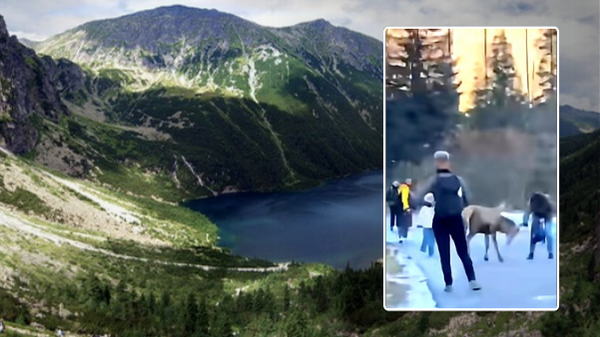
Poland’s Tatra National Park has urged tourists to stop feeding and approaching wild animals after videos emerged showing dangerous encounters between visitors and deer near Morskie Oko, one of the country’s best-known mountain lakes. In one recording, a man grabs a young stag by its antlers and struggles with the animal as other tourists look on. Park authorities are investigating the circumstances and warning that repeated human contact is changing the behaviour of wildlife, potentially putting both visitors and animals at risk.
The videos began circulating widely on Polish social media over the weekend, attracting criticism of how some tourists behave around wildlife.
They were recorded on the popular walking route leading to Morskie Oko, a scenic lake in the Tatra Mountains of southern Poland.
- Find more news from Poland on our Homepage .
The route attracts large numbers of visitors, many of whom encounter deer along the road or in the surrounding woodland.
One of the recordings shows a man holding the animal’s antlers and struggling with it. Other footage shows deer being fed directly by visitors.
Accounts published on 1 November indicate that at least two separate recordings were circulating, potentially showing different encounters. The precise dates on which the incidents took place have not been established.
Following the online reaction, officials from Tatra National Park (TPN) confirmed that they were examining the situation.
Man filmed grabbing stag’s antlers near Morskie Oko
The most widely discussed recording shows a man standing close to a young stag before grabbing its antlers.
A struggle follows as the animal and the man move against one another, with other tourists nearby.
Some Polish media reports describing the recording also say the man strikes the deer.
However, the footage does not establish the complete sequence of events or what happened immediately before the confrontation.
It is therefore unclear whether the deer initially approached the man in search of food, whether the tourist attempted to touch it, or what specifically triggered the struggle.
The park has not publicly identified the man or announced that he has been penalised.
Filip Zięba, deputy director of Tatra National Park, told the Polish Press Agency that employees were investigating the circumstances.
They are also reviewing surveillance recordings that may help establish a fuller account of what happened.
In comments reported by RMF24, Zięba emphasised that the incident was a symptom of a much wider problem involving tourists and wild animals.
Why the deer has stopped fearing people
According to the park, the animal’s unusually confident behaviour around visitors is unlikely to have developed after just one encounter.
Instead, officials believe repeated contact with tourists has gradually caused the deer to lose its natural wariness of humans.
Some visitors have reportedly fed the animal, approached it for photographs, attempted to stroke it or encouraged it to come closer.
Over time, the deer may have learned to associate people with easily available food.

That can lead to behaviour that visitors mistake for friendliness.
A wild animal accustomed to receiving food may approach strangers, follow them or become increasingly persistent when food is not offered.
Zięba stressed that a wild deer would ordinarily maintain a distance from people.
The behaviour captured in the recordings suggests that this natural response has been weakened through repeated human interaction.
The park’s concern is not simply that one tourist behaved irresponsibly.
It is that many seemingly harmless encounters can gradually change an animal’s behaviour, creating conditions for a dangerous confrontation.
Park staff trying to discourage deer from approaching tourists
Tatra National Park has already begun taking measures intended to restore the animal’s natural distance from people.
According to PAP reporting published on 3 November, staff are monitoring the deer and attempting to discourage it from approaching visitors.
The measures have included the use of a specialist wildlife deterrent.
However, officials have not yet determined whether these efforts are working.
Changing behaviour that has developed over a long period can be difficult, particularly if some tourists continue feeding the animal.
The park has not announced that the deer will be relocated or that any other permanent intervention has been decided.
Its immediate priority is to reduce risky interactions and encourage visitors to respect the animal’s space.
The park has also appealed to tourists to respond when they witness inappropriate behaviour by others, provided they can do so safely.
Why feeding wild animals can become dangerous
Tatra National Park has repeatedly warned that feeding deer and other wild animals can have serious consequences.
The problem goes beyond the nutritional value of the food itself.
Animals that become accustomed to receiving food from visitors may gradually lose important survival behaviours.
They can become more dependent on areas heavily used by people and less inclined to avoid potentially dangerous encounters.
Visitors, meanwhile, may underestimate the strength and unpredictability of a large wild animal.
A stag’s antlers and body weight can cause serious injuries, particularly when it feels threatened or is struggling at close range.
An animal that appears calm while accepting food can react suddenly.
The park’s concern is therefore twofold: inappropriate contact can endanger people while also exposing wildlife to unnecessary stress and risk.
These principles are reflected in TPN’s official visitor regulations, which instruct tourists not to feed, approach or disturb wild animals.
The park recommends quietly moving away from wildlife rather than attempting to touch, photograph or feed it at close range.
Even when an animal approaches voluntarily, visitors should not encourage direct contact.
Morskie Oko’s popularity adds to the challenge
Morskie Oko is among Poland’s most recognisable natural attractions.
Situated in the High Tatras near the Slovak border, the lake is surrounded by steep mountains, woodland and rocky slopes.
It is reached by a popular walking route beginning at Palenica Białczańska.
The accessibility of the route means that visitors with different levels of mountain experience can reach the area, including people who may be unfamiliar with the behaviour of large wild animals.
The same popularity creates challenges for protecting wildlife.
Animals that regularly encounter visitors along busy paths can become accustomed to their presence.
That does not mean they are domesticated or safe to touch.
The official Małopolska tourism guidance for Morskie Oko also reminds visitors that approaching or feeding animals is prohibited within the national park.
The latest incident demonstrates why those restrictions matter.
Park calls on tourists to change their behaviour
The circumstances surrounding the recorded confrontation remain under investigation.
Officials have not confirmed whether the man involved has been identified, whether the deer sustained injuries or whether any enforcement proceedings will follow.
The park’s central message, however, is unambiguous.
Visitors must not feed wildlife, encourage animals to approach them or treat them as opportunities for close-up photographs and physical contact.
Park staff cannot monitor every interaction along the region’s numerous trails.
Protecting wildlife therefore depends partly on the choices made by visitors themselves.
The videos from the Morskie Oko route illustrate how repeated feeding and close contact can transform an ordinary wildlife encounter into a potentially dangerous situation.
For tourists, the safest response to seeing a deer is to observe it from a distance and allow it to behave naturally.
For the animal, maintaining that distance may be equally important.