In the early hours of 19 October 1956, Poland stood on the edge of a confrontation with the Soviet Union.
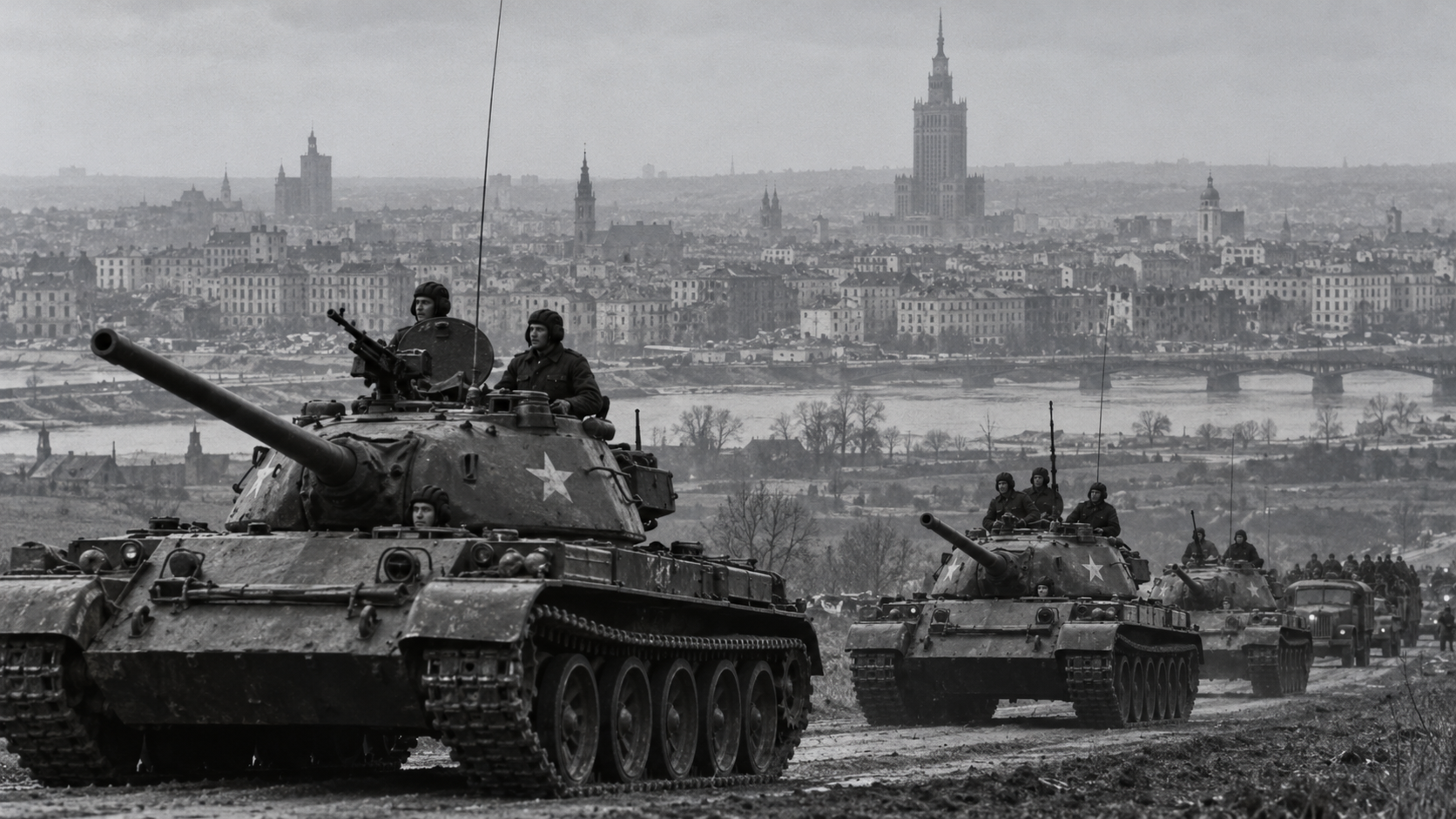
As the ruling Polish United Workers’ Party (PZPR) prepared for its crucial Eighth Plenum, Soviet forces stationed in Poland began moving from their bases on Lower Silesia and Pomerania towards Warsaw. At the same time, Nikita Khrushchev flew into the Polish capital determined to block the political changes taking shape inside the Polish leadership.
This was the most dramatic moment of what became known as Polish October — the crisis that brought Władysław Gomułka back to the top of the party while also exposing just how limited Polish sovereignty remained within the Soviet bloc.
- Find more news from Poland on our Homepage .
The crisis had been building for months. October 1956 was the culmination of a political and social thaw already under way since late 1954. By July 1956, two clear factions had emerged inside the ruling party: the more hard-line “Natolin” group and the more reform-minded “Puławy” camp. At the same time, public pressure for change was growing among workers, students and intellectuals, while Gomułka — previously sidelined and imprisoned by the communist authorities — increasingly returned to the centre of discussion.
A decisive step came on 12 October 1956, when Gomułka attended a meeting of the party Politburo and sharply criticised both the party’s earlier policies and Poland’s deep subordination to the Soviet Union. The leadership then decided to convene the Eighth Plenum and bring Gomułka and his allies back into the political structure. For Moscow, this was alarming. Soviet leaders feared that events in Poland could slip beyond their control or encourage a broader loosening of the communist system in Eastern Europe.
Soviet armour begins moving towards Warsaw
The confrontation peaked during the night of 18–19 October. Soviet ambassador Panteleimon Ponomarenko informed party chief Edward Ochab that a Soviet delegation headed by Khrushchev would arrive in Warsaw the next morning.
When Khrushchev landed at Boernerowo on 19 October, he came not simply for consultations but to prevent Gomułka’s elevation. During talks at the Belweder, Khrushchev confirmed that Soviet troops were moving towards the Polish capital.
This was not yet an assault on Warsaw, and historians are careful not to describe it as one. But it was a direct military threat. The Institute of National Remembrance states plainly that Soviet troops were brought out from bases in western and northern Poland and that armoured columns moved towards Warsaw. In other words, Moscow was using military pressure alongside political pressure in an attempt to shape the outcome of the Polish crisis.
Gomułka chooses negotiation over confrontation
What followed was a tense political gamble. Gomułka did not present himself as an anti-Soviet revolutionary. Instead, he assured Khrushchev that Soviet interests in Poland would not be threatened, that Poland would remain within its alliances, and that he could restore order while maintaining communist rule.
Those assurances were enough to persuade Khrushchev to halt the troop movements rather than push matters towards open intervention.
The plenum then went ahead. On 21 October, Gomułka was elected First Secretary of the PZPR, while the candidacy of Soviet marshal Konstanty Rokossowski was rejected.
In the days that followed, huge rallies across Poland celebrated the change and demanded deeper reforms. For many Poles, it felt as if the country had stepped back from the brink and won a measure of political dignity — even if not full independence.
What Polish October actually changed
The outcome mattered far beyond party politics.
After October 1956, the communist authorities reduced the use of large-scale terror, began rehabilitating some victims of political repression, released Cardinal Stefan Wyszyński, loosened censorship to a degree, halted collectivisation, and made some personnel changes in the armed forces.
Around 30,000 Poles were later repatriated from the Soviet Union.
These were significant changes, even if they fell far short of democratic transformation.
Yet the limits of the breakthrough were equally important. Gomułka’s success came not from breaking with Moscow, but from convincing the Kremlin that Polish reforms would remain contained within the communist system.
The Soviet tanks turned back, but the basic structure of Soviet dominance in Eastern Europe remained intact. That is why October 1956 is remembered both as a moment of national relief and as a reminder of how conditional Polish autonomy still was in the Cold War order.
The events of 18–19 October 1956 therefore deserve to be remembered not as a simple reform episode, but as a real state crisis. Soviet armour did move towards Warsaw. The danger was real. Poland avoided military intervention that time — but only through a political compromise that revealed both the possibilities and the hard limits of change under Soviet hegemony.