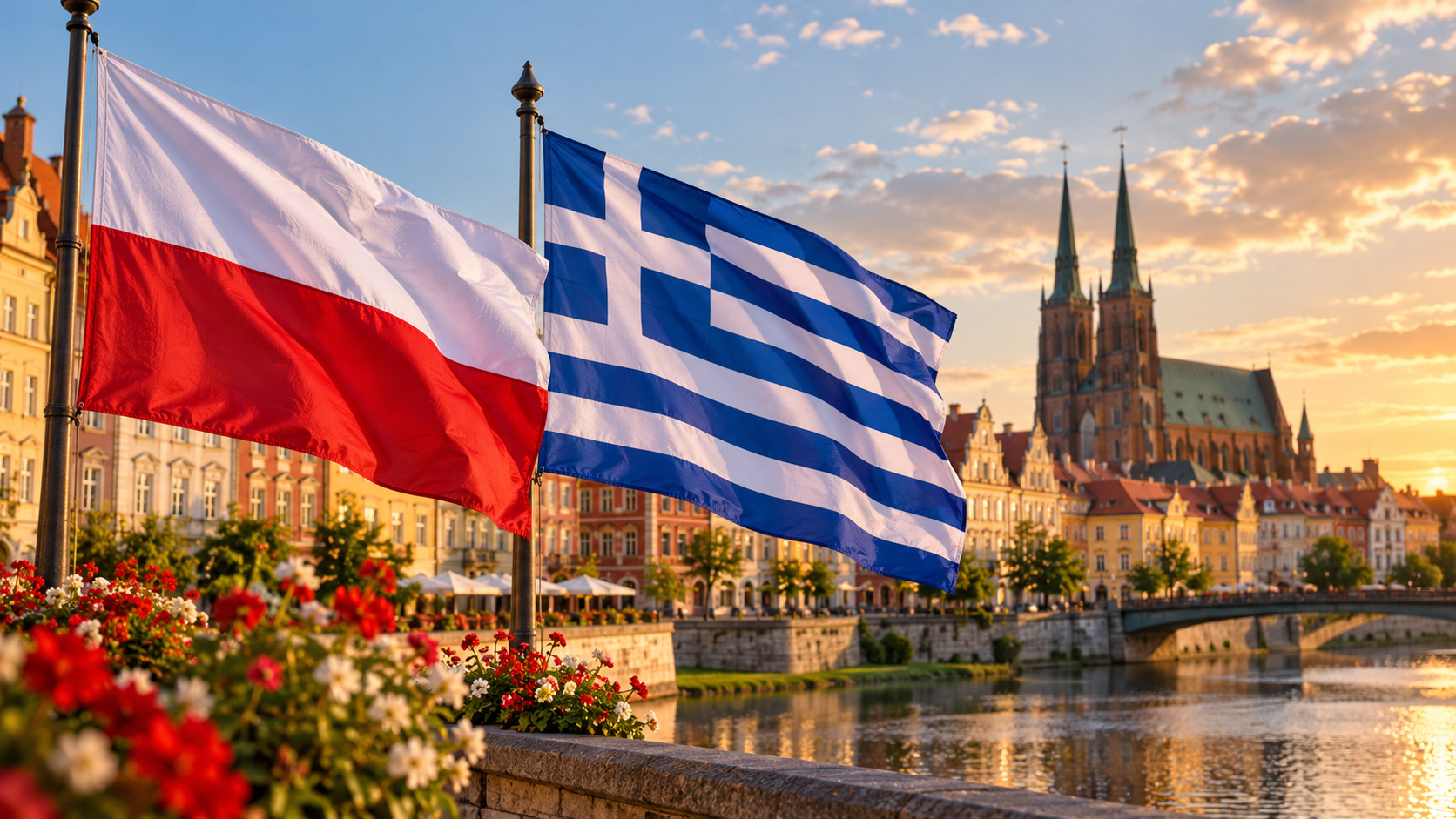
Poland is preparing to recognise its Greek community as the country’s tenth officially recognised national minority, following the adoption of legislation extending protections for Greek language, culture and identity.
The amendment to Poland’s national and ethnic minorities law was approved by parliament earlier this year and signed by President Karol Nawrocki on 11 June 2026.
According to the official Polish legal register, the legislation will enter into force on 16 December 2026, completing a process that followed years of efforts by Greek community organisations to secure recognition.
- Find more news from Poland on our Homepage .
Once the law takes effect, Greeks will join nine existing national minorities recognised under Polish legislation, gaining access to provisions designed to preserve minority languages, cultural traditions and community representation.
The decision carries particular historical significance because many families belonging to Poland’s Greek community trace their roots to people who fled the Greek Civil War in the late 1940s and settled in communist-era Poland.
What will official recognition change?
The legislation extends the protections established under Poland’s 2005 Act on National and Ethnic Minorities and the Regional Language to the Greek minority.
Under the amendment signed by the president, members of the Greek community will become eligible for provisions covering language, cultural identity and public support for minority organisations.
These include access to Greek-language education, recognition of the Greek spelling of personal names in official documents, and the possibility of public funding for activities preserving Greek cultural heritage.
The law also makes provision for the use of Greek as an auxiliary language in qualifying municipalities and the introduction of additional Greek-language place names, subject to the conditions established by Polish law.
These measures will not automatically make Greek an official language throughout Poland or introduce bilingual signs in every community where Greeks live.
The provisions operate within the existing minority-rights framework and depend, where relevant, on local population thresholds and administrative procedures.
An official explanatory document from the President’s Office also confirms that the Greek minority will be entitled to representation on the Joint Commission of the Government and National and Ethnic Minorities.
The responsible minister must begin the prescribed process of notifying Greek minority organisations within 60 days of the legislation taking effect.
The protections concern people meeting the Polish law’s definition of a national minority, rather than automatically applying to every Greek national temporarily living in Poland.
From refugees to an established Polish community
The story of the Greek community in modern Poland began largely in the aftermath of the Greek Civil War of 1946–1949.
Thousands of people fled the conflict and its consequences, including families, political refugees and children evacuated from areas affected by fighting.
Poland, then governed by a communist administration, became one of several Eastern European countries to receive refugees from Greece.
The arrivals included ethnic Greeks and ethnic Macedonians, whose histories and identities should not be treated as interchangeable.
More than 12,000 people from Greece found refuge in Poland during the post-war migration, according to historical accounts, although estimates differ depending on the years and groups included.
Many initially arrived through Gdynia before being accommodated in different parts of the country.


A substantial community developed in Lower Silesia, particularly around Zgorzelec, Wrocław and neighbouring towns.
As documented by Poland’s Adam Mickiewicz Institute in its history of Greek refugees, the newcomers established schools, associations, workplaces and cultural institutions while gradually building new lives in Poland.
What had initially been viewed by many as temporary refuge became a permanent home for families who raised children and grandchildren in Polish communities.
A cultural legacy that remains visible
The Greek community’s influence extended beyond the refugee settlements.
Greek cultural organisations helped preserve language, music, dance and traditions, while succeeding generations increasingly became part of wider Polish society.
Several prominent Polish musicians have Greek family backgrounds, including guitarist Apostolis Anthimos, percussionist Milo Kurtis and singer Eleni Tzoka.
Their careers illustrate how a refugee community became part of Poland’s broader cultural life.
Following political changes in Greece, some refugees and their descendants returned to their ancestral homeland, while others remained in Poland.
Greek associations continue to organise cultural activities in several Polish cities, including Szczecin and Wrocław.
According to figures cited during the Sejm’s debate in April 2026, 5,451 people declared Greek national identity in Poland’s 2021 census.
That figure concerns self-declared identity, including people with more than one national affiliation, and should not be interpreted as a definitive count of everyone with Greek ancestry in Poland.
A long campaign for recognition
The Greek community’s inclusion in the official list of national minorities did not happen immediately.
Poland’s original 2005 legislation recognised nine national minorities: Belarusians, Czechs, Lithuanians, Germans, Armenians, Russians, Slovaks, Ukrainians and Jews.
The law also recognises four ethnic minorities: Karaims, Lemkos, Roma and Tatars.
Greeks were not included in the original national minority list, despite their established community organisations and decades of residence in the country.
One of the disputed issues was the legislation’s requirement concerning at least 100 years of ancestral residence on the territory of present-day Poland.
During parliamentary discussions in 2021, government officials and experts questioned whether the Greek community satisfied that requirement, pointing to discontinuities between earlier historical Greek settlement and the modern community formed after the Civil War.
Supporters of recognition subsequently argued that the community’s longer historical presence and contribution to Poland justified its inclusion. The issue continued to be debated during the 2026 legislative proceedings.
The latest amendment resolves the community’s exclusion from the statutory list by explicitly adding the Greek minority.
Parliament backs the change by a large majority
The legislative proposal was introduced by the Sejm’s Committee on National and Ethnic Minorities in February 2026.
On 30 April, the lower house approved it by 419 votes to 20, with two abstentions.
The Senate adopted the legislation without amendments on 21 May.
President Nawrocki signed the measure on 11 June, and it was published in the Journal of Laws on 15 June.
The parliamentary legislative record confirms that the measure has completed the legislative process. Its December commencement is the remaining step before the new legal provisions apply.
Recognition takes effect in December
From 16 December, the Greek community will formally become Poland’s tenth national minority under the amended legislation.
The change will place Greek cultural and language preservation within the same legal framework used to support Poland’s other recognised national minorities.
For a community shaped by displacement, resettlement and several generations of life in Poland, the legislation marks a significant acknowledgement of its place in the country’s multicultural history.
The next practical stage will involve implementation of the minority-rights provisions and the process of establishing Greek representation on the government’s minority affairs commission.