

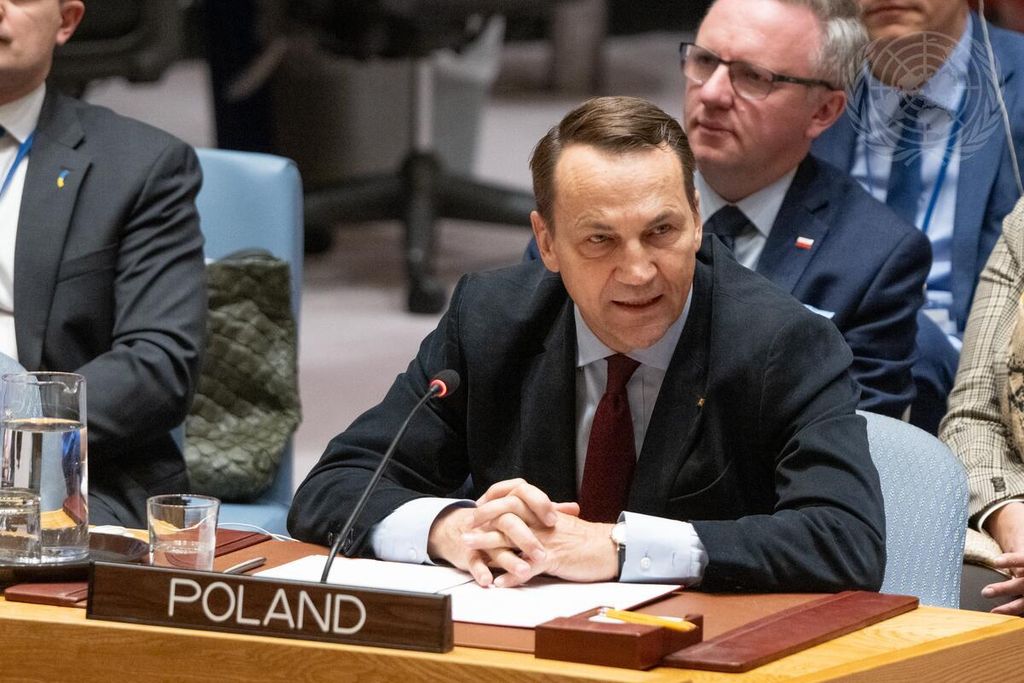
Poland is receiving information from multiple sources indicating that Russia is preparing “something big” before the end of this year, Foreign Minister Radosław Sikorski has said, while suggesting that Moscow could seek a pretext for another mobilisation.
Sikorski, who is also Poland’s deputy prime minister, made the remarks on Thursday during a discussion at the Council on Foreign Relations in New York alongside Romanian Foreign Minister Oana-Silvia Țoiu.
“We are receiving information… we will not disclose the sources, but there are many of them, that Russia is preparing something big this year,” Sikorski said.
- Find more news from Poland on our Homepage .
He did not disclose what intelligence or other information lay behind the assessment and did not say that Poland knew precisely what action Russia might be preparing.
Instead, Sikorski outlined one possible scenario involving a Russian false-flag operation that could be presented domestically as justification for further mobilisation.
“I believe Putin needs a pretext for mobilisation,” Sikorski said, suggesting Russia could stage an attack and then tell its population that the country had itself come under attack.
His comments therefore amounted to a warning about a possible Russian course of action rather than an announcement that Poland had confirmed plans for a particular attack.
Sikorski also discussed the possibility of Russia testing NATO without launching an overt, full-scale invasion of alliance territory.
According to accounts of the discussion, he argued that a conventional Russian attack on NATO would be highly risky for Moscow and instead raised the possibility of less clear-cut actions designed to make the alliance’s response more complicated.
The Polish foreign minister also said Belarusian officials were “very worried about being drawn into the war”.
His remarks came after a meeting with Belarusian Foreign Minister Maksim Ryzhenkov on the sidelines of the UN General Assembly in New York. Belarus has been Russia’s closest regional ally during the war and allowed Russian forces to use its territory during the full-scale invasion of Ukraine launched in February 2022.
Sikorski and Țoiu’s CFR discussion focused more broadly on the consequences of Russia’s war against Ukraine for security in Central and Eastern Europe and the future of transatlantic relations.
The warning also came during a week in which Sikorski adopted unusually direct language towards Moscow.
During a UN Security Council meeting on Ukraine, he told Russian representatives that Moscow had been trying to conquer the Donbas for more than 12 years and Kyiv for more than four, but had been stopped by Ukraine.
The CFR remarks went further in a different direction, however, by suggesting that information reaching Warsaw from several sources was giving the Polish government reason to expect another significant Russian move before the end of 2026.
Sikorski did not identify those sources or provide evidence that could independently establish what Russia may be preparing.
His warning therefore leaves the nature of the reported threat unclear — but indicates that Polish officials are watching for a potentially significant Russian operation during the remaining months of the year.