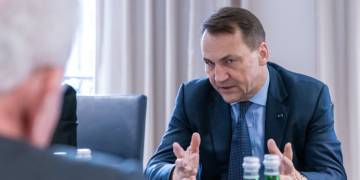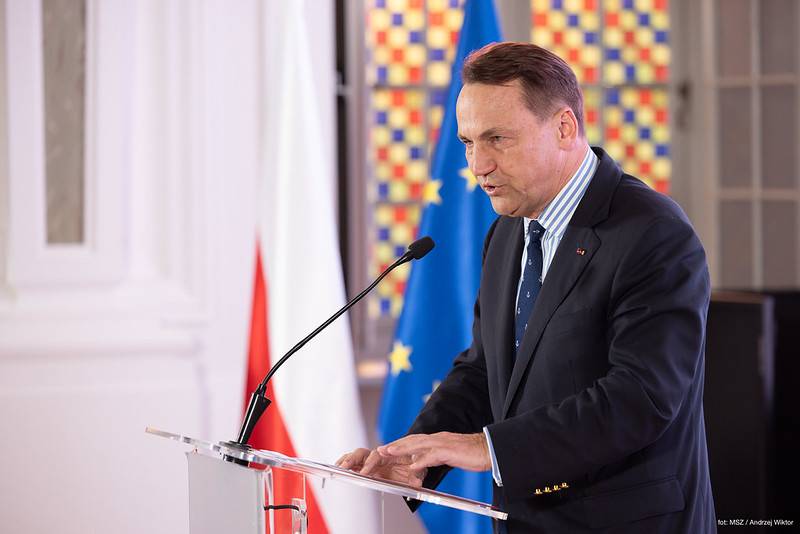
Polish Foreign Minister Radosław Sikorski has compared Poland’s economic transformation over the past three decades with China’s extraordinary rise, while making clear that Warsaw has no intention of entering the war against Iran despite its close alliance with the United States.
The remarks, supplied from an interview with Bloomberg circulated on Monday, 12 October, bring together two themes in Poland’s international position: its growing economic influence and its determination to maintain independent priorities within the Western security alliance.
Speaking about Poland’s development since the transition from communism, Sikorski said its accumulated economic growth was “almost at the level of China” over the past 30 years.
- Find more news from Poland on our Homepage .
It was an unusually ambitious comparison for a European country that began the 1990s with an economy still undergoing a difficult transition from central planning to market capitalism.
Poland’s sustained expansion is well documented. However, the precise comparison depends on how economic growth is measured, and the standard inflation-adjusted figures show that China’s cumulative expansion has been considerably greater.
Poland’s three decades of economic transformation
Since the mid-1990s, Poland has become one of Europe’s most notable examples of sustained economic development.
The country benefited from market reforms, expanding private enterprise, foreign investment and its accession to the European Union in 2004.
EU membership opened access to a vast single market and supported investment in transport, infrastructure, industry and public services.
Polish companies have subsequently expanded into international markets, while the country has developed significant manufacturing, logistics, technology and business-services industries.
The scale of the transformation is reflected in long-term economic statistics.
According to World Bank figures for Poland, the country’s annual economic output increased from approximately $219 billion in 1995 to $682 billion in 2025, measured in constant 2015 US dollars.
That represents an increase of roughly 211% after adjusting for inflation — meaning Poland’s economy became more than three times as large in real terms.
For a country emerging from decades of communist economic management, the achievement is substantial.
Poland has also retained relatively strong growth into the 2020s.
The European Commission’s May 2026 forecast estimated that Poland’s economy expanded by 3.6% in 2025 and projected further growth of 3.5% in 2026.
The forecast for the European Union as a whole was just 1.1% in 2026, making Poland one of the stronger performers among Europe’s larger economies.
How close is Poland’s growth to China’s?
Sikorski’s comparison with China requires a distinction between the scale of Poland’s success and the exact rate of its expansion.
Figures from the World Bank’s historical GDP series for China show that the Chinese economy grew from approximately $1.86 trillion in 1995 to $19.4 trillion in 2025, measured in the same constant-dollar terms.
That represents an increase of approximately 942%, compared with Poland’s 211%.
Both economies recorded remarkable expansion, but China grew more than three times as much proportionally over the period.
The precise economic indicator Sikorski intended when making the comparison has not been established from the available interview extract. His reference to accumulated growth might reflect a different measure, period or set of comparator countries.
The figures nevertheless show why Poland’s development attracts increasing international attention.
Few of Europe’s established economies have experienced a comparable transformation over the same period.
An important distinction also emerges when measuring prosperity per person rather than the total size or growth of an economy.
World Bank figures for 2025 put Poland’s GDP per capita at approximately $54,300 when adjusted for purchasing-power differences, compared with approximately $29,300 for China.
Those figures do not mean that Poland’s economy is larger or has grown faster. They indicate that economic output per resident, adjusted for differences in price levels, is substantially higher in Poland.
Sikorski’s broader point about Poland’s economic progress therefore has a strong factual foundation, even though the direct comparison with Chinese cumulative growth needs qualification.
Poland rules out joining the war against Iran
The foreign minister also addressed Poland’s position on the conflict involving Iran.
“We would like to be helpful, but we are not going into war against Iran,” Sikorski said in the supplied interview extract.
The statement reinforces a position previously established by Poland’s government: Warsaw supports its Western allies but does not intend to deploy Polish forces to fight Iran.
Prime Minister Donald Tusk publicly confirmed that position on 17 March, when the United States was seeking allied assistance during the conflict in the Middle East.
In an official government statement, Tusk said the fighting did not directly concern Poland’s security and that the country’s armed forces already faced other responsibilities.
He identified the protection of Poland’s eastern frontier and security in the Baltic region among the government’s priorities.
Sikorski had also previously told Polish newspaper Rzeczpospolita that Warsaw had no plans to take part in military operations against Iran.
His earlier position, reported by the Polish Press Agency, distinguished political solidarity with the United States from participation in a new military campaign.
The government has therefore maintained a consistent public position rather than announcing an entirely new restriction on Poland’s armed forces.
An ally with its own security priorities
Poland’s refusal to join the Iran war is significant because it maintains one of Europe’s closest defence relationships with Washington.
The country hosts American forces, purchases major US weapons systems and has substantially increased military expenditure in response to Russia’s invasion of neighbouring Ukraine.
However, Warsaw has repeatedly argued that its immediate security responsibilities are concentrated in Europe.
Poland shares borders with Ukraine, Belarus and Russia’s Kaliningrad region, placing it directly alongside areas affected by the continuing confrontation between Russia and NATO.
Its armed forces are undergoing major expansion, while the government is investing heavily in air defence, land forces and military infrastructure.
The Middle East conflict also has consequences for those priorities.
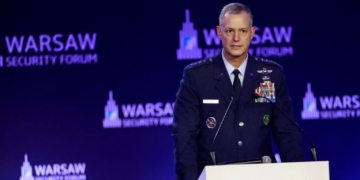
Reporting from the Warsaw Security Forum on 12 October indicated that the war involving Iran was contributing to delays in deliveries of American weapons to Poland, including Patriot air-defence interceptors.
That development illustrates how events in the Middle East can affect Poland’s security even without Polish troops participating in the fighting.
Sikorski’s comments suggest that Warsaw intends to remain diplomatically helpful to its allies while avoiding a new military commitment beyond its immediate strategic priorities.
A changing Polish role in international affairs
The economic and security remarks illustrate two aspects of Poland’s changing international position.
The country’s long-term growth has increased its influence within the European Union and helped finance a major expansion of its defence capabilities.
At the same time, Poland’s proximity to the war in Ukraine has made security policy a central concern for successive governments.
Sikorski’s comparison with China highlights the scale of Poland’s economic ambitions, although the available figures do not establish that its cumulative real growth has nearly matched Beijing’s.
His comments about Iran draw a different boundary: economic success and close military cooperation with Washington do not mean Poland is prepared to take part in every conflict involving its principal ally.
Together, the remarks present a country seeking greater international recognition for its economic achievements while maintaining a security policy focused primarily on its own region.