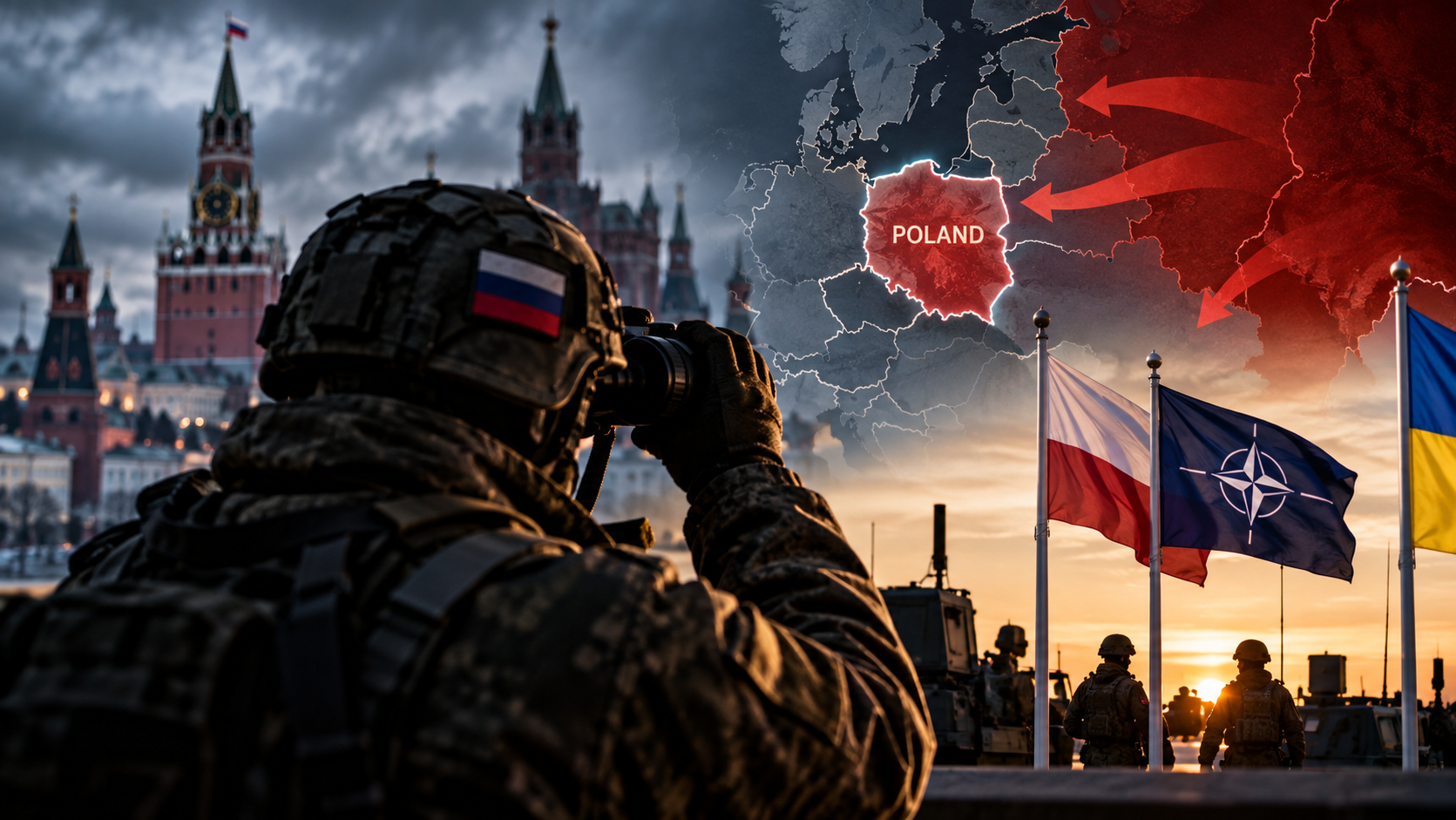
Russia is examining possible military confrontation scenarios involving Poland and the Baltic states as part of longer-term planning extending to 2045, Ukraine’s foreign intelligence service has warned, saying Moscow is also considering how a limited crisis on NATO’s eastern flank could test the alliance’s willingness and ability to defend its members.
The assessment, published on Tuesday, 13 October by Ukraine’s Foreign Intelligence Service, describes a Russian strategy that combines ongoing sabotage, cyberattacks, espionage and information operations with planning for possible future military conflicts in Europe.
The Ukrainian agency said Russia was examining six scenarios involving Northern Europe, alongside separate possibilities concerning Poland and the Baltic states.
- Find more news from Poland on our Homepage .
It also claimed that nearly 400 Russian intelligence personnel were operating across Europe, conducting activities intended to remain below the threshold that might prompt a collective military response from NATO.
The service did not publish the underlying intelligence documents or provide a detailed breakdown of the military scenarios. Its assessment has not been independently verified in full.
Importantly, the reference to 2045 describes the timeframe covered by the scenarios, rather than a predicted date for a Russian attack.
Poland and the Baltic states feature in Russian scenarios
According to the Ukrainian intelligence agency, Moscow has not abandoned the possibility of direct military confrontation with European countries despite its continuing war against Ukraine.
The agency said Russia was considering several possible military conflicts through 2045, including six associated with Northern Europe.
Separate scenarios involving Poland and the Baltic states were also being examined, it said.
The statement did not explain the objectives, geographical scope or military forces envisaged in the different scenarios.
Nor did it establish that Moscow had made a political decision to launch an attack against any NATO member.
The distinction matters because military and intelligence organisations routinely examine possible future conflicts, while the existence of planning scenarios does not itself demonstrate an intention to carry them out.
The Ukrainian service nevertheless presented the planning as part of a broader Russian strategy of preparing for prolonged confrontation with Europe.
It argued that Moscow seeks to maintain an external adversary as a means of supporting domestic political mobilisation and justifying its policies.
A limited crisis designed to test NATO
One of the most significant elements of the Ukrainian assessment concerns a possible Russian attempt to create a controlled regional crisis on NATO’s eastern flank.
The intelligence service suggested that Moscow could seek to exploit uncertainty and impose severe time pressure on allied governments, forcing them to make difficult decisions before the nature of a developing threat became fully clear.
The Baltic states were identified as particularly vulnerable in this scenario.
Rather than trying to defeat NATO militarily, the alleged objective would be to undermine confidence in its collective-defence commitments.
Such an operation could seek to demonstrate that the alliance was unable to respond quickly or decisively to threats against one of its members.
The NATO collective-defence principle, established under Article 5, states that an armed attack against one member is considered an attack against all.
However, the alliance assesses whether an incident constitutes an armed attack according to its circumstances. NATO has also recognised that sufficiently serious cyberattacks and other hybrid operations may fall within the scope of collective defence.
That creates a complicated security challenge when hostile activities are designed to remain below the level of an unmistakable conventional military attack.
Ukraine’s intelligence service argued that Moscow was attempting to exploit precisely that uncertainty.
Nearly 400 Russian intelligence personnel allegedly operating in Europe
The assessment also included a claim about the scale of Russian intelligence operations across Europe.
According to the Ukrainian service, nearly 400 Russian intelligence personnel are currently present in European countries.
It described their activities as including espionage, sabotage, cyberattacks, disinformation and other influence operations.
The agency said these operations allowed Moscow to test European governments’ responses while avoiding direct military confrontation.
It did not disclose how the figure of nearly 400 was calculated, identify the countries concerned or clarify how many of those personnel were operating under diplomatic cover.
The number should therefore be treated as a Ukrainian intelligence estimate rather than an independently established count.
The broader concern about Russian hybrid activities is also reflected in NATO’s public assessments.
In its September 2026 account of security on the eastern flank, NATO identified increasingly frequent airspace violations, cyberattacks and acts of sabotage among the threats facing allied countries.
The alliance has responded by increasing military readiness, strengthening air and missile defence and expanding its presence in member states close to Russia and Belarus.
What Russians think about Poland and the West
Ukraine’s intelligence service also referred to research examining Russian public attitudes towards Europe and the war.
The European Council on Foreign Relations published a study on 1 October drawing on focus groups conducted in Russia between April and August 2026, alongside existing opinion surveys.
Researchers found that participants frequently identified Britain, France, Germany, Poland, Finland and the Baltic states as unfriendly countries.
The findings provide insight into attitudes expressed by the focus-group participants, rather than a representative statistical ranking of every country considered hostile by Russian citizens.
The intelligence service also highlighted seemingly contradictory public attitudes towards the war in Ukraine.
A Levada Center survey conducted in January 2026 found that 61% of respondents believed it was time to move towards peace negotiations.
However, 59% also supported intensifying attacks on Ukraine if peace could not yet be achieved.
The survey covered 1,617 adults across Russia.
These results indicate that support for negotiations does not necessarily translate into support for concessions by Moscow or opposition to continued military operations.
The Ukrainian agency argued that Russia’s leadership takes domestic attitudes into account when developing its policies towards neighbouring countries and Europe.
How NATO is responding
The latest Ukrainian warning comes as NATO continues strengthening its ability to defend Poland and other countries on the alliance’s eastern flank.
The alliance currently maintains multinational forward land forces in nine eastern member states, including Poland, Lithuania, Latvia and Estonia.
It has also increased air policing and established additional measures to protect critical infrastructure and monitor potential threats.
Following a series of airspace violations in 2025, NATO launched its Eastern Sentry activity to strengthen vigilance across the eastern flank.
At their July 2026 summit in Ankara, allied leaders reaffirmed their collective-defence commitment and announced further efforts to strengthen military capabilities and European defence production.
For Poland, the latest intelligence assessment adds to existing concerns about Russian activities in Central and Eastern Europe.
However, NATO has not announced that Russia has decided to invade Poland, and the Ukrainian statement does not establish that such an attack is imminent.
The immediate concern identified by Kyiv is more complex: the possibility that Moscow could use disruption, uncertainty and limited provocations to undermine confidence in European security arrangements.
Ukraine warns of a prolonged confrontation
The Ukrainian intelligence service concluded that Russia was preparing for a long-term confrontation in which the war against Ukraine and pressure on Europe were closely connected.
It argued that European governments should strengthen defence capabilities, reduce dependence on Russian energy and maintain economic pressure on Moscow.
Supporting Ukraine was also presented as a central element of that approach.
These are the Ukrainian agency’s strategic conclusions, rather than an independently established assessment shared in every detail by NATO governments.
Its October statement nevertheless adds a new warning to the wider debate over European security: Moscow’s activities should not be assessed solely through the question of whether Russia is preparing an immediate conventional invasion.
For Poland and its neighbours, the more immediate challenge may be how to respond to hostile operations intended to test NATO’s resolve without openly crossing the threshold into war.