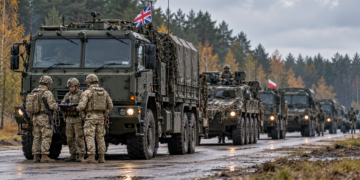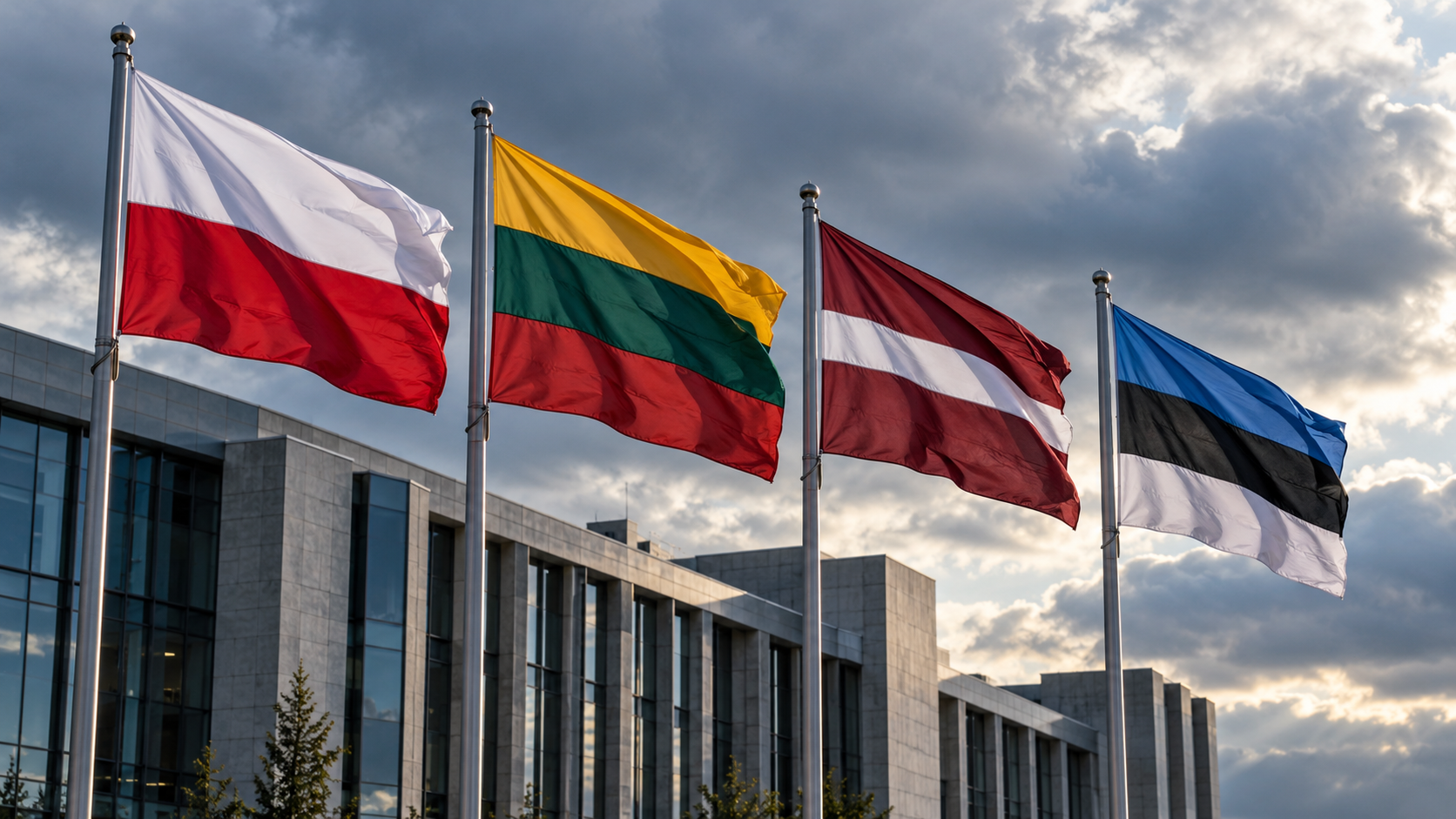
Russia may be more interested in undermining NATO’s credibility and weakening its military presence in Central and Eastern Europe than in occupying the Baltic states (Estonia, Latvia and Lithuania), according to British journalist Oliver Moody, who argues that the future of European security increasingly depends on developments around the Baltic Sea and in Poland.
Moody, Berlin bureau chief for The Times of London and author of Baltic: The Future of Europe, says a growing number of European security officials believe Moscow’s principal objective is to test whether NATO members would actually defend one another in a confrontation with Russia.
Speaking in an interview published on 14 October by Deep Baltic, an English-language site covering the Baltic states, Moody explored whether Russia’s strategic ambitions are primarily territorial or aimed at undermining the Western military alliance.
- Find more news from Poland on our Homepage .
The distinction matters particularly for Poland, Lithuania, Latvia and Estonia, which occupy some of NATO’s most strategically sensitive territory.
It also comes amid renewed warnings about possible Russian military provocations and questions over the future reliability of American security commitments.
Moody’s remarks are an analysis of Russian intentions, not confirmation of an operational plan or evidence that an attack has been ordered.
Is Russia trying to conquer territory or weaken NATO?
One of Moody’s central arguments concerns Russia’s demands shortly before its full-scale invasion of Ukraine in February 2022.
In December 2021, Moscow sought sweeping changes to European security arrangements, including restrictions on NATO military deployments in countries that had joined the alliance after 1997.
Such demands would have affected Poland, which joined NATO in 1999, and the three Baltic states, which became members in 2004.
Moody argues that these demands provide an important indication of what Russia wants from its confrontation with the West.
He says European officials increasingly distinguish between two possible objectives: restoring direct Russian control over territory once held by the Soviet Union and weakening NATO sufficiently to make its security guarantees ineffective.
According to Moody, many officials favour the second interpretation.
Their concern is that Russia could attempt to demonstrate that NATO lacks the political unity or willingness to defend its eastern members.
This could potentially be achieved through limited military provocations, hybrid operations (sabotage, cyberattacks and disinformation below the threshold of open war) or other forms of pressure without necessarily attempting to occupy entire countries.
Moody believes weakening NATO’s effective military presence in Central and Eastern Europe may be a central Russian strategic objective. He says that, in his view and that of many officials he has spoken to, this is “not some kind of side objective; it’s the main quest.”
That is not to say Russia has abandoned territorial ambitions or that a conventional attack is impossible.
Rather, the argument is that NATO’s credibility could itself become the target.
Why Poland is central to the Baltic security question
Although the Baltic states often dominate discussions about a possible confrontation with Russia, Poland is an essential part of the same security system.
Poland borders Lithuania and Kaliningrad (Russia’s exclave between Poland and Lithuania), while also sharing an eastern frontier with Belarus, Moscow’s close military ally.
The Polish-Lithuanian border region includes the strategically important Suwałki corridor, a narrow strip of land (roughly 65 km) between Kaliningrad and Belarus, which connects the Baltic states by land to the rest of NATO territory.


Any serious military crisis involving Lithuania, Latvia or Estonia would therefore have direct implications for Poland and the wider alliance.
Moody argues that Western Europeans were slow to recognise the geopolitical importance of this region.
In his interview, he acknowledged that British media coverage of the Baltic states had historically been limited despite Britain maintaining a military presence in Estonia.
He also stressed that the security of north-eastern Europe should not be viewed as a peripheral issue separate from the war in Ukraine.
In his assessment, geopolitical developments around the Baltic Sea will be among the factors shaping Europe’s future.
For Poland, the implication is that security planning cannot be confined to defending national borders in isolation. It also depends on NATO’s ability to reinforce and defend neighbouring allied countries.
NATO says there is no imminent Russian attack
Moody’s analysis comes at a time of heightened public concern about the possibility of Russian military action against NATO members.
However, the alliance’s current assessment is more reassuring than some of the more alarming predictions circulating in public debate.
During a press conference in Estonia on 14 October, NATO Secretary General Mark Rutte said the alliance did not see an imminent threat of an attack on its territory.
He nevertheless reaffirmed that NATO would defend its members and respond to indications of a Russian military build-up.
The distinction between a possible threat and an imminent attack is significant.
Intelligence assessments can identify scenarios that require military preparation without concluding that an invasion is about to occur.
Moody similarly cautions against assuming that widespread speculation about an immediate Russian occupation of the Baltic states is necessarily well founded.
He argues that a full occupation would pose major practical difficulties for Moscow, including the prospect of sustained resistance.
But he also warns against overlooking other methods Russia could use to challenge NATO.
A limited confrontation intended to expose divisions within the alliance would present a different set of risks from a full-scale invasion.
NATO’s official position remains that collective defence is credible and that the alliance has the necessary plans and forces to respond to aggression.
How NATO has strengthened its eastern flank
The alliance has already taken substantial steps to increase its military presence and readiness in the region.
According to NATO’s official overview of its eastern-flank deployments, multinational forces are stationed along the alliance’s eastern territories, supported by air defence systems, surveillance capabilities and reinforcement plans.
In September 2025, NATO launched the Eastern Sentry initiative, which reinforces air defence along the alliance’s eastern flank, after Russian drones violated Polish airspace and Russian military aircraft entered Estonian airspace.
The operation brought additional allied capabilities to the region and strengthened coordination between participating countries.
An earlier initiative, Baltic Sentry, which protects undersea cables and pipelines, was introduced in January 2025 after incidents involving undersea cables in the Baltic Sea.
These activities are intended to strengthen deterrence and improve the alliance’s ability to respond quickly to security threats.
At the NATO leaders’ summit in Ankara, Türkiye, in July 2026, allied governments also reaffirmed their collective defence commitments under Article 5 of the North Atlantic Treaty.
Article 5 establishes that an armed attack against one NATO member is treated as an attack against all. Each member must assist the attacked ally by taking action it considers necessary, potentially including military force.
Moody’s concern is not that these commitments have formally disappeared.
Instead, he questions whether political divisions and changing attitudes within Western countries could undermine their credibility in a future crisis.
Poland and the Baltic states understood the threat earlier, Moody argues
A further theme of Moody’s analysis is the difference between how Central and Eastern Europeans understand security and how the issue has traditionally been viewed in Western Europe.
He argues that Poland and the Baltic states developed a heightened awareness of Russian power because of their historical experiences, including Soviet domination and the subsequent restoration or recovery of political independence.
That experience influenced how their governments approached national defence, alliances and the prospect of renewed confrontation with Moscow.
Western European governments, by contrast, often operated for decades under assumptions that large-scale war on the continent had become increasingly unlikely.
Moody believes that difference helps explain why countries such as Poland, Estonia, Latvia and Lithuania have frequently been more vocal about the risks posed by Russia.
He also praises the Baltic states for developing approaches to resilience, technology and national security that larger Western countries can learn from.
Finland features prominently in his analysis as an example of a country where civil preparedness and defence planning are integrated into wider society.
For Poland, which has been expanding defence investment and strengthening its military infrastructure, the debate reflects a broader question about how European countries should prepare for threats without treating war as inevitable.
The challenge of keeping NATO united
Perhaps the most important question raised by Moody is whether NATO members would act together if Russia carried out a limited military provocation designed to test the alliance.
Such a scenario would involve difficult political decisions about proportionality, escalation and the obligations of collective defence.
It would also test public willingness in larger Western European countries to accept the costs and risks of defending allies located further east.
Moody argues that European governments need to communicate those responsibilities more effectively to their populations.
At the same time, he cautions against excessively alarming rhetoric that could generate fear without improving public understanding or preparedness.
His broader assessment is that Poland and the Baltic states have moved from being relatively peripheral to Western Europe’s geopolitical debates to occupying a central position in discussions about the continent’s security.
The precise intentions of the Kremlin remain uncertain, and Moody does not claim to know whether Russia will launch a military attack on NATO territory.
What his argument highlights is a wider strategic problem: Moscow would not necessarily need to conquer an entire country to create a serious crisis for NATO.
For Poland and its neighbours, preventing such a crisis depends not only on military capabilities but also on maintaining confidence that the alliance’s collective defence commitments would hold under pressure.