On 11 November, bakeries across Poznań fill their windows with a pastry that looks like an oversized croissant but tastes unlike almost anything found in a typical European bakery.
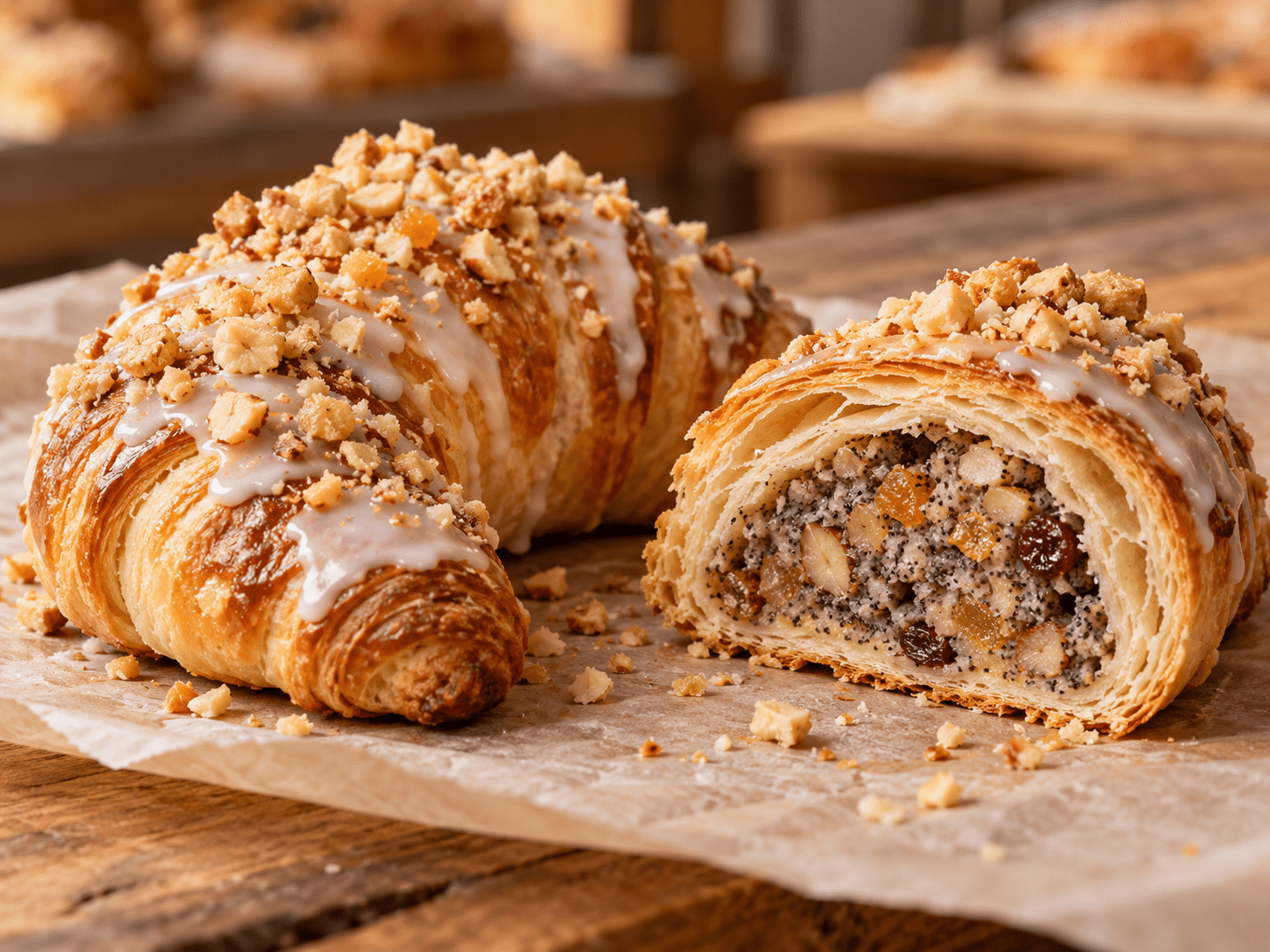
Cut one open and there is no chocolate or almond cream inside. Instead, the layers reveal a dense filling built around white poppy seeds, raisins, nuts and candied fruit.
This is the rogal świętomarciński — the St Martin’s croissant — and in Poznań it is much more than a seasonal sweet.
- Find more news from Poland on our Homepage .
The pastry is bound to St Martin’s Day, celebrated on 11 November, and has become one of the most recognisable culinary traditions of Poznań and the wider Wielkopolska region. Its name is also protected under the European Union’s Protected Geographical Indication, or PGI, system.
That means not every crescent-shaped pastry filled with poppy seeds can legally be sold as a rogal świętomarciński.
What makes a real St Martin’s croissant?
The official specification is surprisingly precise.
An authentic rogal świętomarciński must have a crescent shape, visible layers of flaky yeast dough and a characteristic filling based on white poppy seeds.
The filling also contains sugar, crumbs, eggs, raisins, nuts, candied or syrup-preserved fruit — such as orange peel, pear or cherries — and almond flavouring. The finished pastry is topped with icing and chopped nuts.
Under the current specification, each croissant weighs between 150 and 250 grams.
Its layered texture comes from ciasto półfrancuskie, a laminated yeast dough sometimes described in English as semi-puff pastry. The dough and filling are rolled together in a particular way so that layers of pastry alternate with the poppy-seed mixture towards the centre.
There is a geographical requirement too.
Poland’s Agricultural and Food Quality Inspection says the protected pastry may be produced in Poznań and across specified parts of the Wielkopolska region, including 25 surrounding counties.
The name entered the EU register of protected geographical indications in 2008, placing the pastry in the same European system used to safeguard foods whose reputation or characteristics are closely associated with a particular place.
A pastry tied to St Martin and charity
The connection with 11 November stretches much further back than the EU protection.
Poznań’s municipal history associates the modern tradition with 1891, when the parish priest of St Martin’s Church, Jan Lewicki, appealed to worshippers to follow the saint’s example and help people in need.
According to the traditional account, local confectioner Józef Melzer responded by baking trays of croissants. Wealthier residents bought them while poorer people received them free.
Other bakers subsequently joined in, and the custom became associated with the city’s St Martin’s Day celebrations.
Some of the more colourful explanations surrounding the pastry belong firmly to legend.
One says the crescent shape was inspired by a horseshoe lost by St Martin’s horse. Other stories have connected the shape with much older traditions or even the crescent symbols captured after the Battle of Vienna.
Poland’s food-quality authority notes that it is impossible to determine which of those stories, if any, reflects the true origin of the shape.

What is certain is that the pastry became deeply embedded in Poznań’s culinary culture.
Why the white poppy seeds matter
For international readers, perhaps the most surprising part of the recipe is the filling.
Blue or black poppy seeds are familiar in many Central European cakes and pastries. The St Martin’s croissant instead relies on white poppy seeds, which help give the filling its lighter colour and distinctive nutty character.
Combined with raisins, nuts, candied fruit and almond flavouring, the result is unusually rich — which helps explain why the official specification now allows croissants weighing as little as 150 grams.
That lower limit was introduced in 2013. European regulators noted that consumer preferences had shifted towards smaller portions and that the pastries were increasingly being sold throughout the year rather than only around St Martin’s Day.
Yet 11 November remains the date most closely connected with them.
For Poland as a whole, it is Independence Day. In Poznań, it is also the day when St Martin’s traditions come to the foreground — and when one of the country’s most distinctive regional pastries becomes almost impossible to miss.
A white-poppy-seed croissant may sound like a simple seasonal treat. In Poznań, it carries more than a century of local tradition, a story of charity, a tightly defined recipe and a protected name.