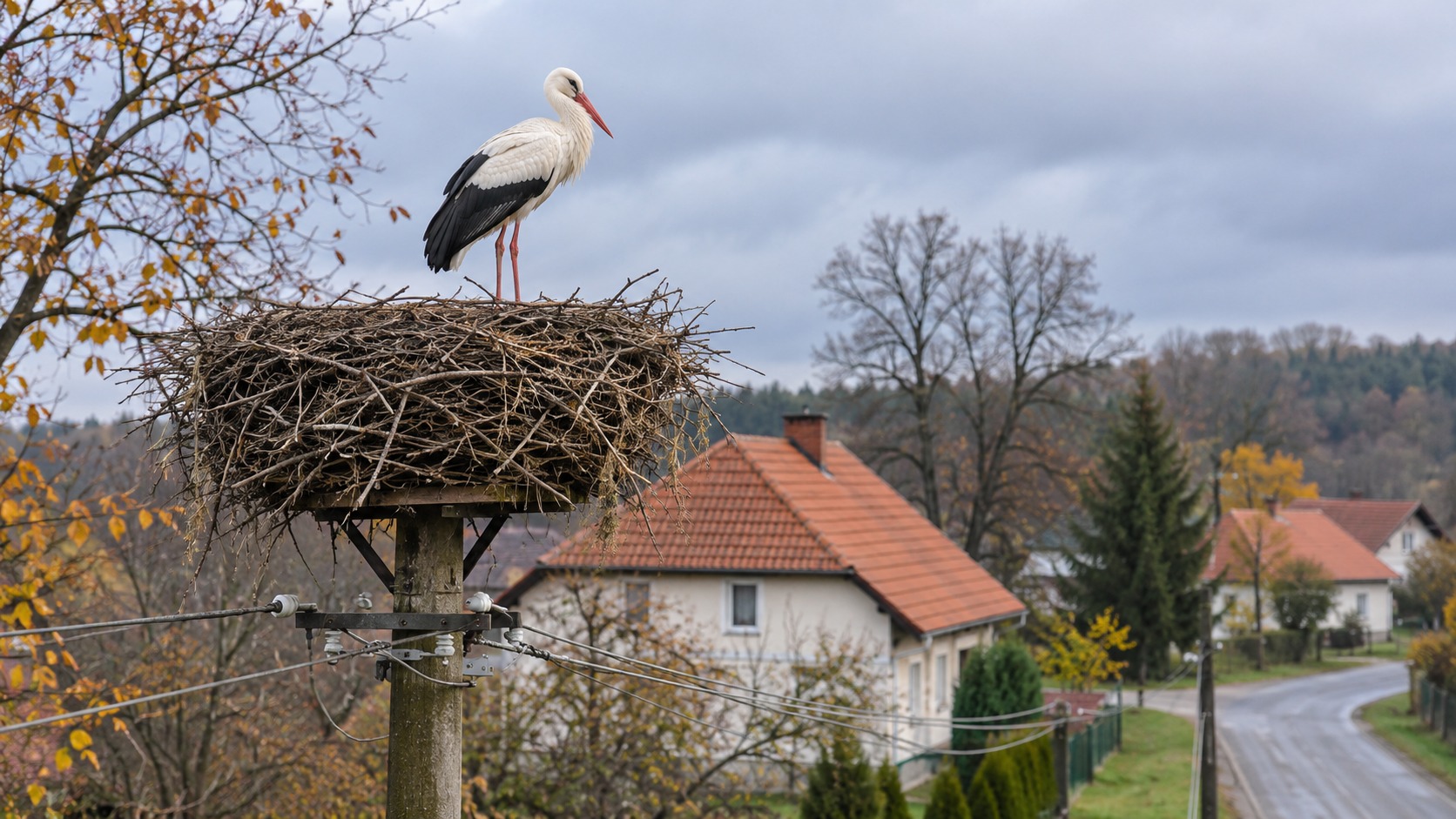
While millions of migratory birds have left Poland for warmer climates, one white stork in the picturesque Masuria region has once again decided to stay behind. For the fourth consecutive year, the bird has remained in the village of Spytkowo near Giżycko, even as his partner and two young storks have departed on their autumn migration towards Africa.
The unusual resident has become a familiar sight to villagers, who have watched him endure previous Polish winters and return to the same daily routines while most other storks are thousands of kilometres away.
His nest stands on an electricity pole beside a road, close to the village fire station. Despite the arrival of November, there is little indication that he intends to leave.
- Find more news from Poland on our Homepage .
Speaking to the Polish Press Agency (PAP), local resident Leon Wojnicz, who lives opposite the nest, described the bird as an established member of the community.
Wojnicz joked that the stork had sent his family off to Africa and was now ruling Spytkowo on his own.
“He seems to like it here,” the resident added.
A familiar sight, even in freezing weather
The stork has already survived three winters in the village, including the particularly cold conditions experienced last year.
According to Wojnicz, residents became concerned when snow covered the ground and temperatures dropped below freezing. Rather than seeking shelter in a barn or another farm building, the bird continued spending time in his exposed nest.
Neighbours consulted someone experienced in caring for storks and were advised that access to sufficient food was particularly important.
Their concerns eased when the bird made it through the winter.
This autumn, he has once again remained in Spytkowo.
The bird is far from isolated. Villagers regularly observe him walking around local farmyards, sometimes alongside chickens and even among groups of geese.
Wojnicz told PAP, in reporting carried by Radio Olsztyn, that residents sometimes leave pieces of meat in a nearby meadow for the stork.
However, most of his food reportedly comes from somewhere less picturesque.
The rubbish dump that may help explain his survival
Approximately two kilometres from the bird’s nest is a rubbish dump where, according to residents, the stork regularly searches for food.
The site attracts small rodents and contains discarded food, providing potential feeding opportunities even when insects and other natural prey become harder to find.
This reliable supply may help explain how the bird has managed to remain in northern Poland through successive winters, although its precise influence on his migration behaviour has not been established.
White storks normally feed on a varied diet that includes insects, earthworms, small mammals and other animals found in grasslands, fields and wetlands.
Their annual journeys to Africa are closely associated with seasonal changes in food availability rather than simply an inability to tolerate cold temperatures.
But increasingly, human activity is changing the food sources available to these birds.


A scientific study examining resident white storks in Spain and Portugal found that access to landfill sites could support birds remaining close to their breeding territories throughout the year, rather than undertaking lengthy migrations.
Research presented in July 2026 also highlighted the potential disadvantages of feeding at rubbish dumps. Scientists reported preliminary evidence suggesting that landfill food can provide useful energy reserves while also exposing storks to environmental contaminants and other health risks.
Those findings do not establish that the Spytkowo bird is experiencing such problems, but they illustrate how human waste can influence the lives of migratory wildlife.
Not all Polish storks migrate
Although the annual departure of white storks is one of the most familiar signs of autumn in Poland, not every bird makes the journey south.
The country’s Regional Directorate for Environmental Protection explains in its guidance on wintering storks that healthy birds can sometimes find enough food to survive without migrating.
Their continued presence does not automatically indicate an injury or illness, and the authorities advise against attempting to capture healthy birds simply because they have remained in Poland.
Another well-known Masurian stork, Krutek, has taken a very different approach this year.
Tracked by a GPS transmitter, Krutek left Poland in August and travelled through the eastern Mediterranean region. By late October, his transmitter had recorded his presence in southern Israel, near Beersheba.
His movements, followed by the Mazurian Landscape Park, provide a striking contrast with the stork in Spytkowo, which has remained near its nest.
For the villagers, however, the appeal of their unusual neighbour is much simpler.
While the arrival of white storks traditionally signals spring across rural Poland, this particular bird has become a year-round presence.
And as another winter approaches, residents of Spytkowo will once again be watching to see how their familiar feathered neighbour copes with the snow, frost and freezing temperatures of Masuria.