

Polish Navy mine-clearance divers have begun an operation off Świnoujście to neutralise five British sea mines left on the Baltic seabed since the Second World War. The weapons, which together carry explosive charges equivalent to around 2.5 tonnes of TNT, were discovered during work connected with construction of a new external port and have prompted restrictions on shipping and a temporary ban on entering the sea along a stretch of coast extending from Germany to Międzyzdroje.
The four-day operation began on Monday, 5 October, and is scheduled to continue until Thursday, 8 October.
The work is being carried out by specialist mine-clearance divers from the 12th Minesweeper Squadron of the Polish Navy’s 8th Coastal Defence Flotilla. Several dozen sailors are involved in the wider operation.
- Find more news from Poland on our Homepage .
British mines dropped from aircraft
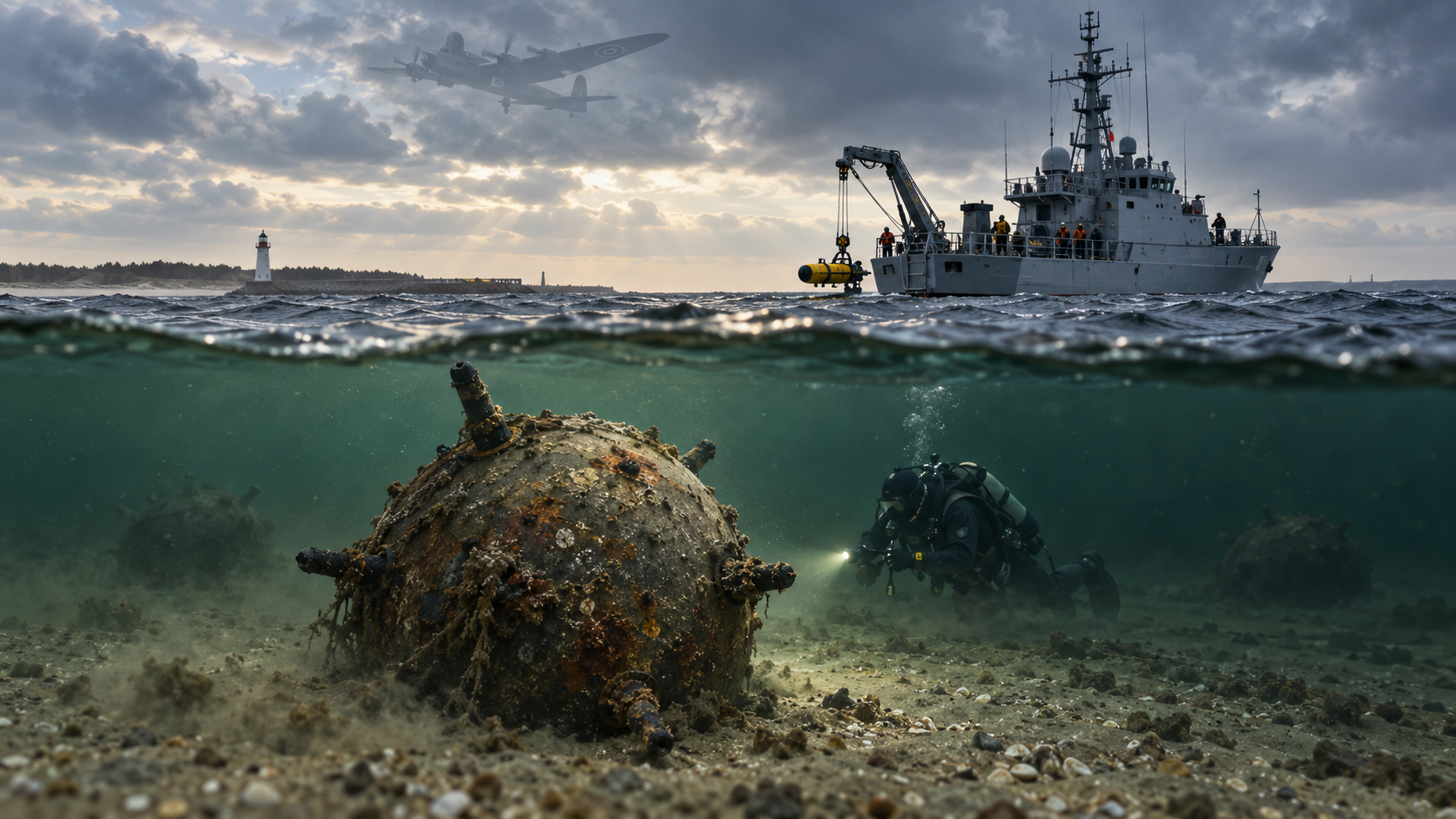
The five objects have been identified as British Mark IV, Mark V and Mark VI air-dropped naval mines.
According to the Maritime Office in Szczecin, the cylindrical mines are about three metres long and each contains between roughly 350 and 550 kilograms of explosive. Their combined explosive charge is equivalent to approximately 2,500 kilograms of TNT, while the mines themselves weigh close to 3.5 tonnes in total.
They lie at a depth of around 10 metres, approximately one kilometre from the breakwater of Świnoujście’s LNG terminal.
Weapons of this type were dropped from aircraft during the war to obstruct maritime routes. The mines could react to the magnetic and acoustic signatures of passing vessels, meaning that more than 80 years later they continue to pose a potential risk to shipping and construction work.
The mines were found during work commissioned by the Maritime Office in the area intended for the integrated breakwater of Świnoujście’s future external port.
Navy using deflagration rather than simply blowing them up
The Navy says the principal method being used to dispose of the weapons is deflagration.
Łukasz Koziarski of the 8th Coastal Defence Flotilla told Radio Szczecin that spectacular explosions were not expected despite the size of the charges. Mine-clearance divers are instead using a process intended to burn through the explosive material while reducing the impact on the surrounding marine environment.
The first mine was scheduled to undergo neutralisation at around 08:40 on Monday, with vessel movements halted during that phase of the operation.
At the time of writing, however, Poland-24 had not seen an official statement confirming that the first mine had already been successfully neutralised.
Sea closed across a long stretch of coastline
The size of the weapons has led authorities to impose safety restrictions across a much wider area than the immediate mine sites.
From 5 to 8 October, generally between 08:00 and 15:00, people are prohibited from entering the Baltic along the coastline running from Ahlbeck in Germany, through Świnoujście, to Międzyzdroje.
The controlled area extends as far as 8.8 kilometres out to sea.
Authorities have stressed that the beaches themselves are not closed. Remaining on the beach or nearby open land is considered safe; the prohibition specifically concerns entering the water while naval work is taking place.
An RCB emergency warning was also sent on Monday to people in Świnoujście and Kamień County, telling them not to enter the water and to follow instructions from local services.
Restrictions on shipping
Maritime traffic is also affected.
A safety radius of 821 metres applies around each neutralisation point, while underwater and diving work inside Świnoujście harbour is prohibited during the operation.
The Navy is working alongside the Maritime Office, police, Border Guard, State Fire Service, environmental authorities, local governments and the 14th West Pomeranian Territorial Defence Brigade.


Radio Szczecin reported that shipping would be temporarily stopped while the first mine was being dealt with.
WWII weapons still complicate modern Baltic projects
The operation highlights a problem that continues to affect infrastructure development around the Baltic decades after the war ended.
Świnoujście is already one of Poland’s most strategically important maritime centres. It hosts the country’s LNG terminal and is the site of plans for a new external port and container terminal.
Preparing that infrastructure requires extensive work on the seabed — which can reveal weapons deposited there during the Second World War.
The five mines now being removed were discovered precisely because of work associated with the planned new breakwater. The Maritime Office says they remain a genuine threat both to navigation and to future investment in the area.
For several days, that wartime legacy is therefore directly affecting modern shipping, construction and public access to one of Poland’s busiest stretches of Baltic coastline.
More than eight decades after British aircraft dropped the mines into waters controlled by Nazi Germany, Polish Navy divers are now clearing them to make way for the next generation of port infrastructure.