Imagine an autumn evening in a traditional Polish village.
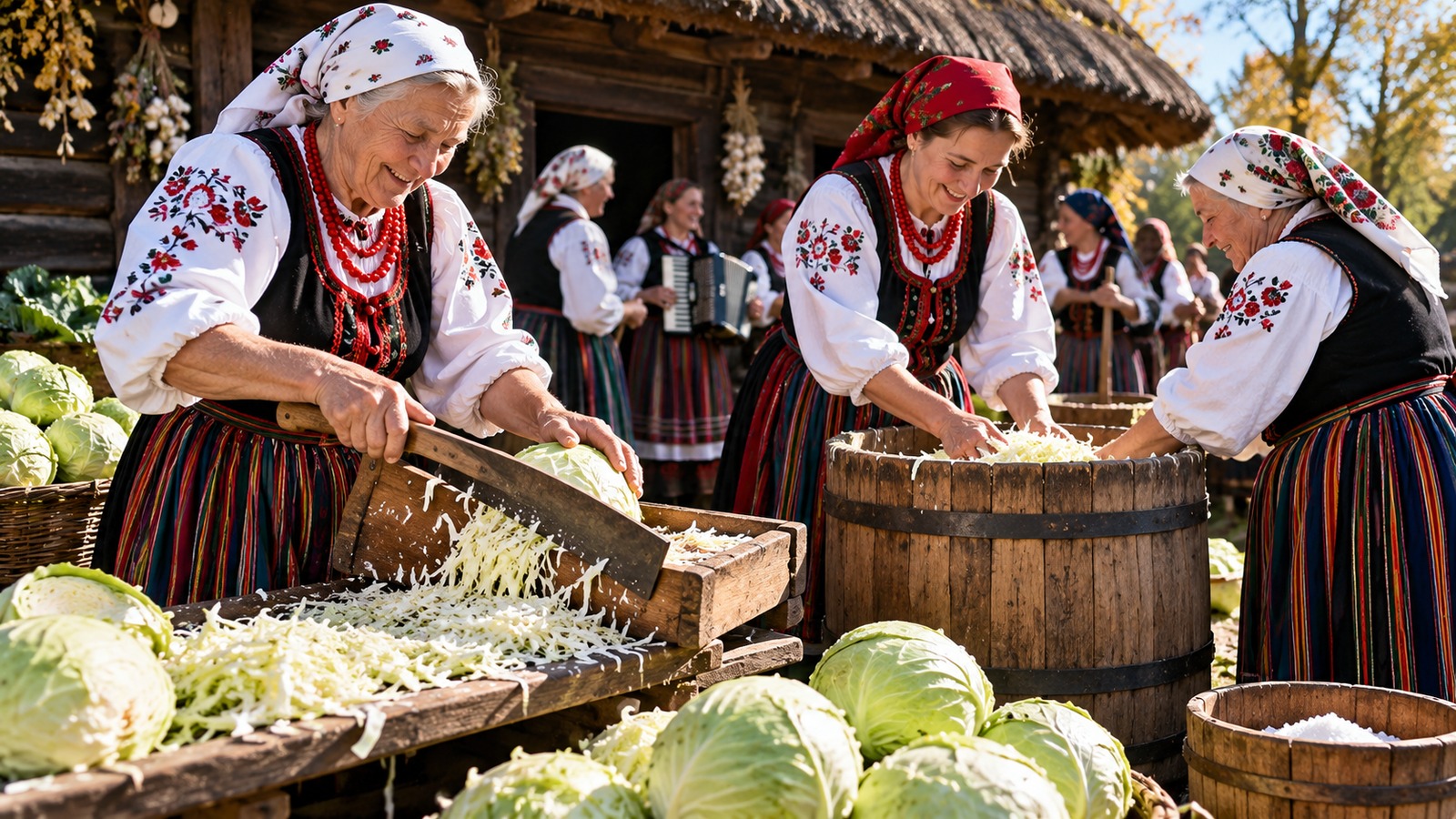
A large wooden barrel stands inside a farmhouse. Freshly harvested cabbages are piled nearby, neighbours have gathered to help, and the sound of chopping is accompanied by conversation, laughter and singing.
The work is serious. Families need to preserve enough food to last through winter.
- Find more news from Poland on our Homepage .
But this is also a social occasion.
In parts of rural Poland, making sauerkraut was once an opportunity to bring the local community together, turning a necessary household task into something resembling a village celebration.
The custom was known in some areas as obieraczki kapuściane — communal gatherings for preparing cabbage.
Although the tradition is no longer a regular part of everyday life in most Polish villages, its memory survives through ethnographic research, regional food heritage and museum demonstrations.
And this October, it returned to a traditional farmhouse setting in eastern Poland.
An autumn custom brought back to life
On 11 October 2026, the Museum of the Lublin Countryside recreated the traditional communal preparation of cabbage for winter.
The demonstration was performed by a folk group from Kocudza, drawing on historical practices from the Biłgoraj area in south-eastern Poland.
According to the museum’s official programme, the event included traditional cabbage chopping, preparation of wooden barrels, folk music and dancing.
Participants could see how cabbage was once prepared using specialised chopping tools known locally as tasaki or tasoki.
The demonstration also showed how whole cabbage heads and chopped cabbage could be arranged together in a barrel.
The gathering was intended to recreate the atmosphere of an earlier rural household, when preparing winter provisions required considerable physical work.
Speaking to Radio Lublin after the event, Alina Myszak from the Kocudzanki folk group described the traditional work as an occasion for singing, storytelling and exchanging village gossip.
The museum’s presentation was a reconstruction, rather than evidence that these communal gatherings remain widespread today.
Nevertheless, it preserved a tradition that once connected an ordinary food-preservation task with community life.
Why cabbage mattered so much
For generations, cabbage was one of the foundations of the rural Polish diet.
Alongside potatoes, grain and other locally grown vegetables, it provided an inexpensive ingredient that could be stored and used long after the autumn harvest.
Fresh cabbage could not simply be left indefinitely in a farmhouse kitchen. Families needed methods of preserving it through the colder months.


Fermentation provided an answer.
The vegetable could be shredded, packed tightly into barrels and left to ferment, producing the sour flavour characteristic of kapusta kiszona, or sauerkraut.
In the more familiar salted method, salt helps draw moisture from the cabbage. Naturally occurring lactic-acid bacteria then convert sugars into acids under suitable conditions, helping preserve the food.
Poland’s Agricultural and Food Quality Inspection authority explains that this process of lactic-acid fermentation has been used to preserve vegetables since long before scientists understood the microbiology involved.
Fermented cabbage became an ingredient in numerous Polish dishes, including kapuśniak (cabbage soup), pierogi filled with cabbage, and cabbage served with peas.
Preserving a substantial quantity for winter could require hours of repetitive preparation.
That was where neighbours came in.
The evening when neighbours came to help
An account preserved by Poland’s Ministry of Agriculture describes how communal cabbage preparation was practised in Bobrowa, a village in the Opole region.
Men and women would gather in one household to help prepare the winter supply.
The cabbages were stripped of damaged outer leaves, cut into pieces and chopped using large blades on wooden boards.
Shredded cabbage was then placed in a barrel, sprinkled with salt and packed down tightly.
Historical methods of compression varied. Some households used wooden pounders, while other traditions involved carefully treading on cabbage inside a barrel.
The work was accompanied by stories and singing.
According to the ministry’s traditional-product documentation for Bobrowa, the gathering was both a preservation exercise and a social event.
The account also records a local belief that cabbage should be fermented before the end of October, because starting the process after All Saints’ Day was thought to risk spoiling the batch.
That belief was part of local folklore, not a scientifically established rule.
But it illustrates how firmly cabbage preparation was connected to the autumn calendar.
Not every Polish village made sauerkraut the same way
One of the most fascinating aspects of the tradition is how preparation methods differed between communities.
The version preserved around Biłgoraj, for example, was not identical to the salted preparation documented in Bobrowa.
In the Biłgoraj-area tradition, cabbage could be fermented without added salt.
Instead, rye flour was used in preparing the barrel, helping establish the conditions for fermentation.
A 2021 account published by Poland’s National Institute of Rural Culture and Heritage describes the practice as continuing in the Biłgoraj area until around the middle of the twentieth century.
Unlike some other regional customs, the cabbage was pressed by hand rather than trodden underfoot.
Barrels were initially kept near the stove for roughly two to three weeks before being moved into a cool cellar for winter storage.
The household hosting the gathering was also expected to provide generous refreshments for those who helped.
This regional variation is important.
There was no single method of making sauerkraut that every Polish village followed, and historical fermentation techniques should not automatically be treated as suitable modern food-safety instructions.
Indeed, contemporary food-preservation guidance recommends tested recipes and controlled salt proportions for home fermentation.
A Polish tradition with a wider European history
Fermented cabbage is not an exclusively Polish invention.
Different forms of preserved and fermented vegetables have long existed across Central and Eastern Europe and in other parts of the world.
What makes the Polish story distinctive is the range of regional customs, recipes and social traditions recorded around the preparation process.
The Ministry of Agriculture’s register of traditional products includes varieties such as Charsznicka kapusta kwaszona, associated with the Charsznica area of Lesser Poland, and whole cabbage heads fermented in barrels in Podlaskie.
The Podlaskie tradition also records households inviting neighbouring girls to help prepare cabbage before winter.
These records reveal something larger than culinary history.
The same basic ingredient could be prepared in different ways depending on local crops, available equipment, family recipes and community practices.
Preserving more than food
Today, sauerkraut remains familiar in Polish kitchens, supermarkets and restaurants.
But the communal labour once involved in preparing large barrels of cabbage has largely given way to more efficient equipment and commercial production.
The tradition’s original purpose — preparing enough food to survive winter — has changed.
Its cultural significance, however, has not entirely disappeared.
Ethnographic museums and regional folk groups help keep the memory alive through demonstrations of historic techniques, traditional tools, music and shared meals.
The Museum of the Lublin Countryside has staged versions of obieraczki kapuściane for years, allowing younger generations to see how an ordinary household task once brought people together.
For Poles whose parents or grandparents remember preparing winter vegetables at home, the sight of a large wooden barrel may evoke familiar memories.
For international visitors, it offers a different perspective on Polish food culture.
Behind a simple serving of fermented cabbage lies a history of harvests, demanding household work, regional customs and neighbours helping one another.
In some Polish villages, the process of preserving food also helped preserve community ties.
And that is perhaps the most interesting part of this autumn tradition: preparing cabbage for winter was necessary, but it could also be a reason to come together.
Featured image: digitally generated editorial illustration of communal cabbage preparation in a traditional Polish-inspired rural setting. This is not an authentic historical photograph or a photograph from the Museum of the Lublin Countryside’s 2026 demonstration.