Polish archaeologists working in Tanzania’s Serengeti National Park have discovered an almost complete fossilised skull of an extinct giraffe and human remains associated with a prehistoric pastoral community. The remarkable findings emerged during the team’s first full excavation season in 2026, alongside new evidence of human activity dating to the Middle Stone Age. Researchers believe the giraffe fossil could potentially belong to a species not previously described by science, although its identity has yet to be established.
The discoveries were announced on 25 October by researchers from the University of Wrocław and the Polish Academy of Sciences’ Institute of Archaeology and Ethnology, who spent approximately two months excavating and surveying sites in the Serengeti.
The Polish teams worked alongside scientists from Tanzania’s University of Dar es Salaam and with support from the country’s wildlife research and national parks institutions.
- Find more news from Poland on our Homepage .
Professor Marta Osypińska, an archaeozoologist at the University of Wrocław who leads its Serengeti research team, told the Polish Press Agency (PAP) that the scale of the discoveries had surprised the expedition.
The original PAP report describes a series of findings that could change researchers’ understanding of the region’s prehistoric inhabitants and the animals that shared their environment.
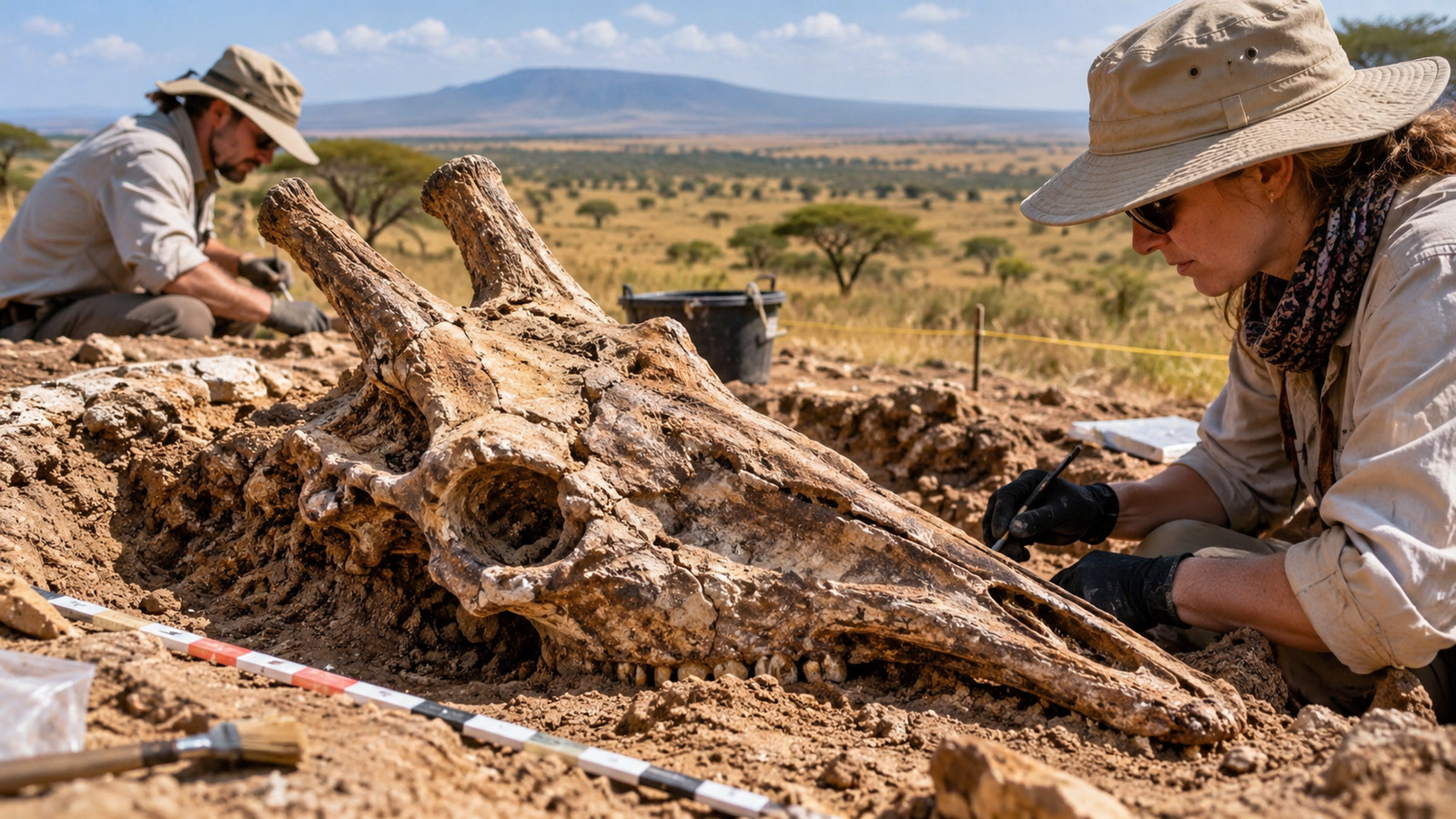
The most unusual is the skull of an extinct giraffe.
An almost complete skull of a prehistoric giraffe
The expedition recovered a nearly complete fossilised giraffe skull together with a radius, one of the bones of the forelimb.
Researchers believe the remains belong to an extinct giraffe that lived during the Pleistocene, the geological period that ended approximately 11,700 years ago.
The skull’s completeness makes it a potentially valuable specimen for studying extinct giraffes and comparing their anatomy with previously identified species.
The team has also raised the possibility that the fossils belong to a species not yet formally described by scientists.
However, no new giraffe species has been confirmed.
Establishing that would require detailed anatomical comparisons with existing fossil collections and formal scientific assessment.
The available reports do not provide a precise age for the skull or establish its final taxonomic classification.
Osypińska explained that identifying ancient animals in the Serengeti presents particular challenges.
East Africa has supported an extraordinary diversity of wildlife, and species can share anatomical characteristics that make their remains difficult to distinguish.
Fossils must therefore be examined carefully, not only for their physical characteristics but also for the geological and archaeological context in which they were found.
Further investigation could help establish where the extinct animal fits within the evolutionary history of the giraffe family.
For now, the fossil represents an important find whose scientific significance has yet to be fully determined.
Human remains discovered at a prehistoric pastoral settlement
The expedition also uncovered human skeletal fragments at a settlement associated with Neolithic pastoral communities.
The material includes dozens of fragments and numerous teeth, which researchers believe belonged to several individuals.


According to Osypińska, previous archaeological work in the Serengeti had not identified recognised human burial grounds or cemeteries.
The newly recovered remains could therefore provide important evidence about how people living in the region treated their dead.
However, researchers have not yet established whether the material represents formal burials, another funerary practice or a different process by which human remains accumulated at the site.
The remains may also provide information about the ancestry, health and diet of prehistoric communities.
Scientific analysis of human teeth can sometimes reveal evidence about childhood conditions, nutrition and environmental exposure.
Other methods may help researchers investigate population movement and relationships between communities, depending on the preservation of the remains and the availability of suitable comparative material.
These are future research possibilities rather than results already established by the expedition.
The human remains must also be distinguished from the giraffe fossils.
Although both were recovered during the 2026 research programme, the available evidence does not establish that they are the same age or came from the same archaeological context.
Searching for the earliest inhabitants of the Serengeti
The wider objective of the Polish expedition is to understand how prehistoric populations lived in East Africa and adapted to their environment.
Researchers are particularly interested in the Middle Stone Age, a long period associated with developments in stone-tool technology and the behaviour of early Homo sapiens populations.
The Serengeti is internationally famous for its wildlife, but much of its archaeological history remains comparatively poorly documented.
The landscape lies near the wider Olduvai Gorge region, one of the most important areas for research into human evolution.
Yet the Serengeti’s protected grasslands, rivers and rocky outcrops have received far less sustained archaeological attention than some neighbouring locations.
Earlier surveys by Polish researchers identified promising sites containing stone tools, animal remains and rock paintings.
In 2026, the team moved beyond reconnaissance to conduct systematic excavations.
According to PAP, researchers investigated two Middle Stone Age sites and undertook additional rescue excavations at two other locations.
The expedition reported that it had increased the available archaeological dataset for the Middle Stone Age in the studied part of Tanzania by approximately 300%.
That figure represents the researchers’ assessment of the increase in documented material, not an independently established measure of the entire region’s archaeological record.
New discoveries at Loiyangalani and Kiboko
One of the expedition’s principal locations was Loiyangalani, an established Pleistocene archaeological site previously investigated by researchers working in the Serengeti.
The University of Wrocław’s September fieldwork report explained that the team intended to re-examine the site using archaeological techniques unavailable or less developed during earlier investigations.
Modern dating methods, environmental analysis and detailed study of animal remains could help establish a clearer chronology of human activity.
The Polish researchers also used larger excavation areas than those employed in some previous surveys.
Where earlier investigations often relied on small test trenches measuring approximately one metre square, the new work included excavations measuring five by five metres or ten by ten metres.
Larger trenches can reveal spatial relationships between stone tools, animal bones, hearths and other traces of human activity.
This helps researchers investigate not simply what objects were left behind, but how prehistoric people used particular locations.
At another site, named Kiboko — the Swahili word for hippopotamus — the team recovered substantial collections of stone artefacts and well-preserved animal remains.
The researchers also reported surviving archaeological layers that could help establish the order in which different activities took place.
The site’s name reflects an encounter with a hippopotamus during the team’s initial fieldwork.
Did prehistoric people make ornaments from turtle shells?
Among the findings at Kiboko were possible indications that prehistoric people used turtle shells to make decorative objects.
This could be significant because personal ornaments provide evidence of activities extending beyond the manufacture of tools for hunting, food preparation or other practical purposes.
Ornaments may offer clues about appearance, social relationships or symbolic expression.
However, the interpretation remains provisional.
The researchers have not yet confirmed that the turtle-shell material was deliberately fashioned into ornaments rather than used or modified for another purpose.
Further analysis will be needed to establish whether the objects were worked by people and, if so, how they were used.
If the hypothesis is confirmed, the material could contribute to wider research into symbolic behaviour among prehistoric humans.
Such questions are central to understanding the development of human cognition and cultural practices.
A major Polish-Tanzanian research programme
The 2026 excavations represent the first full field season following earlier Polish archaeological reconnaissance in the Serengeti.
The programme involves two closely cooperating research teams.
The University of Wrocław mission is led by Professor Marta Osypińska, while research by the Polish Academy of Sciences’ Institute of Archaeology and Ethnology includes a project led by Dr Piotr Osypiński.
The institute’s official 2026 excavation update explains that its project focuses on prehistoric pastoral communities and their migration into the Serengeti.
One question is whether groups arriving from the north continued to depend primarily on domesticated animals or adapted their livelihoods to the surrounding savanna.
The research therefore examines changes in food production, environmental adaptation and population movement over several thousand years.
Scientists from the University of Dar es Salaam are involved in the programme, alongside international specialists.
Fieldwork is supported by the Tanzania Wildlife Research Institute, Tanzania National Parks and the Frankfurt Zoological Society.
The two Polish projects receive funding from Poland’s National Science Centre.
Researchers share logistical resources and field facilities, allowing them to investigate different periods of Serengeti history within a broader collaborative programme.
Archaeology among lions, elephants and hippos
Conducting excavations in the Serengeti presents unusual practical challenges.
The national park is home to large populations of elephants, buffaloes, lions, cheetahs and other wildlife.
Unlike archaeological sites in developed areas, excavation locations cannot simply be isolated from their surrounding environment.
Researchers must work around animal movements and follow the safety requirements of the national park.
In its earlier expedition report, the University of Wrocław described occasions when researchers encountered cheetahs, large herds of buffaloes and elephants near their fieldwork sites.
The expedition operates from a base in the Seronera area and relies on the support of Tanzanian research and conservation authorities.
The region’s protected status also gives it considerable archaeological value.
Large areas have not experienced the intensive agricultural disturbance or urban development that can destroy ancient archaeological deposits elsewhere.
Nevertheless, finding traces of prehistoric people remains difficult.
Stone tools, scattered animal bones and small changes in sediment may be the only surviving evidence of activity dating back many thousands of years.
What happens next?
The discoveries mark the beginning of a longer scientific investigation rather than its conclusion.
According to the researchers’ account published by PAP, collected material has been directed towards specialist laboratories in Europe and the United States for further analysis.
Work planned for February 2027 includes additional examination of archaeological artefacts and animal remains.
The Polish researchers also intend to return to the Serengeti for another field season in July 2027.
Among the outstanding questions are the precise identity and age of the fossil giraffe, the interpretation of the human remains and the possible evidence of prehistoric ornament-making.
Determining whether the giraffe represents a previously unknown species will require particular care.
Likewise, understanding the human skeletal material will depend on further examination of its archaeological context and any recoverable biological evidence.
For the Polish and Tanzanian researchers, the importance of the first season extends beyond one extraordinary fossil.
The discoveries suggest that parts of the Serengeti still contain a substantial and poorly understood record of prehistoric human life and changing wildlife populations.
The almost complete giraffe skull may eventually provide new evidence about an extinct animal. The human remains could offer insights into communities that lived on the East African savanna thousands of years ago.
Together, the findings underline how much remains to be learned about the region’s ancient past.