Poland and the United States have signed a major defence technology cooperation agreement following 17 years of negotiations, opening the way for Polish scientists, universities and defence companies to work directly with American counterparts on developing and testing advanced military technologies.
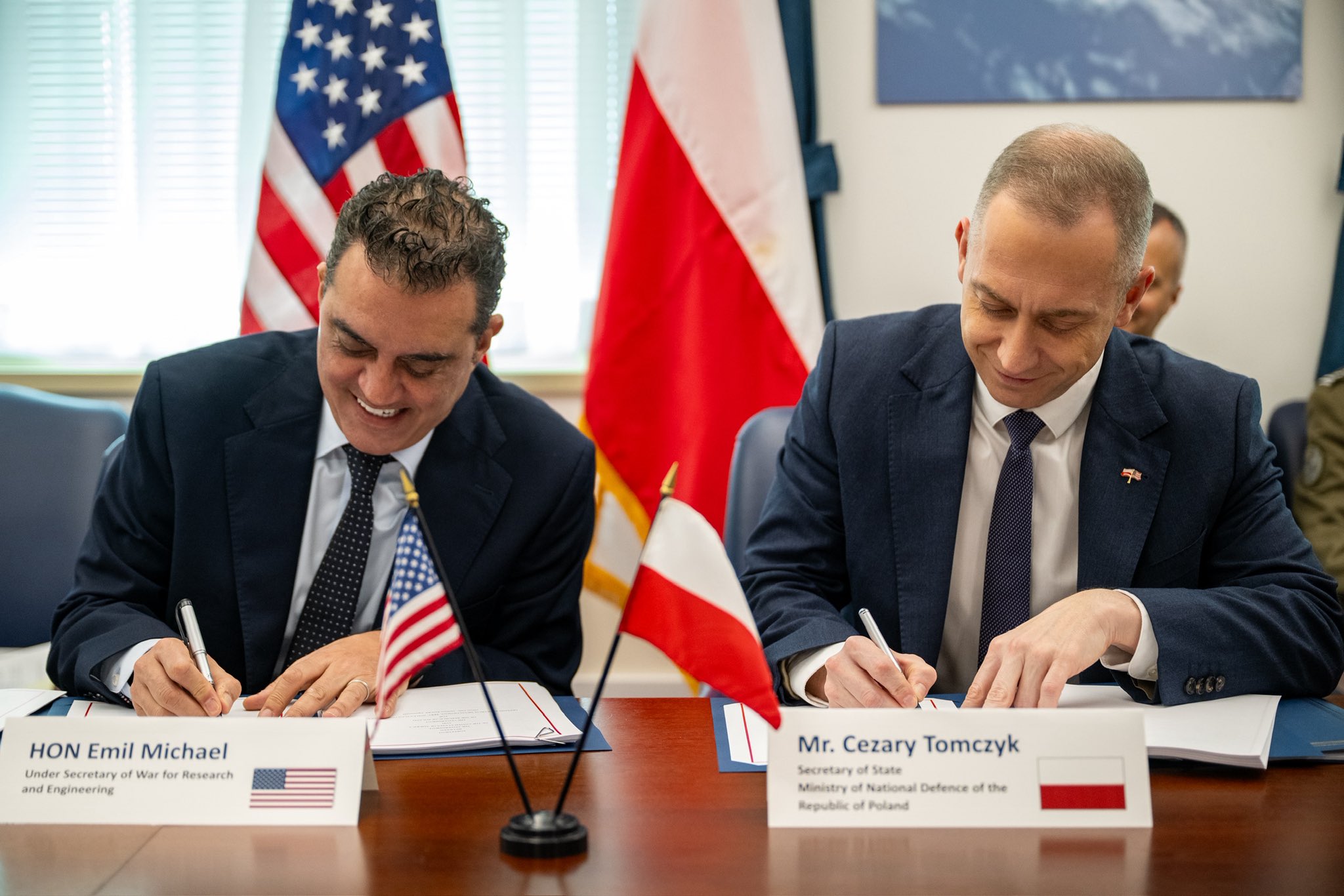
The agreement, signed at the Pentagon by Polish Deputy Defence Minister Cezary Tomczyk and US Under Secretary of War for Research and Engineering Emil Michael, establishes a formal framework for joint research, development, testing and evaluation of defence technologies.
For Poland, one of NATO’s largest purchasers of American military equipment, the agreement represents an opportunity to expand its role from acquiring US weapons to participating in the development of future military systems.
- Find more news from Poland on our Homepage .
According to the Polish Ministry of Defence, the arrangement will allow Polish universities, research institutes and companies to participate in joint projects with American partners.
The announcement comes as Poland accelerates the modernisation of its armed forces and seeks to strengthen its domestic defence industry amid continuing security concerns on NATO’s eastern flank.
Agreement concludes 17 years of negotiations
The defence research, development, test and evaluation agreement, known as RDT&E, was concluded during Tomczyk’s visit to Washington.
According to Polish officials, negotiations had continued for 17 years before the two governments reached an agreement.
The US Department of War’s research and engineering leadership also announced the signing, describing it as a step towards turning technological research into military capabilities for both countries.
The arrangement creates a framework for jointly developing technologies, exchanging technical information and expertise, and evaluating new military systems.
Previously, cooperation in this area had been more limited, largely involving the exchange of information and personnel rather than jointly conducted development programmes.
The new agreement should allow Poland to become involved earlier in the development process, potentially making future technologies better suited to the requirements of the Polish armed forces.
However, the framework agreement does not itself establish that particular weapons have been developed or that specific production contracts have been awarded.
Drones, ammunition and advanced military technologies
One of the first planned areas of cooperation involves high-energy materials and ammunition technologies.
These materials are used in military applications including propellants and explosives, making them important for the development and production of modern ammunition.
Polish officials have also identified drones and counter-drone systems as potential areas for joint research.
General Marcin Górka, who oversees innovation within Poland’s armed forces and accompanied Tomczyk to Washington, said the agreement would create new opportunities for Polish researchers and engineers to work with American military laboratories.
Cooperation could include the development of advanced unmanned systems and technologies designed to detect or counter hostile drones.
Testing and evaluation activities could take place in both Poland and the United States.
The proposed projects remain subject to subsequent technical, financial and institutional arrangements.
Poland seeks to become a defence technology partner, not just a customer
Poland has made substantial purchases of American military equipment in recent years, including F-35 fighter jets, Abrams tanks, Patriot air-defence systems and HIMARS rocket launchers.


These programmes form a major part of the country’s military modernisation.
However, Warsaw has increasingly emphasised the importance of ensuring that spending on foreign equipment also contributes to domestic industrial and technological capabilities.
This includes the ability to maintain, repair and potentially manufacture selected defence equipment in Poland.
The new research agreement complements other initiatives aimed at expanding the country’s role in American defence supply chains.
Earlier in November, Polish Defence Minister Władysław Kosiniak-Kamysz and US Secretary of War Pete Hegseth signed a separate statement of intent on strengthening cooperation between the two countries’ defence industries.
That declaration focused on expanding industrial partnerships and developing opportunities for technology transfer and production.
The latest agreement addresses an earlier stage of technological development, establishing a framework for joint research and testing rather than focusing exclusively on manufacturing or servicing existing equipment.
Talks also cover F-35s, Patriot missiles and HIMARS
During his visit to Washington, Tomczyk also met representatives of American defence manufacturer Lockheed Martin.
According to the Polish Defence Ministry, the discussions included accelerating deliveries of F-35 flight simulators, supporting the future operational readiness of Poland’s F-35 fleet and expanding maintenance capabilities in Poland.
Officials also discussed the possibility of establishing a European servicing centre in Poland for Patriot PAC-3 missiles.
Another topic was potential technology transfer connected with the HIMARS rocket artillery system.
These discussions reflect Poland’s wider ambition to develop domestic capabilities supporting the sophisticated equipment it purchases from the United States.
The ministry did not announce that every project discussed during the meetings had resulted in a new binding agreement.
Cooperation comes amid heightened tensions with Russia
The agreement was announced during a period of heightened tension following Russian missile and drone incursions into Polish airspace.
On 20 November, three Russian cruise missiles entered Polish territory during a large-scale attack on western Ukraine.
The incidents prompted urgent consultations between Warsaw and its NATO allies over strengthening airspace surveillance and defence.
During his Washington visit, Tomczyk also briefed American officials on Poland’s security situation and the threats facing NATO’s eastern flank.
The Polish delegation held discussions with US officials and members of Congress about maintaining a strong American military presence in Poland.
Although the technology agreement reflects a much longer negotiation process, its completion comes at a time when Warsaw is seeking both stronger military capabilities and closer cooperation with its principal defence partner.
What happens next?
The agreement establishes a foundation for joint defence technology projects, but the practical results will depend on subsequent decisions about research priorities, financing, testing and implementation.
Poland’s Ministry of Defence has identified high-energy materials and ammunition as the initial pilot area.
Further cooperation could involve unmanned systems, counter-drone technologies and other capabilities of interest to both armed forces.
For Poland, the long-term objective is to develop a greater domestic role in creating and maintaining modern military technology.
The agreement therefore represents more than another arms purchase: it creates a new channel through which Polish researchers and defence companies may participate in developing military capabilities alongside their American counterparts.