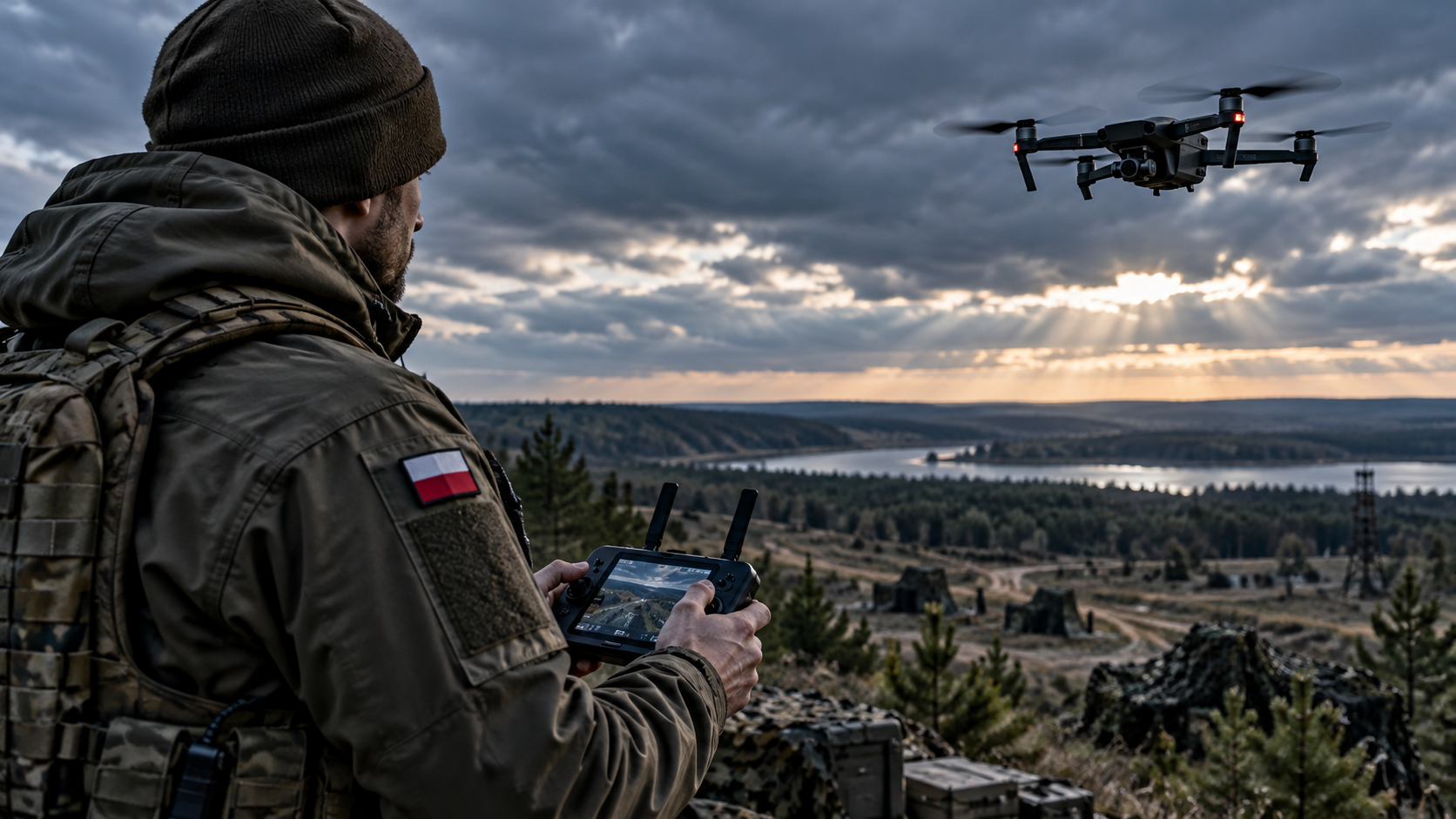
Poland plans to establish a civilian “Drone Legion” capable of supporting its armed forces during a future conflict, as Defence Minister Władysław Kosiniak-Kamysz calls for hundreds of thousands of qualified drone operators and says unmanned aircraft should become standard equipment across the military.
The proposed initiative would bring together civilians who already possess drone-operating skills, allowing the armed forces to draw on their expertise when needed.
Kosiniak-Kamysz announced the plans on Wednesday, 14 October, while visiting the 25th Air Cavalry Brigade in Nowy Glinnik, near Tomaszów Mazowiecki in central Poland.
- Find more news from Poland on our Homepage .
The announcement came during Blue Eye 2026, a military exercise demonstrating how small drones can support reconnaissance, ground forces and helicopter operations.
According to the Ministry of National Defence’s official announcement, the minister has instructed the commander responsible for Poland’s unmanned military systems to develop the new initiative.
The programme is intended to support the armed forces rather than form another conventional military unit.
What is Poland’s planned Drone Legion?
The proposed Drone Legion would bring together civilian drone operators with relevant qualifications and experience.
Kosiniak-Kamysz identified civil-defence volunteers, volunteer firefighters and drone enthusiasts among the groups whose skills could help Poland prepare for a crisis.
The minister said the country needed hundreds of thousands of operators, reflecting lessons from Russia’s war against Ukraine.
The proposed organisation would allow civilians to contribute specialist knowledge without necessarily becoming full-time soldiers.
It is intended to follow the model of existing Polish initiatives that connect civilian professionals with national defence.
However, the government has not yet published detailed regulations governing Drone Legion membership.
Questions remain about how participants would register, what additional military training would be required, how their availability would be organised and what responsibilities they would assume during an emergency.
The announcement therefore represents a plan to build a new civilian support capability, rather than confirmation that a large operational force has already been established.
Poland wants drones in every military squad
The Drone Legion proposal is part of a broader effort to integrate unmanned aircraft throughout Poland’s armed forces.
Kosiniak-Kamysz said the military should move towards a model in which every squad has access to drones and every unit can operate them.
The objective reflects the growing importance of inexpensive unmanned systems in contemporary warfare.
In Ukraine, small drones have become central to battlefield reconnaissance, identifying enemy positions and supporting precision attacks.
They have also demonstrated how relatively inexpensive technologies can change the way conventional military formations operate.
Polish defence planners are seeking to apply these lessons while maintaining investment in more traditional military equipment.


The minister’s announcement does not mean that every Polish squad currently has drones. It describes a capability the armed forces are seeking to establish.
More than 560,000 drone operators already in Poland
Poland’s existing civilian drone community could provide an important starting point.
Infrastructure Minister Dariusz Klimczak, who also attended the military event, said the country already had more than 560,000 certified drone operators.
The figure indicates the scale of civilian interest and experience in unmanned aviation.
However, civilian qualifications do not automatically establish the ability to operate military drones or undertake defence-related missions.
Additional training, equipment familiarisation and coordination with military authorities would be required, depending on the eventual responsibilities assigned to participants.
Klimczak said the Civil Aviation Authority and the Polish Air Navigation Services Agency would cooperate with the Defence Ministry on the project.
The participation of civilian aviation institutions is particularly important because the proposed initiative would involve people whose existing qualifications fall under civilian aviation regulations.
No official figure has yet been announced for the number of people expected to enrol in Drone Legion itself.
Drone training planned for 33,000 students
The government is also planning to expand drone education among younger people.
According to Polish Press Agency reporting reproduced by TVP Info, approximately 33,000 students from 500 military-preparation classes are expected to participate in drone training in 2027.
The courses are intended to conclude with examinations administered through Poland’s Civil Aviation Authority.
The initiative would expand the pool of young people with formal experience of operating unmanned aircraft.
It would also connect aviation education with the government’s wider efforts to improve national defence preparedness.
The school programme is a separate training initiative. The announcement does not mean that all participating students would subsequently join Drone Legion or enter military service.
The 25th Air Cavalry Brigade is expected to become a central location for drone training and certification.
Kosiniak-Kamysz said Blue Eye should become a recurring event, allowing soldiers and qualified operators to develop their skills.
Minister outlines billions in drone investment
Alongside the civilian initiative, Kosiniak-Kamysz announced a renewed focus on technologies that have become important in the war in Ukraine.
He said he had ordered an urgent strategic review covering three priorities: drones and counter-drone systems, affordable long-range precision capabilities, and artificial intelligence.
The minister also presented figures indicating a major increase in resources assigned to unmanned and counter-unmanned systems.
According to the Defence Ministry’s account of his remarks, PLN 100 million was allocated to drone and counter-drone capabilities in 2023, compared with PLN 26 billion earmarked for investment in those capabilities in 2026.
These are figures presented by the minister. The announcement does not provide a detailed breakdown of spending, the contractual status of individual projects or the amount already disbursed.
Nor does the PLN 26 billion figure represent a disclosed budget for Drone Legion itself.
The broader investment programme includes military equipment and capabilities separate from the proposed civilian organisation.
Blue Eye 2026 demonstrates military drone operations
The announcement took place during one of Poland’s larger military exercises devoted to small unmanned aircraft.
Blue Eye 2026 brought together almost 40 military units and institutions, according to contemporary Polish reporting, alongside representatives of the defence industry.
Participants included Poland’s state-owned defence group PGZ and private companies developing unmanned systems.
Approximately 100 drones were used in the training activities.
The exercise involved reconnaissance aircraft identifying targets and passing information to military units.
Other scenarios demonstrated coordination between unmanned systems, ground personnel and helicopters.
The Defence Ministry said the exercise placed particular emphasis on integrating drones with AW149 military helicopters.
The objective was to improve coordination between aerial reconnaissance, command structures and personnel operating on the ground.
Kosiniak-Kamysz also highlighted the development of military drone laboratories, where soldiers and engineers modify, test and adapt unmanned systems.
The ministry said these facilities are intended to help Polish forces respond more rapidly to technological developments.
Modelled on Poland’s existing specialist legions
The proposed Drone Legion would follow the model of two existing initiatives: Cyber Legion and Medical Legion.
These programmes connect the military with civilian specialists in fields considered essential to national security.
Cyber Legion draws on the skills of people working in information technology and cybersecurity.
The Medical Legion provides a framework for cooperation with healthcare professionals, including doctors, nurses, paramedics and other specialists.
During Wednesday’s announcement, Kosiniak-Kamysz said almost 3,000 people were already involved in Cyber Legion.
The Defence Ministry reported in April 2026 that approximately 1,000 people had registered an interest in its medical initiative, including around 800 healthcare professionals.
These programmes offer a precedent for involving civilians in specialised defence preparations.
The proposed Drone Legion would extend that approach into unmanned aviation.
However, the operational requirements and legal framework for the new initiative have not yet been fully explained.
Why Poland is expanding drone capabilities
Poland’s emphasis on drones reflects the security environment facing NATO countries on the alliance’s eastern flank.
The continuing war in Ukraine has demonstrated the extensive use of unmanned systems for surveillance, precision attacks and battlefield support.
Poland has also experienced direct security incidents involving unmanned aircraft.
In September 2025, Russian drones violated Polish airspace during attacks on Ukraine, prompting a Polish and allied military response.
The Defence Ministry described those violations as an unprecedented threat to the country’s security.
Although the new Drone Legion is not presented as a response to a single incident, it fits into Poland’s wider efforts to strengthen military readiness and adapt to emerging threats.
The programme also reflects a shift towards using civilian technological expertise as part of national defence preparation.
What happens next?
The immediate task for the Defence Ministry is to turn the Drone Legion announcement into a functioning programme.
That will require decisions about eligibility, recruitment, training, certification and cooperation between civilian participants and military authorities.
No confirmed launch date or membership target has been published.
The government has also not explained whether participants would receive additional equipment, compensation or formal military status.
For now, the initiative represents an ambition to create a much larger pool of people able to support Poland’s armed forces with unmanned technologies.
Its significance lies in the scale of the skills base the government wants to develop.
While Poland continues purchasing new military equipment, the Defence Ministry is increasingly emphasising that sophisticated weapons must be matched by people capable of operating them.
The proposed Drone Legion is intended to connect those two priorities, drawing on civilian expertise to strengthen Poland’s preparedness for future security challenges.