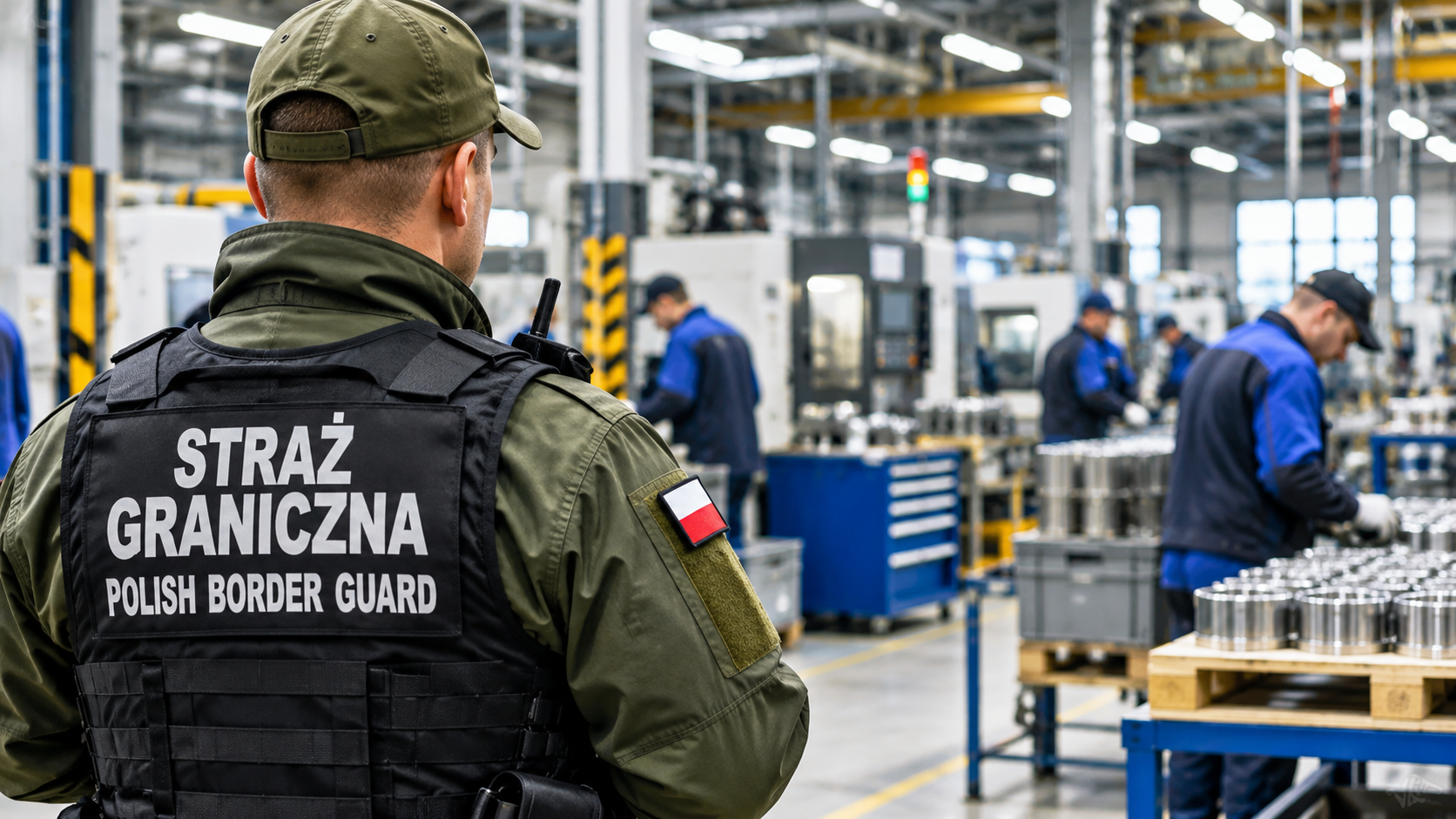
Poland’s Border Guard has identified more than 700 foreign nationals working illegally during inspections in the north-eastern Warmia and Masuria region, according to new figures covering January to October 2026. Officers examined the employment of nearly 2,900 foreign workers, while courts imposed a total of PLN 245,000 in fines on employers found to have breached the regulations.
The figures were released by the Warmińsko-Mazurski Border Guard unit on Monday, 16 November, alongside details of a recently completed workplace inspection in Kętrzyn County.
The findings highlight the role of workplace inspections in Poland’s immigration enforcement system, particularly when companies and recruitment agencies employ foreign nationals under conditions that do not comply with their work authorisations.
- Find more news from Poland on our Homepage .
According to the Border Guard’s official announcement, officers established that more than 700 of the nearly 2,900 foreign nationals checked between January and the end of October were working unlawfully.
The figures apply to inspections carried out by this regional Border Guard unit, not to Poland as a whole.
Thirty-three workers identified in latest inspection
The latest completed operation was conducted by Border Guard officers stationed in Barciany, a town near Poland’s border with Russia’s Kaliningrad region.
Investigators examined the employment arrangements of foreign nationals working at a production facility in Kętrzyn County.
They established that an employment agency based in Łódź, central Poland, had supplied 33 foreign workers to the facility.
The group comprised 28 Ukrainian nationals and five Vietnamese nationals.
According to the Border Guard, the workers were performing different jobs or working under different conditions from those specified in their work permits.
Such discrepancies can constitute unlawful employment even when a foreign national possesses documents permitting them to work in Poland under particular conditions.
The authority did not identify the agency or the production facility, nor did it disclose whether individual penalties had already been imposed in connection with this specific inspection.
The announcement also did not report that the 33 workers had been detained, deported or found to be residing in Poland illegally.
Recruitment agencies and construction among main areas of concern
The regional Border Guard’s figures identify recruitment agencies, construction companies, manufacturing facilities and catering businesses among the main areas where employment irregularities were detected.
According to the authority’s breakdown, employment intermediaries accounted for 25% of the reported cases involving foreign nationals supplied for work without the required documents.
Construction accounted for 22%, manufacturing for 18% and the catering sector for 13%.
The figures illustrate how irregular employment can arise through several different arrangements, including companies directly hiring foreign workers and agencies supplying employees to other businesses.
They also demonstrate why inspections are not limited to checking whether an individual has permission to enter or remain in Poland.
Authorities may examine whether the employer, job position and working conditions comply with the documentation under which the foreign national is authorised to work.
Most irregularities detected in several northern counties
The Border Guard also provided a geographical breakdown of employment irregularities identified during the ten-month period.


Kętrzyn, Ełk and Ostróda counties each accounted for 13% of the reported irregularities.
Gołdap County accounted for 10%, followed by Olsztyn County at 9%, Lidzbark County at 8% and Olecko County at 7%.
Giżycko, Iława and Mrągowo counties each accounted for 5%.
These percentages describe the distribution of detected irregularities across the regional inspection results. They do not establish the proportion of all foreign workers employed unlawfully in each county.
The November figures also provide an update on the unit’s earlier enforcement results.
In a July report covering the first six months of 2026, the same Border Guard unit said it had identified nearly 500 foreign nationals working in breach of employment regulations.
By the end of October, the reported ten-month total had exceeded 700.
Courts impose PLN 245,000 in employer fines
The Border Guard said courts in Warmia and Masuria had imposed fines totalling PLN 245,000 on businesses covered by the employment inspections.
The authority also warned that companies illegally employing foreign nationals could face fines of up to PLN 50,000.
The combined fines relate to the regional enforcement results, rather than exclusively to the recently completed Kętrzyn County case.
Polish employment rules require employers to ensure that foreign nationals have the appropriate right to work and that their actual employment complies with the relevant authorisation.
The National Labour Inspectorate’s guidance on legal employment explains that permission to work and permission to reside are related but separate requirements for non-EU nationals, subject to applicable exemptions.
A person can therefore hold a lawful residence status while still being employed in circumstances that breach employment regulations.
The Border Guard statement did not provide a breakdown of the residence status of the more than 700 workers or specify how many cases resulted in separate immigration proceedings.
Workplace enforcement beyond Poland’s borders
Poland’s Border Guard is widely associated with checking travellers at border crossings, combating people-smuggling and enforcing immigration decisions.
However, officers also conduct inspections inside the country to establish whether foreign nationals are working in accordance with Polish law.
Such inspections can involve examining work permits, employer records, recruitment arrangements and the conditions under which employees perform their duties.
The latest figures demonstrate the scale of irregularities identified during one regional unit’s inspections over ten months.
They do not represent a nationwide total or a statistically representative estimate of illegal employment among Poland’s entire foreign workforce.
For the businesses involved, the consequences can include financial penalties and further administrative or legal proceedings.
The Border Guard has not announced the outcome of any subsequent proceedings arising from the latest 33-worker inspection.