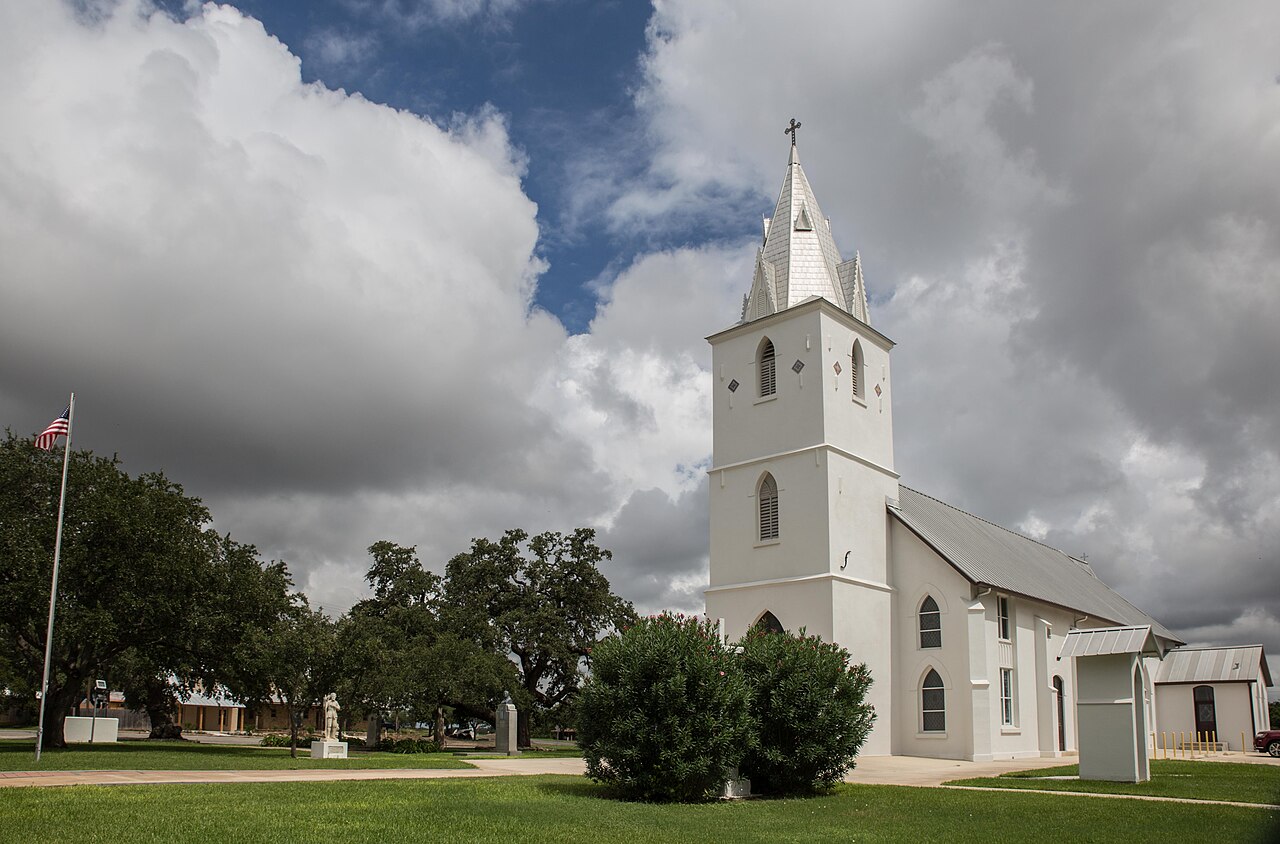
In a quiet corner of Texas, a white church stands beside an old oak tree. The setting may look like an ordinary rural American community, but it marks one of the most important places in Polish-American history.
On 24 December 1854, immigrants from Upper Silesia established Panna Maria, a settlement now recognised as the oldest permanent Polish community in the United States.
Their journey had taken them thousands of miles from their homeland, across the Atlantic Ocean and through the unfamiliar landscape of nineteenth-century Texas.
- Find more news from Poland on our Homepage .
According to local tradition, the settlers gathered beneath an oak tree to celebrate Mass and give thanks for reaching their new home.
More than 170 years later, the tree still stands beside the historic Immaculate Conception Church, while the surrounding community preserves the story of the people who made the extraordinary journey.
As Polish American Heritage Month is celebrated throughout October, Panna Maria offers a reminder that the Polish presence in America reaches far beyond the country’s best-known immigrant neighbourhoods.
Leaving Upper Silesia for a new life
The story begins in Upper Silesia, a region in Central Europe with a long history of Polish language and culture.
In the mid-nineteenth century, the area was part of the Kingdom of Prussia. Poland did not exist as an independent state, having been partitioned by neighbouring powers.
Many families faced difficult economic conditions and limited opportunities.
Among those looking towards a different future was Father Leopold Moczygemba, a Franciscan missionary from Upper Silesia who had arrived in Texas in 1852.
He was working among German-speaking Catholic communities when he began encouraging families from his home region to consider settling in America.
Texas offered the prospect of agricultural land and an opportunity to establish a community while maintaining their religious and cultural traditions.
The priest’s invitations inspired a migration that would eventually reshape parts of southern Texas.
In September 1854, the first group of emigrants began their journey from Upper Silesia.
They travelled towards the German port of Bremen, where they boarded ships bound for the United States.
For families accustomed to rural life in Central Europe, the journey was an enormous undertaking.
They were leaving behind familiar villages, relatives and landscapes without knowing precisely what awaited them across the ocean.
Nine weeks at sea and a difficult journey inland
The Polish Heritage Center at Panna Maria records that approximately 150 emigrants formed the initial travelling group.
Their Atlantic crossing lasted around nine weeks.
Conditions aboard the ships were difficult, with passengers spending much of the voyage in cramped accommodation between decks.

On 3 December 1854, the first group reached Galveston on the Texas coast.
But their journey was far from over.
From Galveston, they travelled by coastal vessel towards Indianola before beginning the long journey inland.
Much of the remaining distance was covered on foot, with hired ox carts carrying belongings and supplies.
The immigrants eventually reached San Antonio on 21 December, where Father Moczygemba met them.
He then accompanied them to the land selected for their settlement near the San Antonio River and Cibolo Creek.
The journey had taken approximately three months from their departure from Europe.
Contemporary accounts differ over the total number of original settlers, partly because the migration developed through successive groups and some travellers established themselves elsewhere.
What is clear is that the movement brought families from Upper Silesia to a region where they began building a permanent Polish community.
Christmas Eve beneath an oak tree
Panna Maria traces its founding to Christmas Eve, 24 December 1854.
According to the community’s historical tradition, the settlers gathered beneath a large live oak tree, where Father Moczygemba celebrated a Mass of thanksgiving.
The tree became a lasting symbol of their arrival.
The settlement was named Panna Maria, Polish for the Virgin Mary, reflecting the community’s Catholic faith.
The location developed into a centre of Polish religious and community life in Texas.
A first church building was constructed in 1855.
The original church was later destroyed by lightning, and the present Immaculate Conception Church was completed in 1877.
With its white exterior and prominent tower, the church remains one of the most recognisable landmarks of historic Panna Maria.
The famous oak tree still stands nearby.
In 1976, Father Moczygemba’s remains were reinterred close to the tree, connecting the founder of the settlement once again with the place where the immigrants’ American story began.
The hardships behind the settlement’s survival
Panna Maria’s survival was far from guaranteed.
The newcomers encountered a climate, landscape and agricultural environment very different from those they had known in Upper Silesia.
Their first years were marked by serious difficulties, including drought, disease, crop failures and disputes over land.
Some families became disillusioned and moved elsewhere in Texas.
Even Father Moczygemba eventually left the region after disagreements within the settlement.
Yet the community endured.
Families established farms, built homes and created institutions that supported religious life and education.
Further immigration from Upper Silesia helped strengthen the Polish presence across southern Texas.
Settlers and their descendants contributed to the development of other communities, including St Hedwig, Bandera and Cestohowa.
Panna Maria became an important starting point in the history of Polish-American settlement in the region.
A living piece of Polish-American history
Today, Panna Maria’s heritage is preserved through its church, historic buildings and the work of local organisations.
The Panna Maria Historic District includes surviving nineteenth-century structures, among them former homes, stores and the historic St Joseph School building.
The Panna Maria Historical Society, founded in 1966, has worked to preserve buildings, historical records and family histories.
The nearby Polish Heritage Center tells the story of the original immigrants and the generations that followed.
Its exhibits connect the settlement’s history with the wider story of Poland and Polish migration to the United States.
For descendants of the settlers, these records and buildings provide a tangible connection with the villages their ancestors left behind.
The community also occupies a distinctive place in American history.
Polish people had reached North America long before 1854, including craftsmen associated with the Jamestown settlement in Virginia in 1608.
Panna Maria’s claim is therefore not that it was the first place in America where Polish people arrived.
Its distinction lies in becoming the oldest permanent Polish settlement in the United States.
That difference matters.
Earlier arrivals helped establish a Polish presence in America, but Panna Maria developed into a lasting community whose institutions, descendants and heritage remain visible today.
The legacy of Panna Maria
More than a century and a half after its founding, Panna Maria continues to connect two countries separated by an ocean.
The families who travelled from Upper Silesia in 1854 could not have known how widely Polish-American communities would eventually spread across the United States.
Their settlement became part of a much larger history of migration, family life and cultural preservation.
Today, the church, the historic buildings and the oak tree offer a connection to that beginning.
In a small Texas community, the story of Polish America is still remembered at the place where immigrants gathered in 1854 and began building a permanent home.
And every Christmas Eve, the anniversary recalls an extraordinary journey that helped establish a lasting chapter of Polish-American history.