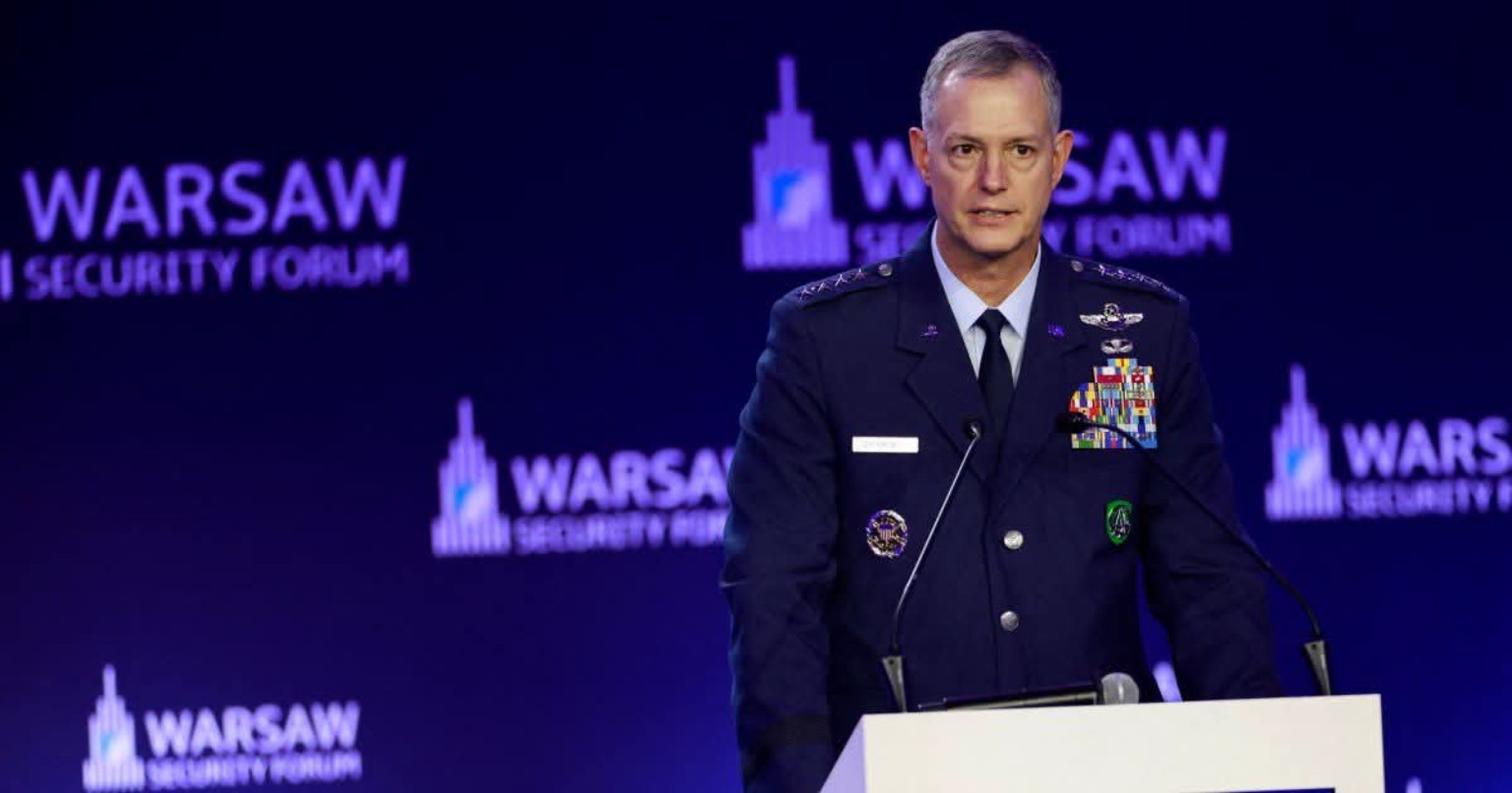
NATO’s top military commander has publicly outlined how the alliance would respond to an attack on its territory, presenting a three-stage defence concept in Warsaw designed to stop an invasion, destroy the attacking forces’ ability to continue fighting and avoid unnecessarily escalating the conflict.
US Air Force General Alexus Grynkewich, NATO’s Supreme Allied Commander Europe (SACEUR), presented his Theory of Victory at the Warsaw Security Forum on Monday, 12 October.
The approach, summarised in three words — block, blunt and break — sets out how NATO intends to prevent an adversary from capturing allied territory and, if necessary, dismantle the military system supporting an invasion.
- Find more news from Poland on our Homepage .
Grynkewich said the alliance’s objective was to ensure that any attack on a member state would prove “utterly futile”.
Although he did not explicitly name Russia during his address, his remarks came amid mounting tensions between Moscow and European NATO members. The alliance’s 2022 Strategic Concept identifies Russia as its most significant and direct security threat.
Block, blunt and break: NATO’s three-stage approach
The first stage, block, would involve stopping an invasion before attacking forces could establish control over allied territory.
NATO ground troops, particularly those positioned along the alliance’s eastern flank, would seek to prevent an adversary from achieving a rapid breakthrough or presenting allied governments with territory already captured.
Air and naval forces, supported by capabilities in space and cyberspace, would work to establish freedom of manoeuvre and enable a coordinated military response.
The second stage, blunt, would focus on weakening any continuing offensive and preventing the attacking forces from maintaining momentum.
Grynkewich described how advanced sensors, drones, precision weapons and operations coordinated across different military domains could help NATO detect threats, identify targets and disrupt advancing formations.
If the aggressor continued its offensive or committed additional forces, NATO would move to the final stage: break.
This would involve attacking not only the invading formations but also the logistical, communications and command systems that enabled them to continue fighting.
As Stars and Stripes reported from the presentation, the concept envisages sustained military pressure intended to leave enemy forces without adequate supplies, reinforcements or effective command.
The objective would be to make continued offensive operations impossible.
Defeating an attack without pursuing a wider war
A central feature of Grynkewich’s presentation was the distinction between defeating an invading force and seeking the broader strategic defeat of an adversary.
He said NATO’s objective would be to stop aggression against allied territory, rather than pursue unlimited military objectives beyond that defensive purpose.
The general argued that demonstrating NATO’s capacity to defeat an attack decisively could discourage an opponent from initiating a conflict in the first place.
The strategy nevertheless envisages operations against military systems supporting an invasion, potentially extending beyond the immediate area of fighting.
Grynkewich maintained that such actions would serve the specific purpose of ending the attack, while emphasising that NATO was a defensive alliance.
His explanation also reflected the challenge facing allied military planners: ensuring that a response is sufficiently powerful to repel an invasion without creating unnecessary incentives for a broader confrontation.

What is actually new about NATO’s strategy?
The Warsaw presentation marked the public explanation of a military concept that had previously been developed within NATO.
According to specialist defence reporting accompanying the recorded speech, Grynkewich distinguished his Theory of Victory from an operational military plan.
He described it as a common vision for how allied forces should prepare to deter and defeat aggression, building on NATO’s existing Deterrence and Defence of the Euro-Atlantic Area framework.
NATO had already approved a new generation of regional defence plans at its 2023 Vilnius summit, strengthening arrangements for defending member states and reinforcing threatened regions.
The Warsaw address therefore did not constitute the publication of NATO’s classified operational plans or, on the available evidence, a new decision to deploy forces.
Instead, it offered a clearer public explanation of how the alliance’s senior military commander envisages achieving victory in a defensive conflict.
Grynkewich also identified long-range precision weapons, extensive sensor networks and interconnected battlefield information systems as important areas for investment and military preparation.
Why the announcement matters for Poland
Poland occupies a particularly important position in NATO’s eastern defence arrangements, bordering Ukraine, Belarus and Russia’s Kaliningrad exclave.
Any serious military confrontation along this part of the alliance’s territory would place particular importance on the readiness of forward-deployed forces, rapid reinforcement and coordination between allied militaries.
Grynkewich praised Poland’s defence investment, military modernisation and efforts to expand its defence industry during his Warsaw appearance.
His presentation also came as European governments raised concerns about suspected Russian sabotage operations, drone incursions and cyberattacks.
The general acknowledged anxiety among allied populations but sought to reassure them that NATO possessed the military capability and collective commitment necessary to defend its territory.
He also pointed to the presence of American troops in Poland and elsewhere on the eastern flank when addressing concerns about Washington’s continued commitment to European security.
NATO says conflict is not inevitable
Despite the emphasis on military readiness, Grynkewich explicitly rejected the suggestion that war was unavoidable.
“I do not assess that conflict is imminent or inevitable. It isn’t,” he said.
His central argument was that NATO could reduce the danger of conflict by clearly communicating its defensive intentions while demonstrating that an attack would fail.
That message is consistent with the alliance’s longstanding principle of collective defence under Article 5 of the North Atlantic Treaty, which obliges members to assist an ally subjected to an armed attack.
For Poland and other countries on NATO’s eastern flank, the significance of the Warsaw presentation lies in the practical military question behind that commitment: how the alliance would prevent an aggressor from achieving its objectives if deterrence failed.
Grynkewich’s answer was that NATO must be capable of stopping an attack immediately, preventing its continuation and ultimately rendering the attacking force unable to fight.