

On 28 September 1939, while Polish soldiers were still fighting both German and Soviet forces, Joachim von Ribbentrop and Vyacheslav Molotov signed an agreement in Moscow that redrew the division of occupied Poland.
The German-Soviet Boundary and Friendship Treaty came little more than a month after the better-known Molotov-Ribbentrop Pact. It was not simply a restatement of the August agreement. Germany and the Soviet Union altered the territorial settlement they had secretly envisaged before the invasion, established a new dividing line across Polish territory and agreed that each would suppress Polish activity directed against the other occupier.
The timing was striking. Warsaw formally capitulated on 28 September, but the Polish campaign was not over. Modlin Fortress held out until the following day, Hel until 2 October, and organised Polish resistance continued until the fighting around Kock ended in early October. Germany and the Soviet Union were therefore determining the political geography of occupied Poland while Polish troops were still in the field.
- Find more news from Poland on our Homepage .
From the Molotov-Ribbentrop Pact to two invasions
The arrangement had begun on 23 August 1939, when Nazi Germany and the Soviet Union signed their non-aggression pact in Moscow.
The public treaty committed each state not to attack the other. A secret protocol went considerably further, allocating areas of Eastern Europe to German and Soviet spheres of interest. In the case of Poland, the proposed division broadly followed the Narew, Vistula and San rivers. Lithuania was initially placed largely within the German sphere, while Finland, Estonia and Latvia were assigned to the Soviet sphere.
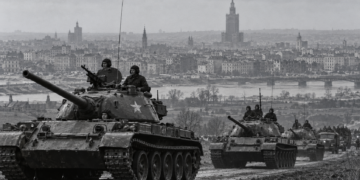
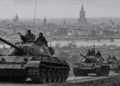
Nine days later, Germany invaded Poland from the west on 1 September, beginning the Second World War in Europe. Britain and France declared war on Germany on 3 September. On 17 September, the Red Army crossed Poland’s eastern frontier as Polish forces were already engaged in the struggle against Germany.
The August protocol had divided prospective spheres of influence. The military situation created by the two invasions now required Berlin and Moscow to decide where their forces and administrations would actually meet.
Ribbentrop therefore returned to Moscow at the end of September for another round of negotiations with the Soviet leadership.
A new border across occupied Poland
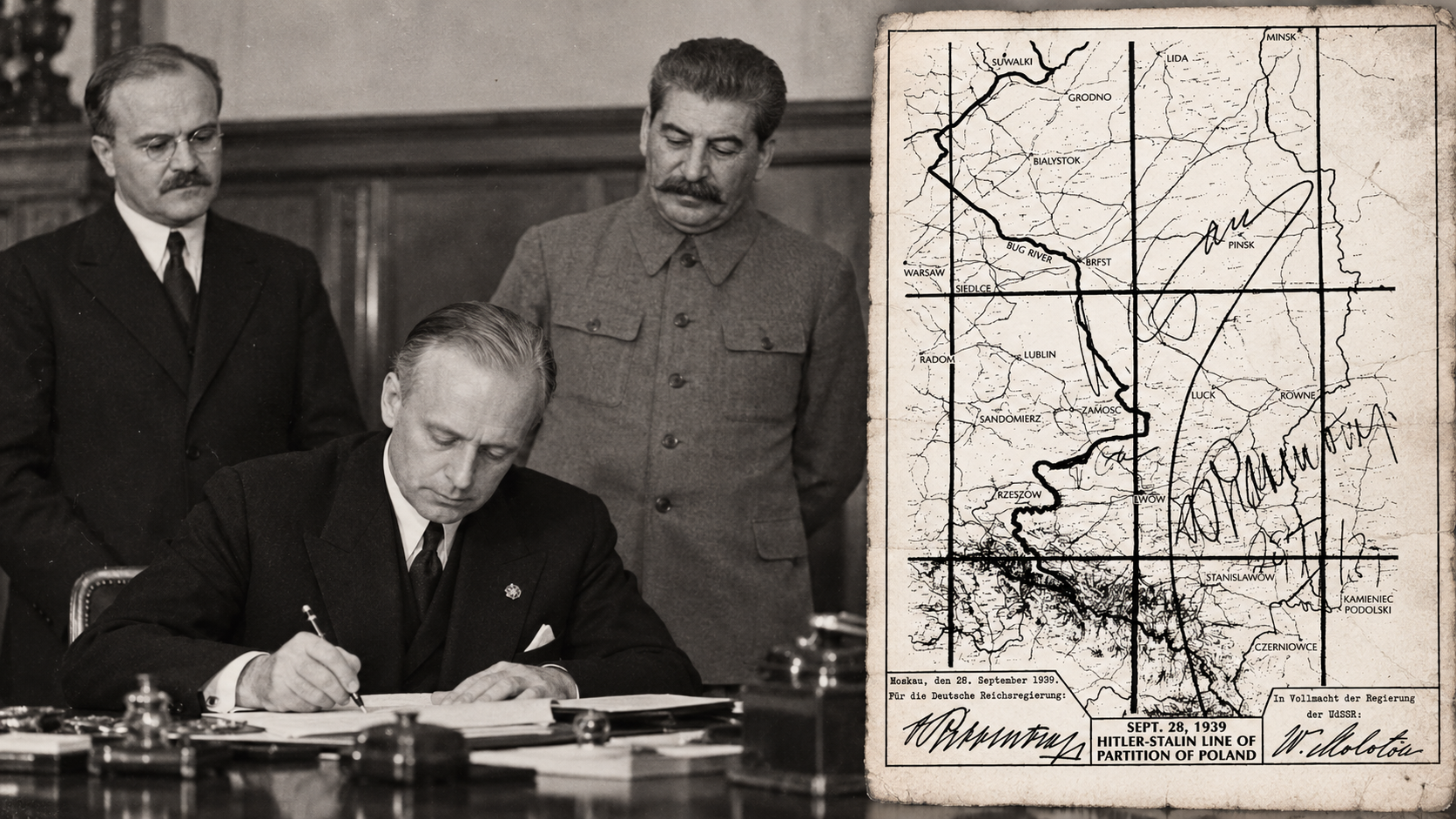
The treaty signed on 28 September declared that Germany and the Soviet Union had established the boundary of their respective interests in what the document called the “former Polish state”. Each power was to reorganise administration on its own side of the line, and the two governments said they would reject outside interference with the settlement.
The new line differed significantly from the one envisaged on 23 August.
According to the Institute of National Remembrance, it ran along the Pisa and Narew rivers before turning towards the Bug around the Treblinka area and then continuing south towards the San. The adjustment shifted part of the planned division eastwards. The Soviet Union relinquished territory in parts of the pre-war Warsaw and Lublin provinces that had fallen within its earlier sphere.
In exchange, a secret supplementary protocol transferred Lithuania into the Soviet sphere of influence, apart from a small area envisaged for Germany. The same document explicitly stated that Lublin province and parts of Warsaw province would fall within the German sphere.
That change mattered far beyond Poland. Soviet pressure on Lithuania followed in the months ahead, although Lithuania was not annexed by the Soviet Union in September 1939 itself. Soviet occupation and incorporation of Lithuania would come in 1940.
The map attached to the 28 September agreement made the territorial bargain unusually tangible. The surviving document shows the new line drawn through Poland and bears the signatures of Joseph Stalin and Ribbentrop.
A secret agreement to suppress Polish activity
Territory was only one part of the settlement.
Another secret supplementary protocol dealt directly with Polish opposition to the occupation. Germany and the Soviet Union agreed that neither would tolerate Polish political activity on its territory if it affected the other side. Each would suppress such activity and exchange information about the measures it had taken.
The provision is significant because it shows that the September agreement went beyond simply drawing a line on a map. Both occupying powers anticipated the continued existence of Polish resistance and formally committed themselves to acting against it within their respective zones.
That resistance was already beginning. On 27 September, even before the Moscow treaty was signed, the clandestine Service for Poland’s Victory was established in Warsaw, one of the first central organisations of what developed into the Polish Underground State.
The treaty’s language, meanwhile, treated Poland as if its statehood had already disappeared. Legally and diplomatically, that was not the case.
Poland was occupied — but the Polish state continued
The wording used by Berlin and Moscow referred to the collapse of the “former Polish state”. Neither occupying power, however, had the authority to abolish Poland’s international legal existence by bilateral agreement.
Polish constitutional authorities were re-established abroad. On 30 September, Władysław Raczkiewicz became president and General Władysław Sikorski headed a new government in France. France and Britain recognised it as the sovereign representation of the Polish state, and Polish diplomatic missions and armed forces continued to operate alongside the Allies.
The distinction is important. By the beginning of October, virtually all Polish territory had been conquered and divided between two occupying powers, but Poland had not legally surrendered as a state.
German and Soviet rule also developed into different occupation systems, and they should not be treated as interchangeable.
In the west and centre, Nazi Germany directly annexed substantial Polish territories. The remaining German-controlled area, including Warsaw, Kraków, Radom and Lublin, became the General Government under German civilian occupation authorities from October 1939. German policy combined racial persecution, mass repression, forced displacement and exploitation; during the subsequent occupation, German-occupied Poland also became the principal geographical setting for the Nazi murder of European Jews.
In the east, the Soviet authorities organised controlled political processes before formally incorporating most of the territories they had seized into the Belarusian and Ukrainian Soviet republics in November 1939. Soviet rule brought the destruction of pre-war Polish institutions, nationalisation, arrests, deportations, executions and other forms of political repression by the Soviet state and the NKVD.
These policies affected a population that was far from ethnically homogeneous. Pre-war eastern Poland was home to millions of Poles, Ukrainians, Belarusians and Jews, as well as other communities. The consequences of the partition therefore cannot be understood simply as one nation being divided geographically; different populations were subjected to radically changing borders, citizenship regimes and occupation policies.
A partition that did not settle Poland’s future
The 28 September agreement was presented by Germany and the Soviet Union as a definitive settlement.
In a separate declaration signed the same day, the two governments claimed that the “Polish problem” had been settled and called for an end to the war between Germany and Britain and France. They warned that if the Western powers continued fighting, Berlin and Moscow would consult on further measures.
That supposed permanence lasted less than two years.
On 22 June 1941, Nazi Germany invaded the Soviet Union. German forces crossed the very boundary the two dictatorships had negotiated in 1939 and occupied the eastern Polish territories previously controlled by Moscow.
The map agreed on 28 September 1939 therefore did not determine Poland’s eventual post-war borders. Its historical importance lies elsewhere.
It shows how, after invading Poland from opposite directions, Nazi Germany and the Soviet Union moved from a secret pre-war understanding to the practical division and administration of conquered Polish territory. The Molotov-Ribbentrop Pact of 23 August prepared the ground. The treaty of 28 September adjusted the bargain to the reality created by invasion — while Polish soldiers were still fighting and the Polish state was already preparing to continue the war from abroad.