Israeli police have arrested ten suspects following a series of violent attacks in the occupied West Bank, including an assault on a European diplomatic delegation involving Polish representatives.
The arrests were announced on Monday, 19 October, after a pre-dawn operation involving Israeli police, military personnel and the Shin Bet domestic security service.
The investigation covers several incidents over the weekend, including Saturday’s attack on Polish, French and Belgian diplomats near the Palestinian town of Taybeh, as well as a separate assault on an American photojournalist.
- Find more news from Poland on our Homepage .
In an official announcement published on Monday, Israeli police confirmed that ten suspects had been detained during an operation called Olive Leaf.
Police said evidence linking suspects to alleged offences had been recovered and several vehicles seized.
The authorities have not identified which of the ten detainees, if any, were directly involved in the attack on the European diplomats.
The arrests represent the first major reported law-enforcement development following demands for accountability from Poland, France, Belgium, the European Union and the United States.
Israeli police launch operation after weekend violence
The operation was conducted before dawn on Monday in several locations in the central West Bank.
According to the Israeli police announcement, officers from the Judea and Samaria District worked alongside Border Police personnel, the Israeli military and Shin Bet.
The investigation concerns suspected involvement in violent incidents, breaches of military orders restricting access to particular areas and other alleged offences.
The police said investigators recovered evidence potentially connecting suspects to the incidents and confiscated several vehicles.
Israeli Police Commissioner Daniel Levy said officers were committed to applying the law impartially, regardless of a suspect’s identity or affiliation.
He emphasised that investigations would be conducted according to the available evidence and applicable law.
West Bank district commander Moshe Finchi said investigators were gathering evidence and witness testimony to establish the circumstances and determine who could be held criminally responsible.
The Reuters report published on Monday confirmed that the suspects had been taken into custody for questioning.
Israeli Army Radio reported that they were Israeli citizens.
An earlier police update referred to eight arrests. The later official announcement increased the number to ten.
The authorities have not publicly identified the suspects or provided a breakdown linking individual detainees to particular incidents.
No confirmed criminal charges or convictions arising from Monday’s arrests have been established in the reporting reviewed.
Polish diplomats caught in attack near Taybeh
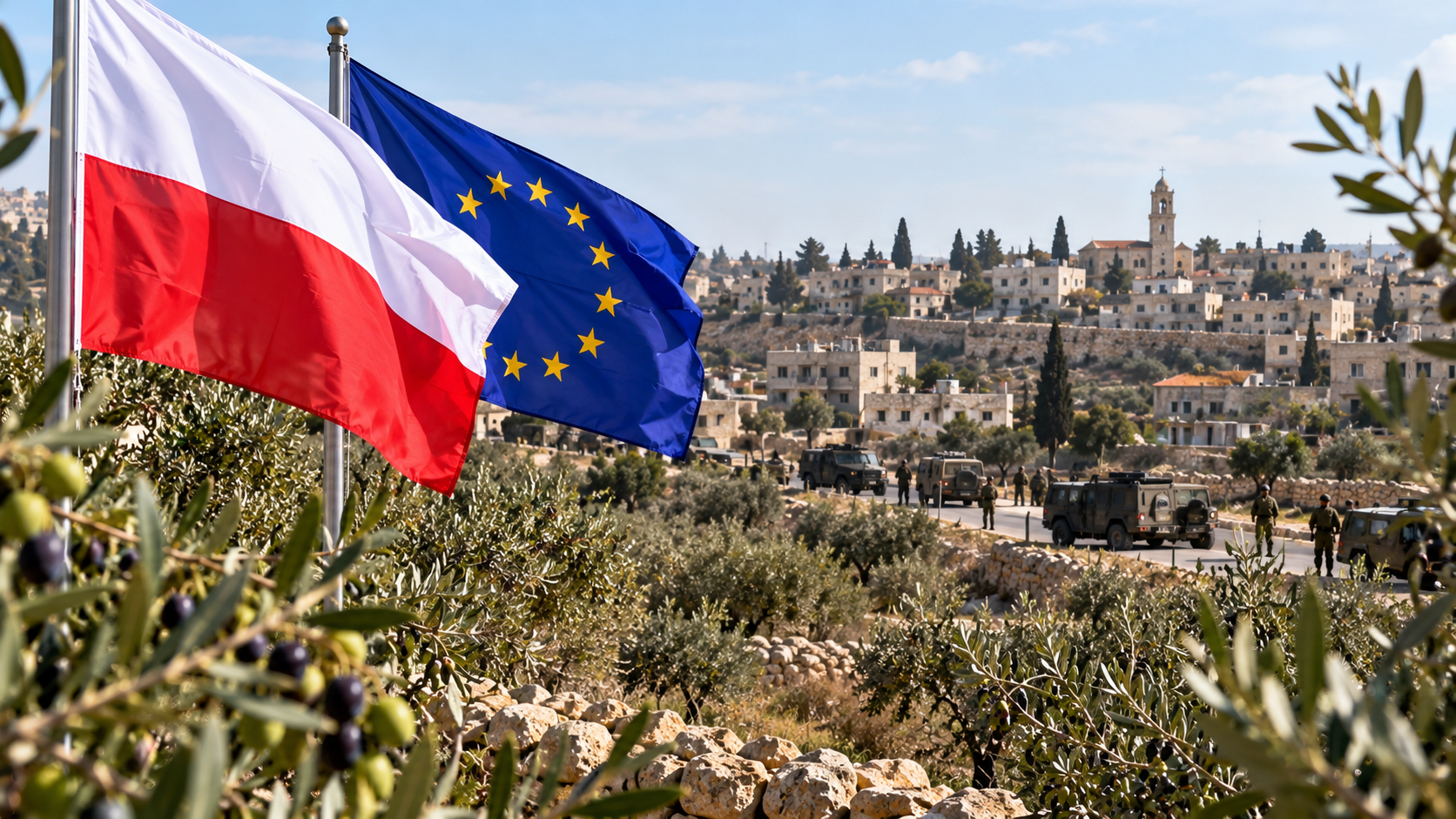
The investigation follows an assault on a European delegation visiting the predominantly Christian Palestinian town of Taybeh on Saturday, 17 October.
You May Also Be Interested In


The group included Polish, French and Belgian diplomatic representatives, Catholic Church figures and Bernard Baudoux, the mayor of Aulnoye-Aymeries in northern France.
The delegation was visiting the area during the Palestinian olive harvest, when masked men confronted and attacked members of the group.
According to Associated Press reporting on the incident, some of the attackers carried metal bars.
Baudoux was physically assaulted, while a vehicle belonging to the Belgian diplomatic mission was damaged.
Poland’s Foreign Ministry confirmed that Polish personnel had been present but had escaped injury.
Warsaw condemned the attack and demanded that Israeli authorities establish the circumstances and hold those responsible accountable.
The incident raised concerns about the safety of diplomatic personnel and other international representatives visiting occupied Palestinian territory.
Poland demands firm Israeli response
Poland’s Foreign Ministry issued a formal statement on 18 October, condemning the attack by masked settlers in Taybeh.
The ministry said the incident demonstrated the violence faced by Palestinian residents and called on Israel to take firm action.
Warsaw also expressed support for the positions adopted by the foreign ministers of France and Belgium.
The Polish statement urged an end to the escalation of violence in the West Bank and respect for international law.
Monday’s arrests constitute a concrete Israeli law-enforcement response to the wider violence.
However, the arrests do not yet establish that Israel has fulfilled all the requests for explanations and accountability made by Poland.
No separate, detailed Israeli diplomatic response specifically addressing Warsaw’s complaint has been verified in the official material reviewed.
European Union also demands accountability
The European Union joined the diplomatic response on Sunday, condemning attacks by violent settlers, including those involving European representatives.
In its official statement on 18 October, the European External Action Service said it expected full accountability and effective measures to prevent further attacks.
Brussels acknowledged that several Israeli officials had condemned the violence but insisted that practical steps were necessary to protect Palestinian civilians, journalists and diplomatic personnel.
The EU’s condemnation followed the initial demands from Poland and other affected countries.
Monday’s arrests are therefore an important development in an incident that has already become a wider European diplomatic concern.
However, the EU has not announced new sanctions specifically in response to Saturday’s attack.
Belgium has separately called for stronger European measures against those responsible for settler violence.
Such proposals remain distinct from penalties already adopted by the EU.
American journalist seriously injured in separate attack
The police investigation also covers an attack on American photojournalist Heidi Levine on Friday, 16 October.
Levine, who was covering the Palestinian olive harvest near Abu Falah, was assaulted by masked men.
The attack left her with serious injuries, including broken bones, and she required hospital treatment and surgery on an injured finger.
According to Associated Press reporting on Monday, Levine was attacked while covering confrontations involving settlers and Palestinian residents.
The incident prompted criticism from US officials.
American Ambassador to Israel Mike Huckabee condemned the violence and called for those responsible to be prosecuted.
Following Monday’s arrests, Huckabee welcomed the development as progress towards identifying and punishing the attackers.
Israeli President Isaac Herzog also condemned the assault on Levine and apologised for what had happened.
The attack on Levine occurred in a different location and on a different day from the assault involving Polish diplomats.
Although both incidents form part of the wider police investigation, they must not be presented as a single attack.
Israeli officials condemn violence as investigation continues
Israeli Foreign Minister Gideon Sa’ar and the Israeli military previously condemned the attack on European diplomats.
Both described the perpetrators as Israeli rioters.
Prime Minister Benjamin Netanyahu took a more cautious position, pointing out that the delegation had entered an area with a history of confrontations without prior military coordination.
He also questioned aspects of the reporting surrounding the assault on Levine.
The subsequent arrests do not determine the legal responsibility of any individual, but they establish that Israeli law-enforcement agencies are actively investigating the incidents.
Human rights organisations have repeatedly raised concerns over the difficulty of securing criminal accountability for violence committed by settlers against Palestinians.
Israeli organisation Yesh Din reported at least 170 settler attacks on Palestinians and others since 27 September, according to Reuters.
That figure represents the organisation’s monitoring rather than a verified tally of completed criminal offences established by Israeli courts.
What happens next?
The immediate focus is now on whether Israeli investigators can connect particular detainees to the attack involving Polish diplomats.
Police must also establish whether the available evidence supports formal charges and whether the suspects will remain in custody.
The outcome could have implications for Israel’s diplomatic relations with Poland and other European countries involved in the incident.
For Warsaw, the central questions remain whether the perpetrators are identified, whether legal proceedings follow and whether measures are introduced to protect diplomatic personnel operating in the area.
The European Union has made clear that public condemnation alone is insufficient and that accountability and prevention are both necessary.
Monday’s arrests represent a significant development, but they are the beginning of a possible legal process rather than its conclusion.