Lithuania has proposed a joint investigation with Poland after an unidentified flying object, believed to be a drone, triggered an airspace emergency on Sunday, 18 October, prompting NATO fighter jets to scramble and residents in parts of the country to seek shelter.
Lithuanian officials said the object appeared to have approached from Polish territory, but Poland’s Defence Ministry said its radar systems had not confirmed a crossing of the Polish-Lithuanian border.
In a significant development later on Sunday, Ukraine’s Foreign Ministry expressed regret over the possibility that Ukrainian drones had entered Lithuanian airspace after being diverted by Russian electronic warfare.
- Find more news from Poland on our Homepage .
The statement raises a potential explanation for the incident but does not establish the identity, origin or exact route of the object under investigation.
Lithuanian military personnel are examining suspected drone debris discovered near the village of Juodžionys, in the northern Pasvalys district. Officials have also reported possible damage to a civilian vehicle.
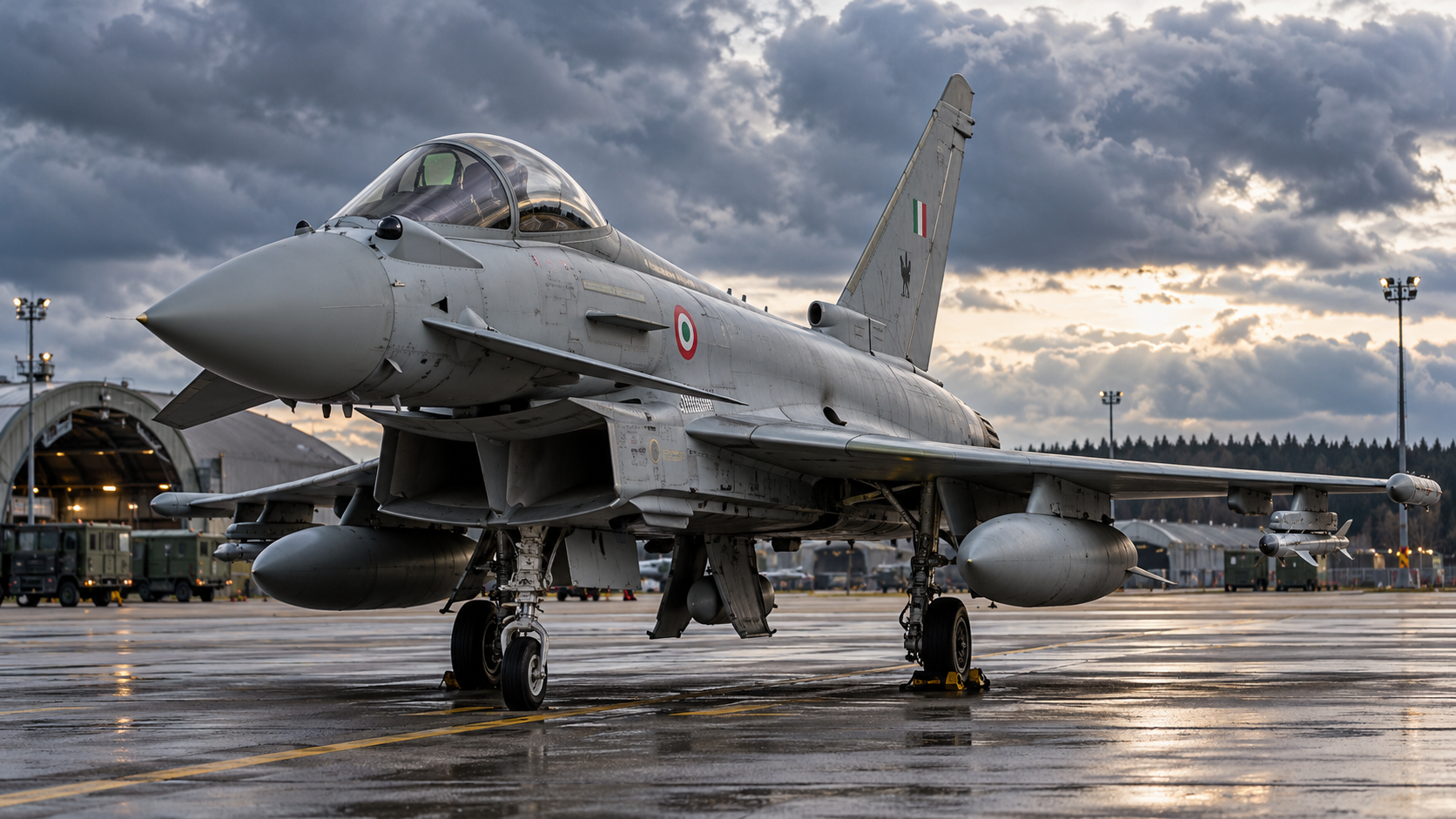
The incident prompted NATO to deploy two Italian Eurofighter jets and led to a temporary suspension of operations at Kaunas Airport.
Ukraine raises possibility of Russian electronic warfare
The Ukrainian Foreign Ministry’s intervention introduces a new dimension to the investigation.
In a statement reported by Reuters on Sunday afternoon, ministry spokesperson Heorhii Tykhyi said Ukraine regretted the disruption and concern caused by the incident.
He suggested that Russian electronic warfare could have diverted Ukrainian drones during operations directed against military targets in Russia.
Kyiv apologised for the possible risks and disruption and said it was prepared to share relevant information with Lithuanian authorities to establish the circumstances.
Russian electronic warfare can interfere with satellite navigation and communications used by unmanned aircraft, potentially causing them to deviate from their intended routes.
However, Ukraine’s statement was conditional. It did not provide a confirmed identification of the object found in Lithuania or establish that Russian interference caused this particular incident.
Determining whether the recovered material belongs to a Ukrainian drone remains a matter for investigators.
Lithuania says object may have approached from Poland
Lithuanian Defence Minister Robertas Kaunas said preliminary information indicated that the unidentified object had entered Lithuania from the direction of Poland.
According to Lithuanian public broadcaster LRT, the minister said Lithuania’s radar systems had detected the object and that the military response began at approximately 6am local time.
A radar track was reported moving northwards from the direction of Polish territory.
But Polish authorities have not independently confirmed that interpretation.
Polish Defence Ministry spokesperson Janusz Sejmej told the Polish Press Agency that Poland’s radar systems did not confirm the object crossing the border into Lithuania.
His comments, reported by Radio ZET, did not rule out continued cooperation with Lithuanian investigators. Polish authorities remained in contact with their counterparts across the border.
Kaunas said he had already contacted Polish Defence Minister Władysław Kosiniak-Kamysz and requested cooperation in a joint investigation.

That confirms a Lithuanian request for cooperation, but the reporting reviewed does not establish that a formal joint investigative team has already been constituted.
Crucially, an object approaching Lithuania from the direction of Poland would not, by itself, establish that the aircraft was launched in Poland or operated by anyone on Polish territory.
NATO scrambles Italian fighter jets
The unidentified aircraft prompted an immediate NATO air-defence response.
A NATO official confirmed to Reuters that two Italian Eurofighter aircraft had been scrambled in response to the drone alert.
The aircraft were operating under NATO command as part of the alliance’s air-defence arrangements.
However, difficult weather conditions prevented their crews from visually identifying the object.
The Lithuanian authorities said cloud cover prevented positive visual identification, and the aircraft did not attempt to shoot it down.
Lithuania’s Defence Minister also explained that peacetime procedures require identification before certain interception decisions can be taken.
The radar contact subsequently disappeared, and the NATO aircraft returned to their base at Šiauliai.
NATO said it remained in close contact with Lithuanian authorities while the investigation continued.
The alliance’s response demonstrates how an unidentified aircraft can activate multinational air-defence systems even when its identity and intentions remain unknown.
Shelter warnings and airport closure
The incident caused disruption across parts of Lithuania on Sunday morning.
The country’s official emergency-warning service records red air alerts for Panevėžys and Šiauliai counties, instructing residents to seek shelter.
A yellow warning was also issued for the Kaunas region, indicating a possible threat requiring preparedness.
The alerts were subsequently withdrawn, with authorities indicating that residents could resume normal activities.
Kaunas Airport, serving Lithuania’s second-largest city, temporarily suspended flight operations while the incident was assessed.
Neighbouring Latvia also issued a precautionary yellow air warning in some regions near Lithuania before withdrawing it.
The Lithuanian government’s emergency response has itself come under scrutiny.
Speaking to LRT, Kaunas questioned why warning messages had initially reached only certain regions, despite radar information suggesting that the object might have travelled across a wider area.
He instructed the military to establish a detailed chronology and examine whether the public-warning system had responded appropriately.
Suspected drone debris found in northern Lithuania
Lithuanian investigators subsequently located material believed to be drone debris near Juodžionys, in the Pasvalys district of northern Lithuania.
The location lies close to the Latvian border, considerably farther north than Lithuania’s border with Poland.
The country’s National Crisis Management Centre said military personnel were investigating the material after the unidentified radar contact disappeared.
Kaunas also reported information indicating that debris may have damaged a civilian vehicle.
Lithuanian authorities have not yet publicly established the full technical characteristics of the object or whether it contained explosives.
Nor has the material been conclusively linked, in the reporting reviewed, to a particular drone model or operator.
The identification of the recovered components will be central to determining what happened.
A growing challenge for NATO’s eastern air defences
The incident comes amid growing concern about unmanned aircraft entering NATO airspace during Russia’s war against Ukraine.
Aircraft can cross international borders deliberately or unintentionally, including after navigation failures or electronic interference.
The Baltic states and Poland have experienced repeated security alerts involving unidentified aircraft and suspected drones.
NATO has responded by strengthening air surveillance, interception capabilities and cooperation between national air-defence systems.
The alliance’s air-defence framework operates continuously, combining fighter aircraft, radar systems and ground-based capabilities across member states.
Poland and Lithuania also cooperate on regional security, including protection of the strategically important area around their shared border, between Belarus and Russia’s Kaliningrad exclave.
Earlier this month, their defence ministers discussed air defence and counter-drone cooperation during a meeting in Warsaw.
Lithuania has also been working towards acquiring Polish-manufactured Piorun short-range air-defence systems.
These existing security relationships provide a basis for information-sharing over Sunday’s incident, although they do not establish the disputed flight path.
Separate Polish investigation near Lublin
On Sunday, Polish military personnel were also investigating reports of a possible unidentified aircraft near Lublin in eastern Poland.
That operation followed a radar indication and reports from local residents who said they had heard an unusual object overhead.
Poland’s military said it had not confirmed an airspace violation.
The investigation, previously covered by Poland-24, is distinct from the Lithuanian incident.
No verified evidence currently establishes that the possible object near Lublin and the aircraft detected over Lithuania were the same.
Investigators face unanswered questions
Three issues remain central to the Lithuanian investigation.
First, authorities must establish whether the recovered debris belongs to the aircraft tracked by Lithuanian radar and identify its type and origin.
Second, Poland and Lithuania need to reconcile their preliminary radar assessments to determine whether the object actually crossed their shared border.
Third, investigators must assess Ukraine’s suggestion that Russian electronic warfare could have diverted an aircraft from its intended route.
Lithuania has requested Polish assistance, NATO is cooperating with Lithuanian authorities, and Kyiv has offered to share relevant information.
Until the evidence is examined, responsibility for the object’s route and the circumstances of its entry into Lithuanian airspace remain unresolved.