

Archaeologists in eastern Poland have uncovered an exceptionally rare early medieval boat burial containing cremated human remains, silver jewellery and animal remains. The 4.5-metre-long grave, discovered at Chodlik in Lublin Voivodeship, appears to have held a dugout canoe and is the first burial of its type known from the territory of historical Lesser Poland, according to the archaeologist leading the excavation.
The discovery was made at a cremation cemetery broadly dated to the 8th–10th centuries, during the latest season of research into the extensive early medieval settlement complex around Chodlik.
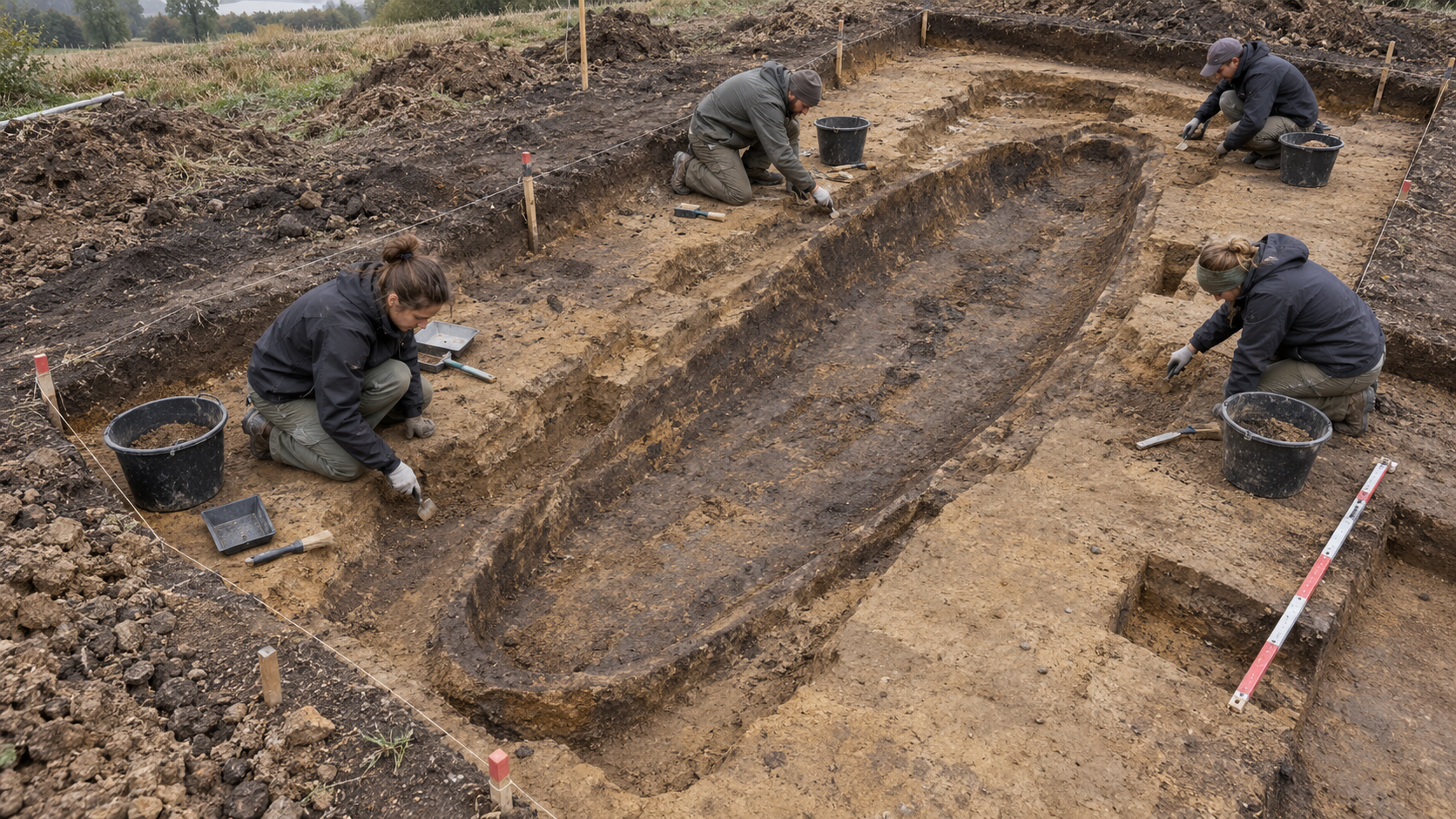
Dr Łukasz Miechowicz of the Institute of Archaeology and Ethnology of the Polish Academy of Sciences, who leads the excavation, told Radio Lublin that researchers had identified a feature approximately 4.5 metres long and just under 1.5 metres wide whose outline resembles an early medieval dugout canoe.
- Find more news from Poland on our Homepage .
Boat graves are extremely unusual in the archaeological record of the Western Slavs. Miechowicz said comparable examples are known principally from Pomerania, Mecklenburg and Wolin, while nothing similar had previously been identified in historical Lesser Poland.
The find should not, however, automatically be described as a “Viking burial”. Researchers are studying it within a Western Slavic funerary context, and the presence of a boat does not on its own establish Scandinavian identity or origin.
Silver, burned bones and a horse tooth
The contents of the grave have added to its significance.
Near its upper part, archaeologists uncovered a well-preserved silver temple ornament, decorated with hollow beads and granulation. Further excavation produced more than a dozen fragments of silver that had been melted or damaged by fire and which researchers believe came from early medieval jewellery.
Numerous pottery fragments have also been recovered, together with heavily burned bones that researchers have identified as human. At least two fragments of human teeth have survived.
The grave also contained animal remains, including a horse tooth. Miechowicz noted that animal and horse remains are unusual in Slavic burials generally, although previous discoveries at Chodlik have already demonstrated that horses could form part of funerary practices at the site.
Earlier research at Chodlik produced an 8th–9th-century cremation burial containing human and horse remains. That grave was radiocarbon-dated and formed the subject of a peer-reviewed study by Miechowicz published in Slavia Antiqua.
The new boat-shaped grave is different and appears to represent another unusually elaborate form of burial.
Was there really a wooden boat?
The archaeological evidence is more subtle than the outline of a complete wooden vessel preserved in the ground.
Most of the wood has decayed. Miechowicz said researchers believe they have identified traces of the structure in places where the rotted timber has survived as changes and streaks in the surrounding sand.
He nevertheless interprets the grave as a burial deposited in a dugout canoe or boat, based on its form and the surviving traces. Detailed three-dimensional documentation is being produced to reconstruct how the feature and its contents were arranged.
Every piece of bone, pottery and charcoal is being recorded individually so that researchers can later recreate the burial as a three-dimensional point cloud.
That work should help determine whether the traces represent the walls of the vessel and provide a clearer reconstruction of how the cremated remains and objects were placed inside it.
Who was buried there remains a mystery
The identity of the deceased is not yet known.
The surviving cremated material has not so far allowed researchers to establish the person’s sex or identity, and the presence of valuable objects does not by itself establish that the individual belonged to an elite.
Scientists hope the surviving teeth may preserve material suitable for further analysis. Miechowicz said specialists would examine whether collagen or strontium has survived, potentially allowing researchers to learn more about the person buried there and possibly their geographical origins.
The entire fill of the grave is also being collected for flotation, a technique that can recover tiny botanical and other remains invisible during ordinary excavation.


Researchers will search for charred food, seeds and plant remains, while charcoal from the grave could provide further information about the cremation pyre and potentially support future dating work.
Miechowicz believes some of that material was taken from the funeral pyre and deposited in the boat together with the cremated human remains.
A major centre before the Polish state
The location makes the discovery particularly intriguing.
Chodlik lies in the Chodelka river valley near the Vistula and formed part of a dense early medieval settlement zone. The Polish Academy of Sciences describes its fortified settlement as one of the oldest and largest defensive complexes of its kind in Poland, covering more than eight hectares and protected by multiple ramparts. Its main period of importance fell between the 8th and 10th centuries.
The complex belongs to the centuries immediately before and during the emergence of the early Polish state.
Its position near the Vistula gave the area access to an important communication and trading artery. Archaeological research has identified evidence of long-distance contacts, while Miechowicz says objects and influences found at Chodlik point towards regions including Rus’, the Rhineland and Great Moravia.
The site also lay close to river crossings that connected routes running from west to east.
That makes cultural exchange one possible context for an unusual funerary practice appearing so far inland — although researchers have not yet established why this particular person was buried in a boat or where the custom came from.
More unusual graves at Chodlik
The boat burial is not the first funerary discovery at Chodlik to stand out from conventional early medieval graves.
Archaeologists there have previously excavated so-called Alt Käbelich-type “houses of the dead” — sunken structures containing layers of cremated human remains. One studied example contained remains from five individuals as well as horse bones and objects damaged by fire.
This year’s work was originally intended in part to investigate the area between two such structures when the archaeologists encountered the boat-shaped feature.
The Institute of Archaeology and Ethnology has confirmed that Miechowicz is leading the continuing research at Chodlik, now one of the longest-running investigations of an early medieval settlement complex in the region.
For now, the most fundamental questions remain unanswered: who was placed in the boat, why this unusual form of burial was chosen, and whether it reflects local experimentation or contacts with communities far beyond the Chodelka valley.
The scientific analysis now beginning may provide some of those answers.