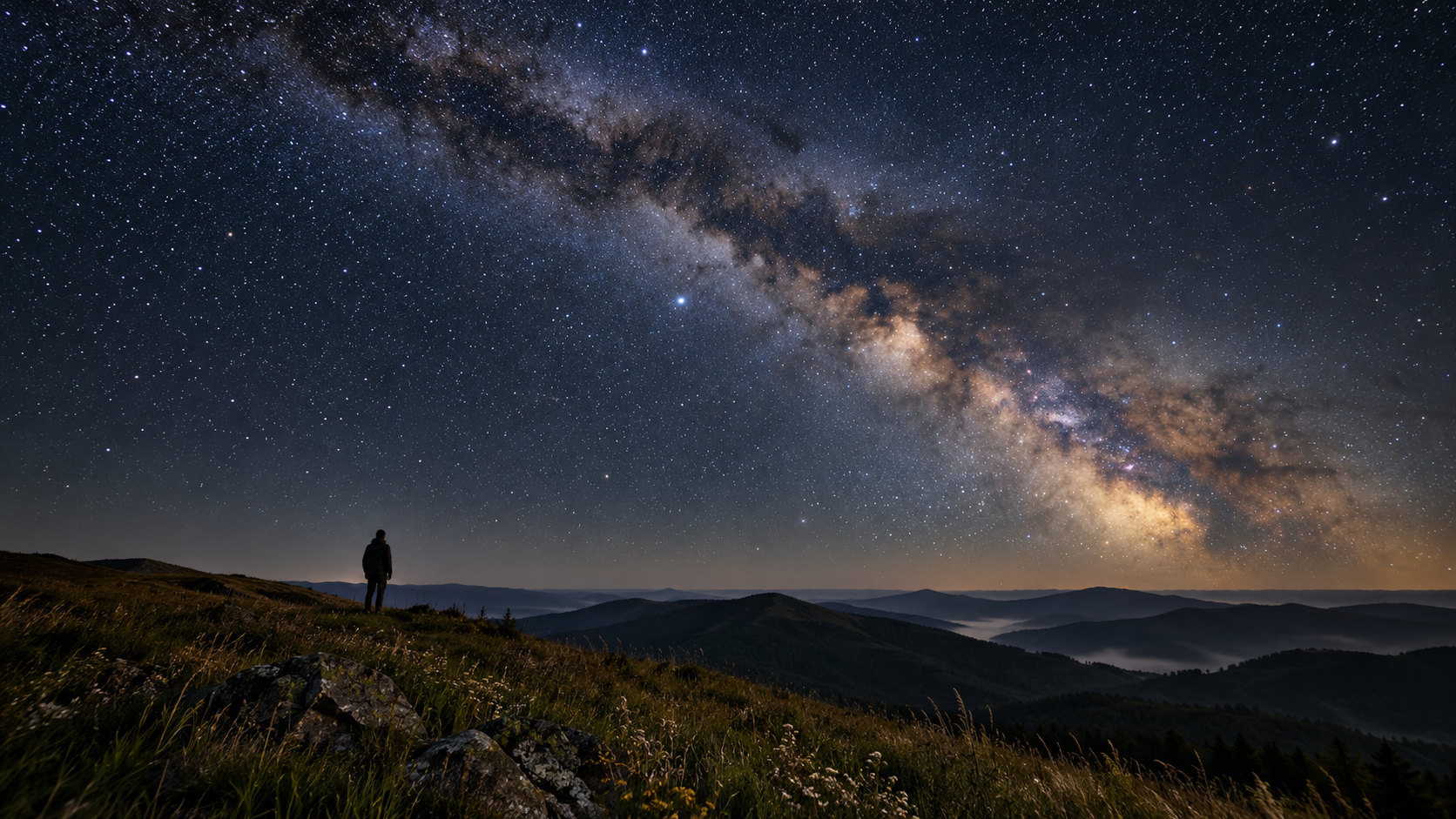
On a clear, moonless night in south-eastern Poland, the Bieszczady Mountains can reveal something that millions of people living in cities rarely see: the Milky Way stretching across the sky.
No telescope is required.
Away from streetlights and illuminated buildings, the galaxy can appear as a pale, cloud-like band of light, surrounded by thousands of stars. It is a sight that has become increasingly difficult to experience in much of Europe.
- Find more news from Poland on our Homepage .
The Bieszczady Mountains, close to Poland’s borders with Slovakia and Ukraine, remain one of the country’s most remarkable places for observing the natural night sky.
And now, as autumn continues, the region’s Starry Sky Park is preparing another series of astronomy evenings, giving visitors an opportunity to discover what darkness can reveal.
Where darkness is something worth protecting
The Bieszczady are known for their forested valleys, open mountain meadows and relatively sparse population. Their distance from major urban centres has helped preserve areas with exceptionally low levels of artificial light.
That makes the region particularly attractive to astronomers, photographers and visitors who want to experience a truly dark sky.
The importance of this environment was formally recognised in March 2013, when local authorities, conservation organisations and scientific institutions joined forces to establish the Bieszczady Starry Sky Park.
The initiative covers approximately 113,846 hectares, encompassing Bieszczady National Park and the surrounding San Valley and Cisna-Wetlina landscape parks.
Its purpose is not simply to promote stargazing.
According to the organisation responsible for the initiative, the park aims to protect the natural night environment, raise awareness of light pollution and encourage more responsible outdoor lighting.
Excessive artificial illumination can obscure stars, disrupt natural day-and-night cycles and affect wildlife.
Protecting darkness therefore means safeguarding an environmental resource that is easy to overlook.
Unlike a conventional national park designation, the Starry Sky Park was established through cooperation between participating institutions. Its work focuses on education, voluntary conservation efforts and promoting appropriate lighting rather than creating a separate statutory lighting-protection regime.
The initiative also extends an idea beyond Poland’s borders. The Bieszczady protected-sky area neighbours the Poloniny Dark Sky Park in Slovakia, reflecting the shared landscape of the Eastern Carpathians.
Thousands of stars above the mountains
For visitors accustomed to urban skies, the difference can be striking.
In July 2026, the Polish Press Agency reported that the Bieszczady’s dark skies allow visitors to observe the Milky Way and meteor showers without specialist equipment.
Pavol Ďuriš, who initiated the Starry Sky Park, explained that the region attracts people who have never previously seen the Milky Way, despite having spent their entire lives beneath it.
He identified the Upper San Valley as one of the particularly attractive areas for observing the sky.
The most favourable period for summer stargazing generally runs from mid-July to mid-September, when clear nights are comparatively more likely and the brightest central regions of the Milky Way are better positioned for viewing.


But the experience does not end with summer.
Different sections of the Milky Way remain visible at different times of year, while autumn evenings bring their own opportunities to identify constellations, planets and distant celestial objects.
Visitors should not expect the naked-eye view to look exactly like a photograph. Long-exposure cameras reveal considerably more colour, contrast and detail than human vision.
Even so, the ability to distinguish our galaxy’s faint band against a genuinely dark sky is remarkable enough.
Autumn astronomy evenings in Bieszczady
The Starry Sky Park organises guided astronomy sessions near Tarnawa Niżna, in the Upper San Valley.
These experiences combine an introduction to the night sky with explanations of constellations, demonstrations using laser pointers and observations through large telescopes.
Depending on conditions, participants may observe planets, star clusters, nebulae and distant galaxies.
The organisers’ programme includes telescopes with apertures ranging from 150 to 457 millimetres, allowing visitors to see objects that are invisible or barely distinguishable without magnification.
The latest autumn 2026 programme, updated on 21 October, confirms a break in organised sessions between 19 October and 1 November because of lunar conditions.
Weather-dependent sessions are provisionally expected to resume from 2 November until approximately 20 November 2026, with the final dates dependent on the conditions.
The sessions normally begin at around 7pm and last at least three hours. Visitors must arrange participation with the organisers, who confirm the meeting place and time.
As the park makes clear, an advertised observation window is not a guarantee of a visible Milky Way. Cloud, moonlight and atmospheric conditions can determine whether a session takes place at all.
A natural wonder increasingly hidden from view
The appeal of the Bieszczady night sky lies partly in its simplicity.
It does not require a spectacular observatory, expensive technology or a journey to another continent. On the right night, away from artificial light, visitors can discover something that was once familiar to people almost everywhere.
The experience also offers an introduction to a wider environmental problem.
Light pollution is often discussed in terms of what astronomers can no longer see. Yet its consequences extend beyond astronomy, affecting nocturnal habitats and changing the natural character of landscapes after sunset.
By promoting suitable lighting and sustainable tourism, the Bieszczady initiative is seeking to ensure that visitors can continue experiencing darkness as part of the region’s natural heritage.
Poland’s mountains are celebrated for their hiking trails, wildlife and panoramic views.
In the Bieszczady, however, one of the most extraordinary views appears only after the landscape itself has disappeared into darkness.
Look upwards on the right night, and an entire galaxy is waiting.