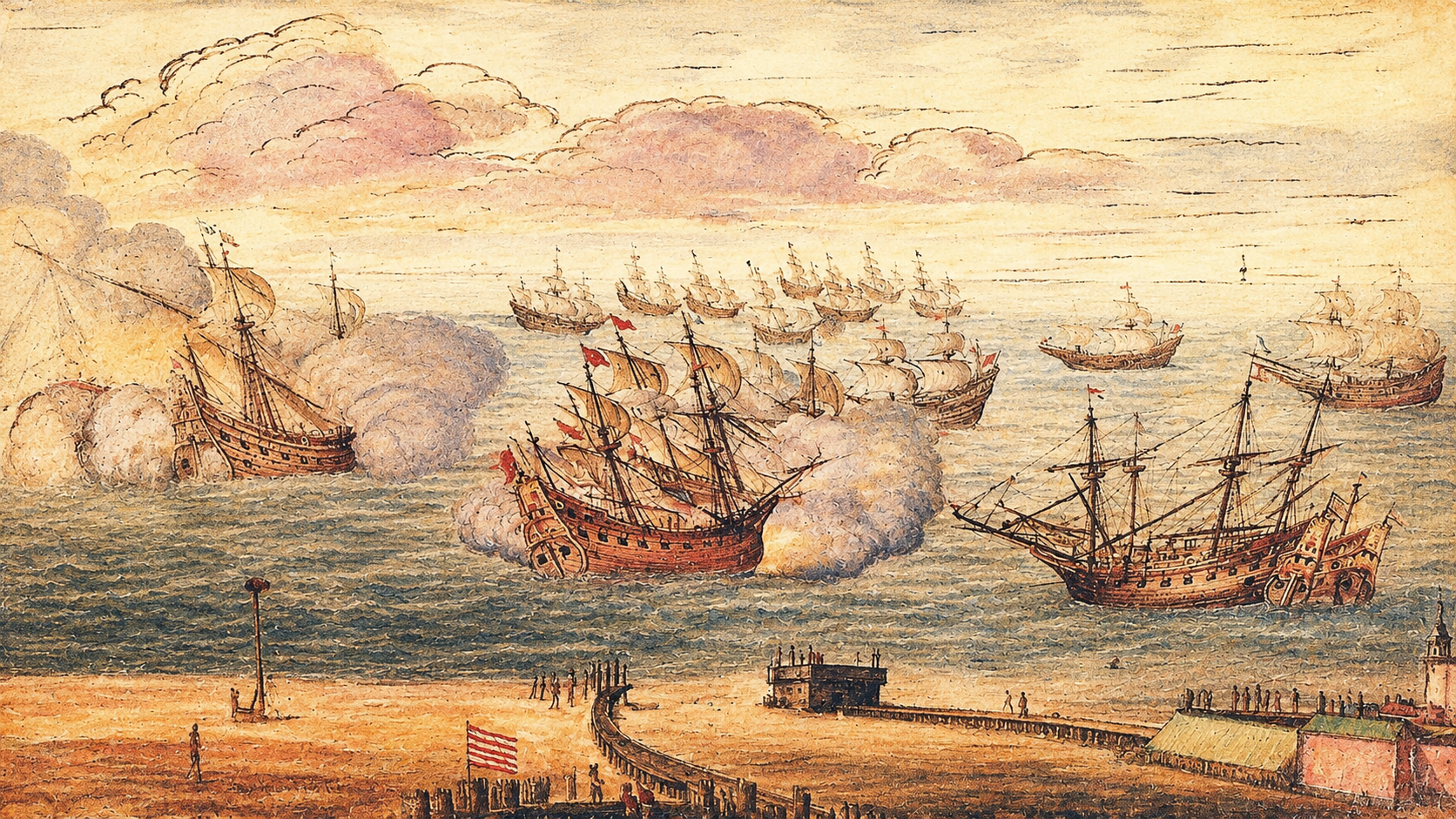
On 28 November 1627, a fleet of ten warships sailing under the Polish royal flag confronted six Swedish vessels in the Baltic Sea near Gdańsk.
What followed became the most famous naval victory of the seventeenth-century Polish-Lithuanian Commonwealth.
The Polish fleet captured the Swedish flagship Tigern, while another Swedish warship, Solen, exploded and sank during the fighting.
- Find more news from Poland on our Homepage .
Both sides lost senior commanders, including the Polish admiral Arend Dickmann, who was killed in the battle.
Almost four centuries later, the encounter is remembered as the Battle of Oliwa — a rare moment when the Commonwealth’s comparatively small naval force defeated a squadron belonging to one of the Baltic’s greatest maritime powers.
Why Sweden was blockading Gdańsk
In the early seventeenth century, the Baltic Sea was an important arena of competition between the Polish-Lithuanian Commonwealth and Sweden.
Both states sought influence over its ports, shipping routes and valuable trade.
Gdańsk, then one of the Commonwealth’s most important cities, was particularly significant. Its harbour connected the grain-producing lands of the Vistula basin with markets across Europe.
During the Polish-Swedish War of 1626–1629, Sweden’s King Gustavus Adolphus launched a military campaign along the southern Baltic coast.
Swedish forces occupied several towns and ports, while warships restricted shipping around Gdańsk and collected duties from merchant vessels.
The disruption threatened one of the Commonwealth’s principal trading routes.
King Sigismund III Vasa and the authorities in Gdańsk worked to strengthen the royal fleet, using a mixture of acquired and adapted vessels.
By November 1627, ten ships were available for an operation against the Swedish squadron.
Their commander was Arend Dickmann, a Dutch-born seafarer who had entered Polish royal service.
The crews also reflected the international maritime world of the period, with sailors recruited from several European countries.
The battle that captured a Swedish flagship
On the morning of 28 November, the royal fleet sailed out from the vicinity of Wisłoujście, near the mouth of the Vistula.
Its opponents were six Swedish warships operating in the Bay of Gdańsk.
The Polish vessels advanced towards the Swedish squadron, initiating a battle fought at close range.
Unlike later naval engagements dominated by long-range artillery exchanges, seventeenth-century sea battles often involved boarding enemy ships.
Warships would manoeuvre alongside one another, allowing armed sailors and soldiers to fight directly for control of the decks.


The Polish flagship Święty Jerzy — Saint George — attacked the Swedish flagship Tigern, meaning Tiger.
Following fierce fighting, Polish forces captured the vessel.
The Swedish commander, Nils Stiernsköld, was mortally wounded.
Elsewhere in the battle, the Polish warship Wodnik — Aquarius — engaged the Swedish vessel Solen, meaning The Sun.
As Polish troops threatened to seize the ship, members of its Swedish crew ignited the gunpowder stores.
The resulting explosion destroyed Solen, sending the warship to the bottom of the Baltic.
The remaining Swedish vessels withdrew.
The Polish fleet had won, capturing one enemy ship and destroying another.
But the victory came at a personal cost.
Admiral Dickmann was struck by a cannonball during the fighting and died before he could celebrate the outcome.
A victory whose importance was greater than its scale
The Battle of Oliwa demonstrated that the Commonwealth’s royal fleet could successfully challenge Swedish naval forces.
It was an important achievement for a state whose military strength was much more closely associated with armies fighting on land.
Nevertheless, the battle did not fundamentally change the course of the war.
Swedish maritime historians note that deteriorating weather, illness and supply shortages had already forced Sweden to wind down its blockade as winter approached.
The Polish victory came as Swedish ships were preparing to withdraw.
Although the battle confirmed the Commonwealth fleet’s fighting ability and removed two Swedish warships from action, it did not permanently secure Gdańsk against further naval pressure.
Sweden resumed its blockade in the spring of 1628.
The wider conflict continued until the Truce of Altmark in 1629.
The battle’s lasting significance was therefore as much symbolic as strategic: it showed that the Commonwealth could win a major encounter at sea, even without possessing a navy comparable in size to Sweden’s.
The Swedish warship still remembered in Gdańsk
The Battle of Oliwa has left more than written accounts and historical paintings.
In 1969, the wreck of the Swedish warship Solen was discovered during construction work in the port of Gdańsk.
Archaeological investigations recovered thousands of objects, including weapons, equipment and personal belongings.
Artefacts from the wreck are preserved in the collections of Poland’s National Maritime Museum.
The battle is also commemorated in the history of the modern Polish Navy.
Its anniversary, 28 November, carries additional significance because the Polish Navy was formally established on that date in 1918, after Poland regained independence.
For international readers, Oliwa offers a glimpse of a less familiar dimension of Polish history: a Baltic maritime world in which the Commonwealth maintained warships, recruited international crews and fought Sweden for control of trade.
The victory did not decide the war.
But the capture of Tigern and the destruction of Solen ensured that the events of 28 November 1627 would remain part of Poland’s naval memory.