Archaeologists have recovered several thousand ancient artefacts from a burial ground at the site of Poland’s future international airport, including swords deliberately bent before burial, pottery urns, jewellery and a rare crescent-shaped pendant. The discoveries offer a glimpse into the lives and burial traditions of communities that inhabited central Poland around 2,000 years ago.
The findings were announced on 26 November by Port Polska, the company overseeing Poland’s new national airport project near Baranów, west of Warsaw.
Archaeologists have completed three years of excavations at a cemetery associated with the Przeworsk culture, which flourished across much of present-day Poland during antiquity. The burial ground is believed to have been used for approximately 200 to 300 years.
- Find more news from Poland on our Homepage .
More than one hectare of the site was investigated, revealing thousands of objects that researchers hope will provide new insights into the beliefs, customs and everyday activities of its ancient inhabitants.
Swords, burial urns and a mysterious crescent pendant
Among the most striking discoveries are iron swords that appear to have been deliberately bent or broken before being placed in graves.
Such objects are associated with funerary practices in which weapons were intentionally damaged, possibly as part of rituals accompanying the burial of their owners.
Archaeologists also recovered spearheads, axes and metal shield components, alongside ceramic vessels and personal ornaments. Many of the graves contained cremated human remains placed inside pottery urns, reflecting burial traditions characteristic of the Przeworsk culture.
Other discoveries include decorative brooches used to fasten clothing, beads and spindle whorls — small objects used in the process of spinning fibres into yarn.
One particularly unusual find is a finely decorated metal pendant shaped like a crescent moon, known as a lunula. Some archaeologists associate such ornaments with ancient lunar symbolism or religious beliefs, although the precise significance of this pendant remains uncertain.
The discoveries offer evidence of both the practical and spiritual aspects of life in the region during the Roman period. That term describes a historical era and should not be taken to mean that the site was a Roman military cemetery.
A cemetery first identified decades ago
Although the latest discoveries were announced this week, the archaeological site itself has been known for more than half a century.
The cemetery was first identified during surveys conducted by archaeologist Stefan Woyda in the late 1960s and early 1970s. Fragments of Roman-period pottery and cremated human bones found at the time indicated the presence of an ancient burial ground, but its full extent remained unknown.
Excavations began in 2023 as part of archaeological investigations connected with the development of the new airport. Researchers initially expected to investigate a relatively small area, but the cemetery proved considerably larger, eventually requiring the excavation of more than 10,000 square metres.
According to Port Polska, completing the investigation of an entire burial ground on this scale is unusual in Polish archaeology. It allows researchers to examine the arrangement of graves and the changing use of the cemetery over time rather than interpreting isolated finds.
The work was carried out by the archaeological firm Asinus Igor Maciszewski under the supervision of the Mazovian regional heritage authorities.
Ancient settlement could reveal how the community lived
The cemetery is not the only archaeological site being investigated in the area. Researchers are also examining the remains of a nearby settlement provisionally believed to date from a similar period.
If further research establishes a connection between the two sites, the discoveries could offer a more complete picture of the community. The burial ground provides evidence about funerary customs, personal possessions and possible religious practices, while the settlement could shed light on housing, agriculture, craftsmanship and everyday life.
The discoveries are associated with the Przeworsk culture, an archaeological culture present mainly in the territory of modern Poland from approximately the third century BC to the fifth century AD. Archaeologists identify it through characteristic burial practices, pottery, tools and other material remains; the classification does not, by itself, establish the ethnicity of the people who lived at the site.
Poland’s future mega-airport takes shape
The archaeological discoveries have emerged during preparations for one of the largest infrastructure projects in modern Polish history.
Port Polska, previously known as the Centralny Port Komunikacyjny (CPK) project, is intended to become a major international aviation and transport hub approximately 37 kilometres west of Warsaw, between the Polish capital and Łódź.


The airport is currently scheduled to open in 2032, with an initial planned capacity of approximately 34 million passengers annually and provision for expansion towards 44 million as demand grows. The plans include two independent runways, a passenger terminal covering approximately 450,000 square metres, facilities for long-haul flights and extensive cargo infrastructure.
A defining feature is its integration with high-speed rail. The planned network will connect Warsaw, the new airport and Łódź, with further connections towards Poznań and Wrocław. Trains on the new network are expected to operate at speeds of up to 320 kilometres per hour.
The architectural design, developed by British practice Foster + Partners, recently received international recognition. As Poland-24 reported on 23 November, Port Polska won the Future Projects: Infrastructure category at the 2026 World Architecture Festival in the United States.
Preparations are also advancing beyond the main terminal. In October, the developer concluded agreements worth approximately PLN 117 million to design 36 supporting facilities, including an air traffic control tower, cargo infrastructure, emergency-service buildings and a multistorey car park. Poland 24 Business covered those contracts as part of the wider construction preparations.
The broader Port Polska programme has a planned expenditure envelope of PLN 131.7 billion through 2032, covering the airport, railway connections and associated infrastructure. The figure does not represent the cost of the passenger terminal alone.
Preserving Poland’s ancient heritage
Before the new airport can take shape, archaeologists are investigating sites that could otherwise be affected by construction. According to Port Polska, more than 80% of the identified archaeological sites within the planned airport area have already been investigated.
The objects recovered near Baranów are now undergoing specialist examination and conservation. They are expected eventually to enter museum collections, although their final destination has yet to be determined.
For researchers, the significance extends beyond the thousands of individual artefacts. By examining an entire burial ground alongside a potentially contemporary settlement, archaeologists hope to develop a fuller understanding of how people lived, worked and commemorated their dead in ancient central Poland.
The same land that Poland intends to transform into a major European transport hub is revealing an extraordinary record of its ancient past.
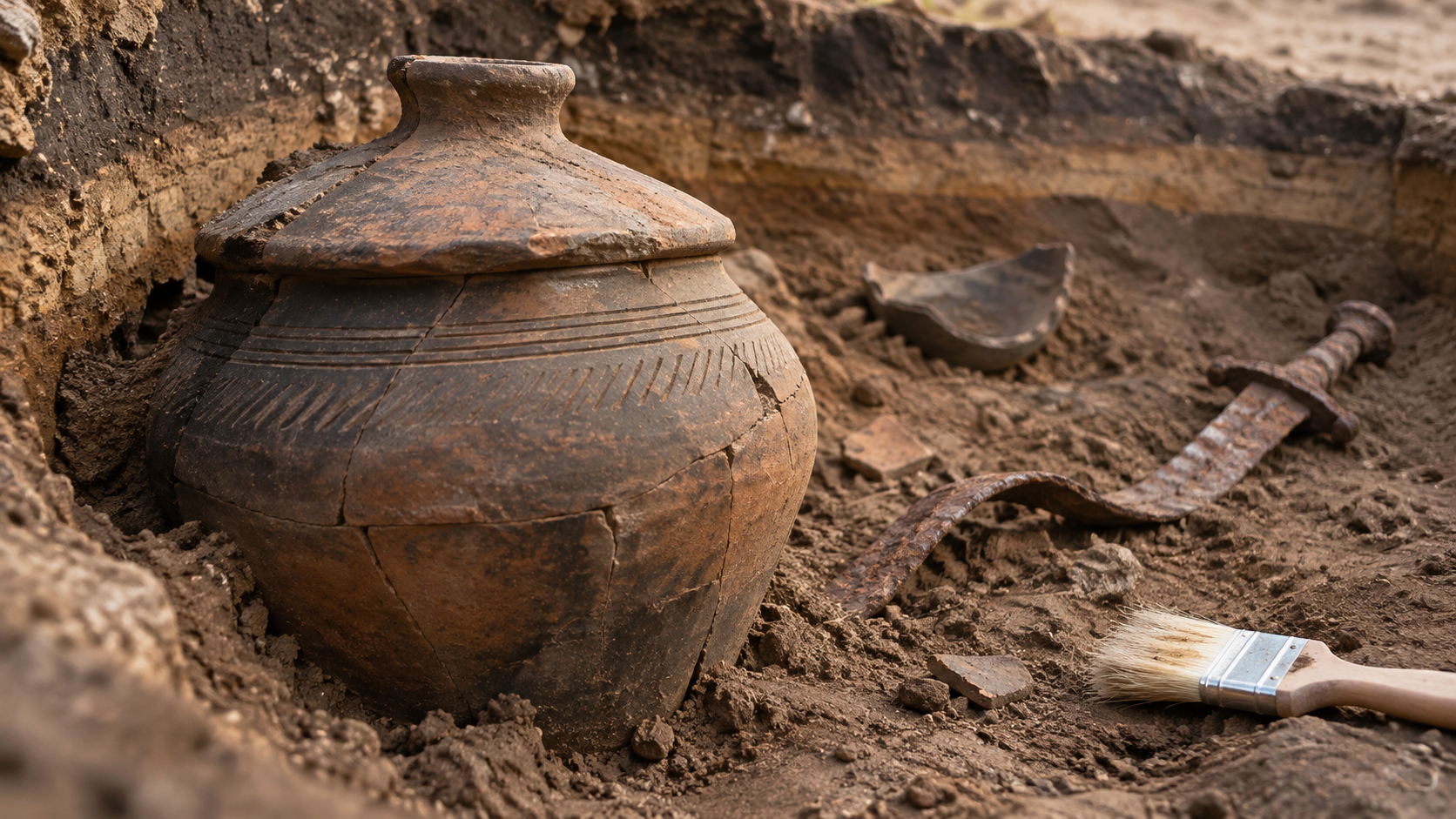
Featured image: AI-generated editorial illustration of an ancient urn and sword. It does not depict the actual archaeological finds from Baranów.