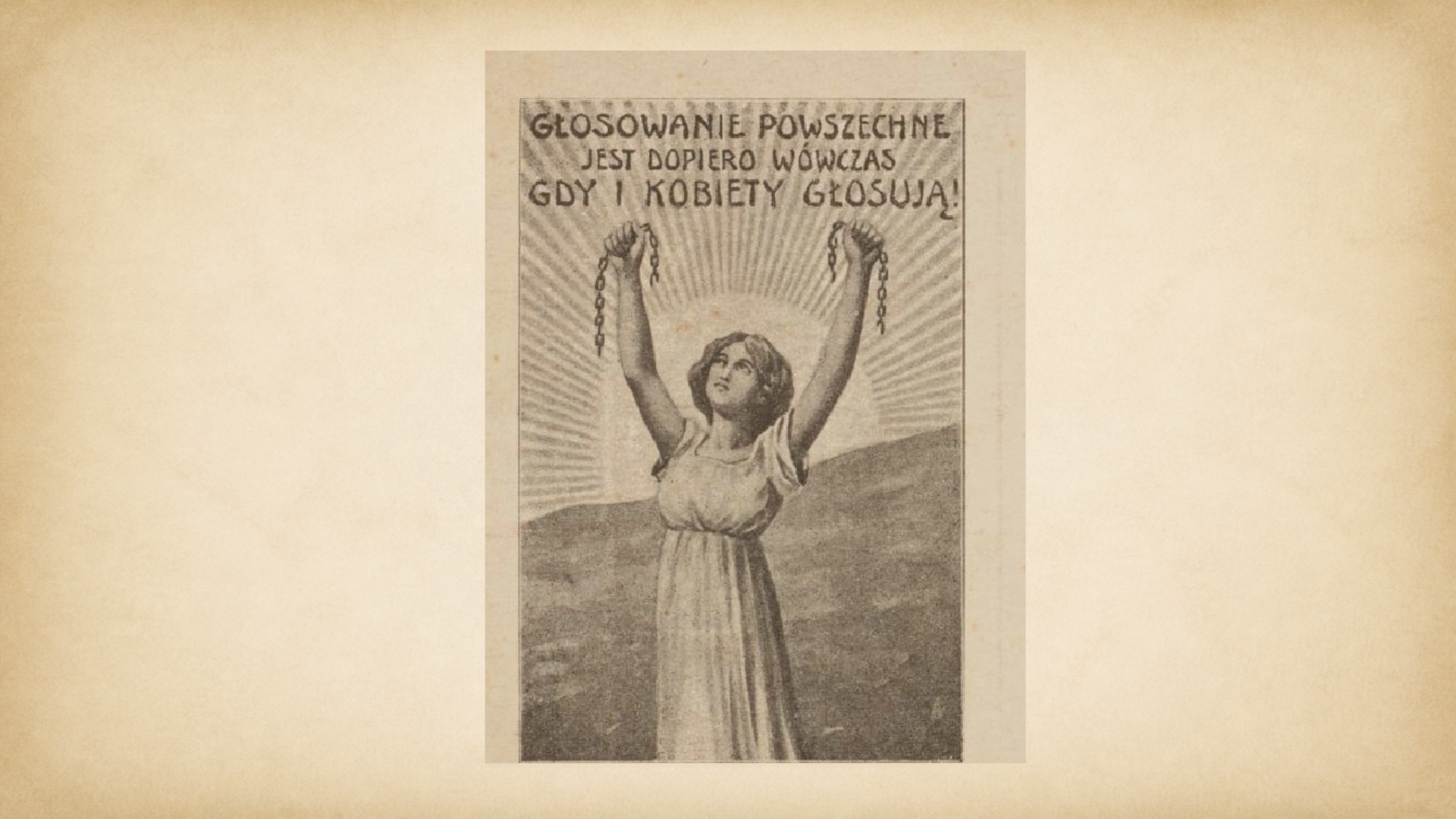
On 28 November 1918, just 17 days after Poland regained independence, the country’s new authorities adopted an electoral law that placed it among Europe’s early leaders in women’s political rights.
The legislation gave women the right to vote in parliamentary elections and to stand for election on the same terms as men.
It was a remarkable decision for a country still struggling to establish its borders, institutions and government after more than a century without independence.
- Find more news from Poland on our Homepage .
Poland was not the first country in the world to enfranchise women. But it acted years before several established Western democracies introduced equal parliamentary voting rights.
Britain did not achieve equal voting rights for women until 1928. France waited until 1944.
In Poland, the principle was written into the electoral system of the newly restored republic from the beginning.
A new Polish state, a new political right
Poland had disappeared from the map of Europe at the end of the eighteenth century, when its territory was divided between Russia, Prussia and Austria.
Its return as an independent country in November 1918 created an urgent challenge: how should the new state be governed, and who should have a voice in choosing its representatives?
On 28 November, Józef Piłsudski, serving as Temporary Chief of State, signed an electoral ordinance for the Constituent Sejm — the parliament that would establish the foundations of the new political system.
Article 1 stated that every citizen aged 21 or over could vote, regardless of sex.
Article 7 extended eligibility to stand for parliament to citizens who possessed voting rights, explicitly including women.
The decree was published and entered into force on 6 December 1918.
For women, its importance went beyond participation in a single election. They were recognised as full participants in the parliamentary system being established for independent Poland.
How early was Poland compared with the rest of the world?
The international comparison is one of the most striking aspects of Poland’s decision.
New Zealand had become the first self-governing country to grant women the parliamentary vote in 1893, although women there could not stand for parliament until 1919.
Finland, then an autonomous grand duchy within the Russian Empire, introduced voting and candidacy rights for women in 1906. Nineteen women were elected to the Finnish parliament the following year.
Norway introduced full women’s suffrage in 1913, while Denmark extended national parliamentary voting rights to women in 1915.
Poland therefore joined an existing international movement rather than pioneering women’s suffrage outright.
Nevertheless, its position was advanced by the standards of 1918.
That February, Britain had granted voting rights to some women, but only those aged 30 or over who met certain qualifications. British men could generally vote from 21, while women would have to wait another decade for equal voting rights.

Germany also introduced women’s suffrage in November 1918, amid the political upheaval that followed the First World War.
France, despite its long republican tradition, did not grant women the parliamentary vote until April 1944.
Poland’s achievement was therefore not a world first, but it belonged to an early European wave of countries establishing political equality between men and women.
Polish women had fought for the change
The November decree was not simply a concession made by Piłsudski.
Women’s organisations had spent years campaigning for political representation, education and equal citizenship, despite the difficulties of operating across territories controlled by three different empires.
During the First World War, Polish women also participated in independence organisations, relief efforts, medical services and political activism.
As independence approached, women’s groups intensified their demands.
In September and November 1918, activists organised meetings and demonstrations demanding that the restored Polish state recognise women as equal citizens.
Campaign literature challenged the idea that an election could be considered universal if women were excluded.
On 11 November, the day associated with Poland’s restored independence, activists Justyna Budzińska-Tylicka and Maria Chmieleńska presented demands for political equality to Piłsudski.
Their argument was straightforward: a state seeking to build a democratic future could not justify restricting citizenship because of sex.
The electoral rules subsequently prepared under Prime Minister Jędrzej Moraczewski’s government incorporated that principle.
The decree of 28 November gave it legal force.
From voting rights to seats in parliament
The new system was tested on 26 January 1919, when Poland held elections to its Constituent Sejm.
Women could participate as voters and candidates.
The elections took place while the country was still consolidating its territory, so additional parliamentary elections were held in different regions over the following years.
Eight women ultimately served in the Legislative Sejm of 1919–1922.
They included Gabriela Balicka, Jadwiga Dziubińska, Irena Kosmowska, Maria Moczydłowska, Zofia Moraczewska, Anna Piasecka, Zofia Sokolnicka and Franciszka Wilczkowiakowa.
They represented different political movements and brought experience from education, social reform, independence activism and public life.
Yet their presence also demonstrated the distance between legal equality and equal political representation.
Women remained a tiny minority in parliament. Securing the right to stand for election did not immediately overcome the political, social and institutional barriers to winning office.
Nevertheless, the principle established in 1918 endured.
The March Constitution of 1921 confirmed the democratic electoral foundations of the Second Polish Republic.
An early achievement of restored independence
The 28 November decree is remembered as an important milestone in Polish women’s history.
It also reveals something significant about the creation of the modern Polish state.
In the weeks after independence, the government faced enormous challenges: rebuilding administration, establishing borders and creating representative institutions.
Yet women’s parliamentary suffrage was included in the first nationwide electoral framework rather than postponed until the country’s political situation had stabilised.
The achievement belonged both to the politicians who enacted the legislation and to the generations of women who had campaigned for the right to participate.
Poland was not the first country to give women the vote.
But when the independent Polish state returned to Europe’s political map in 1918, it did so with women legally entitled to help choose — and become — its parliamentary representatives.