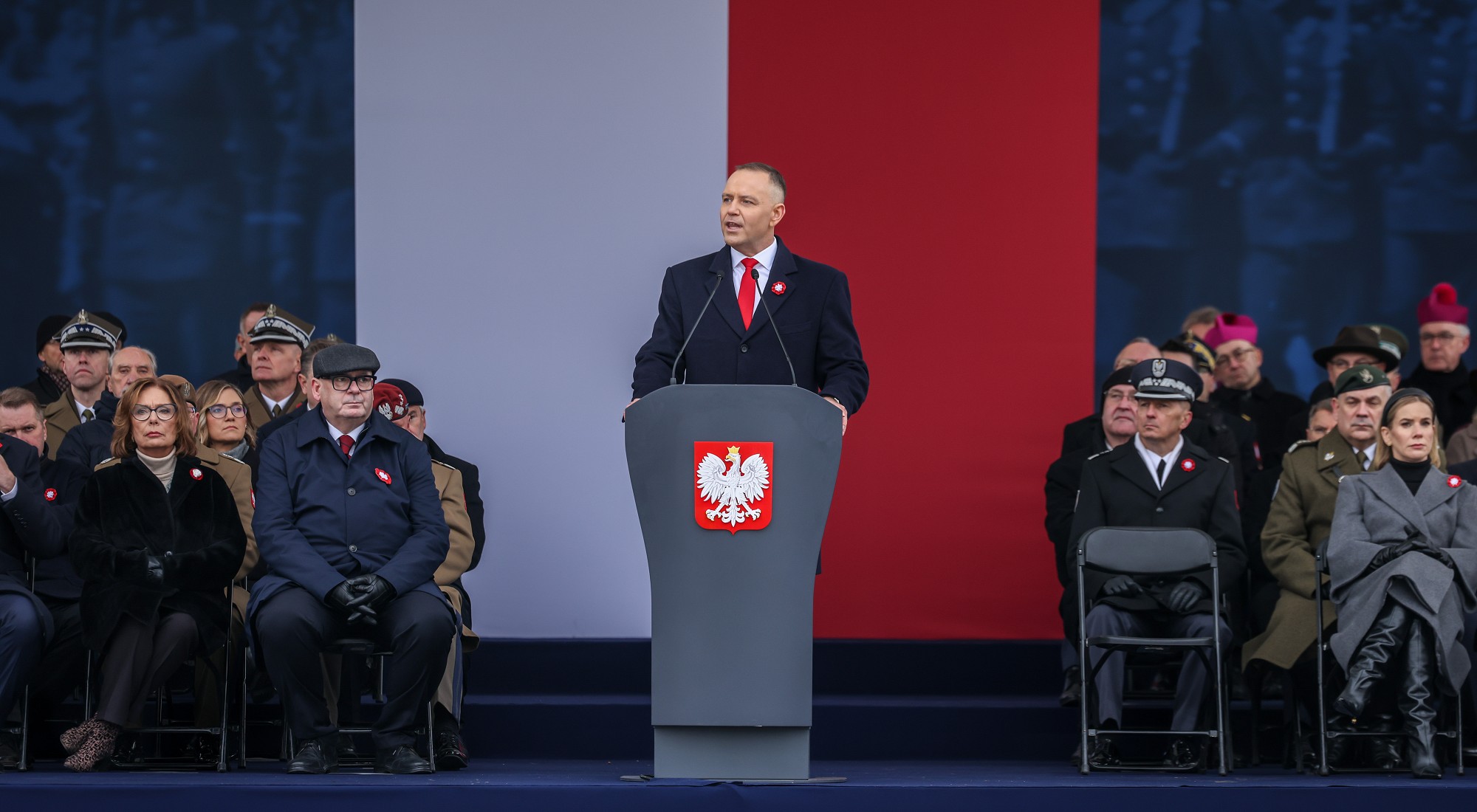
Polish President Karol Nawrocki has called for an end to political interference in the country’s Constitutional Tribunal, urging government and parliamentary leaders to work together to restore the court’s independence and credibility as Poland marked its National Independence Day.
Speaking at Warsaw’s Piłsudski Square on Wednesday, 11 November, Nawrocki said the tribunal had been at the centre of political and legal disputes for a decade, with the latest confrontation severely damaging its reputation.
The president called for a court free from both political influence and police cordons, appealing directly to the country’s prime ministers and parliamentary speakers to help find a way out of the crisis.
- Find more news from Poland on our Homepage .
His remarks came as the dispute between the presidential office and Prime Minister Donald Tusk’s government continued over the status of Constitutional Tribunal judges and who has the authority to lead the institution.
Nawrocki calls for a court free from politicians
During the central Independence Day ceremony in Warsaw, Nawrocki argued that Poland’s constitutional institutions should operate beyond party-political conflict.
He acknowledged that disagreements over the Constitutional Tribunal had persisted for approximately ten years, but said recent events had further undermined public confidence in the institution.
According to Gazeta Wyborcza’s account of the president’s speech, Nawrocki said the tribunal’s prestige had been effectively destroyed in recent weeks.
He then appealed to political leaders to help rebuild it through collective responsibility for Poland’s future.
“A free nation deserves a free Constitutional Tribunal,” the president said, adding that it should be free from police cordons and politicians alike.
Nawrocki argued that the court should serve the Polish state and constitution rather than successive parliamentary majorities and political parties.
He expressed hope that the tribunal could be restored to proper functioning in the coming weeks, months or years.
The remarks were an appeal for institutional cooperation, rather than the announcement of a formal agreement.
The president did not present a new legislative proposal or specify a negotiated mechanism for resolving the current dispute.
What is happening at Poland’s Constitutional Tribunal?
The Constitutional Tribunal is responsible for reviewing whether Polish legislation and certain other legal acts comply with the constitution.
Under Article 188 of Poland’s constitution, the court can assess the constitutionality of legislation and international agreements, among other responsibilities.
Its decisions can have significant consequences for the government, parliament, judiciary and ordinary citizens.
The tribunal has been the subject of prolonged controversy since 2015, when the Law and Justice (PiS) government began introducing changes to Poland’s judiciary.
Those changes attracted criticism from European institutions and courts over judicial independence and the rule of law.
Since taking office in December 2023, Tusk’s governing coalition has sought to reverse elements of the previous government’s judicial reforms.
However, disagreements over appointments, judicial authority and the tribunal’s leadership have continued.
You May Also Be Interested In

The latest confrontation escalated on 30 October 2026.
A group of judges elected by the current parliamentary majority announced that Anna Korwin-Piotrowska, the judge with the longest judicial service, had assumed responsibility for leading the tribunal.
She subsequently issued orders suspending the court’s president, Bogdan Święczkowski, and deputy president, Bartłomiej Sochański, from performing their duties.
The legality of those actions is disputed.
Święczkowski and Sochański reject the orders, while Nawrocki and his office have argued that the process amounts to an unlawful attempt to take control of a constitutional institution.
The government and the judges supporting Korwin-Piotrowska maintain that their actions are necessary to restore the tribunal’s lawful functioning.
The competing legal positions have not been resolved by an agreement between the institutions involved.
President and prime minister remain divided
Nawrocki has repeatedly accused Tusk’s government of exceeding its constitutional authority during the confrontation.
At a National Security Council meeting on 3 November, the president held the prime minister politically responsible for the police presence around the tribunal and for actions taken against its disputed leadership.
He said that restoring the rule of law could not justify measures that he considered unlawful.
Tusk has rejected those accusations.
In a statement published by the Prime Minister’s Office, he argued that judges lawfully elected by parliament must be able to perform their constitutional duties.
The prime minister has said police were deployed to protect the court and its judges, rather than to facilitate a politically motivated takeover.
Tusk has also accused Nawrocki of contributing to the confrontation by refusing to recognise the status of some judges elected by the current parliament.
The president’s office disputes that interpretation, maintaining that questions surrounding the judges’ appointments and oaths remain unresolved.
The disagreement has become a wider institutional confrontation, involving the government, presidency, parliament, judges and law-enforcement authorities.
Poland-24 previously examined how the Constitutional Tribunal crisis developed, including the constitutional questions behind the competing claims.
Government advances new court procedures
The latest appeal came one day after another development in the tribunal dispute.
On 10 November, judges supporting Korwin-Piotrowska adopted a resolution amending the tribunal’s rules of procedure.
The changes are intended to strengthen the role of judges in overseeing the institution’s administration, according to those supporting the resolution.
Tusk subsequently announced that the government would publish the resolution in the relevant official journal.
As Polish Radio reported on 10 November, the prime minister presented the move as a step towards restoring the court’s proper functioning.
However, the changes remain contested by members of the tribunal’s existing leadership, who reject the authority of the judges responsible for adopting them.
The government’s announcement should not be confused with an agreed settlement of the court’s leadership dispute.
Independence Day becomes another appeal for unity
Nawrocki’s remarks were delivered during celebrations marking the 108th anniversary of Poland’s restoration of independence in 1918.
The holiday commemorates the emergence of an independent Polish state after more than a century of partition by neighbouring powers.
The president used the occasion to argue that the constitution, national sovereignty and state institutions should be protected from partisan confrontation.
He also stressed the importance of national security, saying that Poland could not afford to become divided over its fundamental interests.
His appeal followed several unsuccessful efforts to arrange direct talks with Tusk about reducing tensions.
On the same day, the prime minister made a separate conciliatory gesture during an Independence Day ceremony in Szczecin, publicly inviting Nawrocki and his family to his home in Sopot for a meeting before Christmas.
The invitation did not establish that a meeting had been agreed, and neither leader has announced a settlement of the tribunal dispute.
Can Poland’s leaders reach an agreement?
The central obstacle remains the question of which judges and leadership arrangements should be recognised as lawful.
The government insists that judges elected by parliament must be able to exercise their responsibilities.
Nawrocki’s office maintains that the recent changes within the tribunal are legally defective and that the president has a duty to defend the constitutional order.
Those conflicting positions have made even preliminary discussions difficult.
Nawrocki’s Independence Day address introduced a public appeal for broader cooperation, but it did not remove the legal or political disagreements.
Whether the president, government and parliamentary leaders can translate that appeal into a workable agreement remains uncertain.
For now, the Constitutional Tribunal continues to operate amid a dispute over its leadership and the authority of those seeking to direct its work.