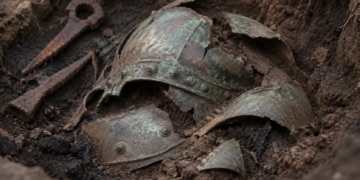
A collection of ancient weapons and personal belongings dating back almost 2,000 years has been anonymously handed to a museum in eastern Poland, offering a rare glimpse into the burial traditions of the Vandals, a Germanic people who once inhabited parts of present-day Poland.
The objects, including a broken iron sword, spearheads, shield fittings and horse-riding equipment, were transferred to the Father Stanisław Staszic Museum in Hrubieszów, near Poland’s border with Ukraine.
Museum specialists believe they represent the grave goods of a high-ranking mounted warrior who lived around the second century AD, during a period when communities associated with the Vandals occupied the region.
- Find more news from Poland on our Homepage .
But the collection has arrived with an unusual mystery: nobody at the museum knows who originally discovered the artefacts or exactly where the burial was located.
According to information obtained by the museum, the objects were recovered from an agricultural field in the nearby Werbkowice municipality several years ago. They have only recently been brought into professional archaeological care.
A broken sword, shield and equipment of an ancient warrior
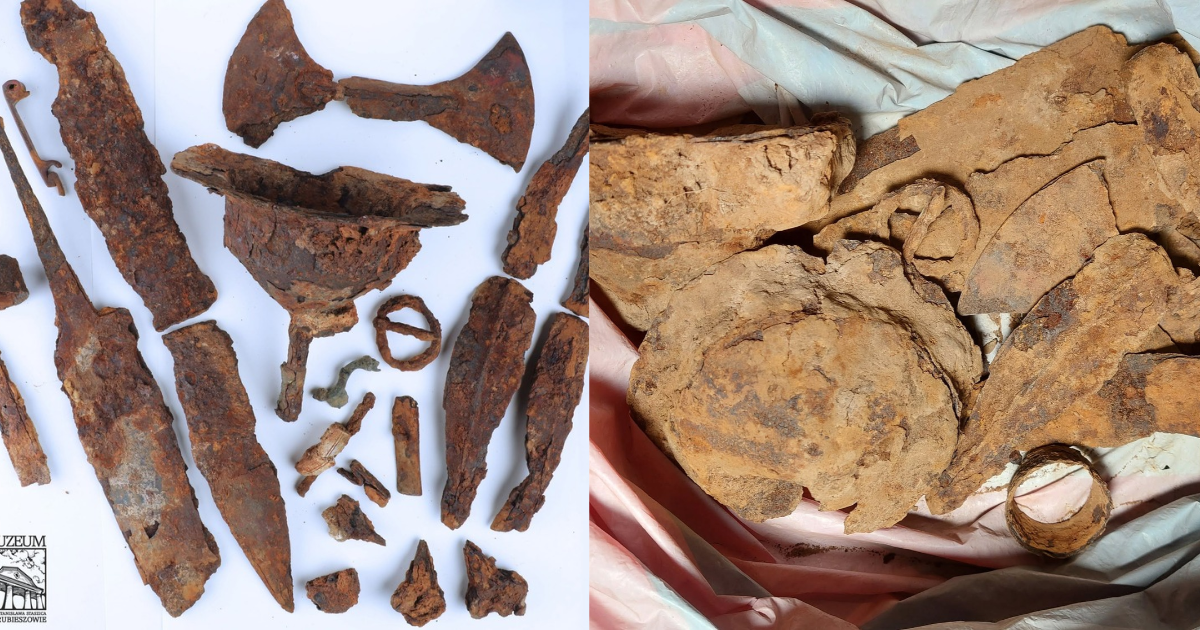
The collection contains an unusually extensive assortment of military equipment and personal possessions.
Its most significant object is an iron sword preserved in three pieces, accompanied by fittings from its scabbard, including a suspension attachment and a protective end fitting.
There are also two broken and bent weapon points, identified as belonging to a spear and a javelin.
Other equipment includes a spiked iron shield boss, which originally protected the central part of a wooden shield, and a metal shield grip.
Alongside the weapons are a knife fragment, a belt buckle, two spurs, pieces of a bone comb and a bronze brooch, known as a fibula, used to fasten clothing.
The combination is important because weapons, particularly swords, were not placed in every burial during this period.
As National Geographic Polska reported, drawing on information from the museum, the sword and pair of spurs suggest that the deceased was a mounted warrior of relatively high social or military standing.
The person’s biological sex has not been established. The surviving grave goods cannot independently determine whether the individual was male or female.
Why were the weapons broken?
Several objects show evidence of deliberate damage, including the sword and bent weapon points.
These features are consistent with funerary practices associated with communities of the Przeworsk archaeological culture, which is commonly linked to the Vandals and other populations living in Central Europe during the Roman period.
Cremation was an important part of these burial traditions.
The deceased and selected possessions were placed on a funeral pyre, exposing weapons and other belongings to intense heat. Some objects were deliberately bent, broken or otherwise damaged before burial.
Archaeologists interpret such treatment as a ritual practice, although the precise beliefs behind it cannot be reconstructed with certainty.
The Hrubieszów artefacts show extensive corrosion and traces of exposure to high temperatures, supporting the museum’s interpretation that they originally formed part of a cremation burial.
However, because the objects were not recovered during a documented archaeological excavation, researchers cannot yet reconstruct the original grave or establish precisely how its contents were arranged.
You May Also Be Interested In

A mysterious delivery arranged through an intermediary
The circumstances surrounding the collection’s recovery are almost as unusual as the objects themselves.
According to the museum’s account, the original finder remains unidentified. The person who later arranged for the artefacts to be recovered and transferred also wished to remain anonymous.
Rather than being delivered through a conventional handover at the museum, the objects were left at an agreed collection point.
Artur Troncik, known in Poland’s metal-detecting community as Saper, helped facilitate the transfer.
The arrangement was coordinated with the Zamość branch of the Lublin provincial heritage conservation authority, according to local reporting by Tygodnik Zamojski.
Museum staff welcomed the recovery, while acknowledging that they would have preferred to speak directly with the original finder and inspect the discovery site.
Knowing where and how an artefact was found is often as important to archaeologists as the object itself. The position of weapons, cremated remains and other burial goods can reveal information that is lost when objects are removed without archaeological documentation.
The anonymity surrounding this collection leaves those questions unresolved.
Archaeologists hope to find more graves in 2027
The recovered objects are in poor condition and require urgent specialist treatment.
Their iron components have deteriorated considerably following centuries underground, and the museum has transferred the collection for conservation work expected to take several months.
The work will help stabilise the fragile objects and may reveal further details about their construction and decoration.
Meanwhile, researchers are planning to investigate the reported discovery area in Werbkowice.
As TVP World reported, citing the museum, specialists hope to conduct archaeological excavations during the summer of 2027, subject to the necessary arrangements, to establish the burial’s precise location.
Information received by specialists suggests that other graves may survive in the surrounding agricultural land, although some may already have been disturbed by ploughing.
No additional burials have yet been confirmed as part of this investigation.
Who were the Vandals who once lived in Poland?
The Vandals were a group of ancient Germanic peoples whose history is closely connected with Central Europe and the later transformation of the Roman Empire.
Archaeologists commonly associate at least some Vandal communities with the Przeworsk culture, which developed across parts of today’s Poland during the centuries before and after the beginning of the Common Era.
The culture is recognised through distinctive burial practices, weapons, metalwork and settlements.
However, archaeological cultures do not correspond neatly to individual ethnic groups. Objects characteristic of the Przeworsk culture cannot, by themselves, establish how every person buried with them identified.
Over the following centuries, groups known as Vandals migrated southwards and westwards. They eventually established a kingdom in North Africa and became widely known in Roman history.
Their earlier presence in Central Europe belongs to a much less familiar chapter of European history, long before the emergence of the medieval Polish state.
The territory around Hrubieszów has yielded important archaeological evidence from several ancient periods. Earlier excavations at nearby Gródek, also covered by Poland-24, revealed a succession of prehistoric and later activity, including burial evidence and settlement features.
In August 2026, another striking object associated with a Vandal-period warrior was recovered from a scrap-metal yard in the same town.
The earlier discovery, described by Rzeczpospolita, involved an iron shield boss dating to approximately the second century AD. Burnt human bone fragments survived inside material attached to the object.
The newly recovered collection adds considerably more evidence to the region’s archaeological record, despite the uncertainty surrounding its origins.
For the Hrubieszów museum, the immediate task is to preserve the fragile weapons and personal objects.
The longer-term challenge will be to establish where they came from — and whether more graves from the same ancient community remain hidden beneath the fields of eastern Poland.