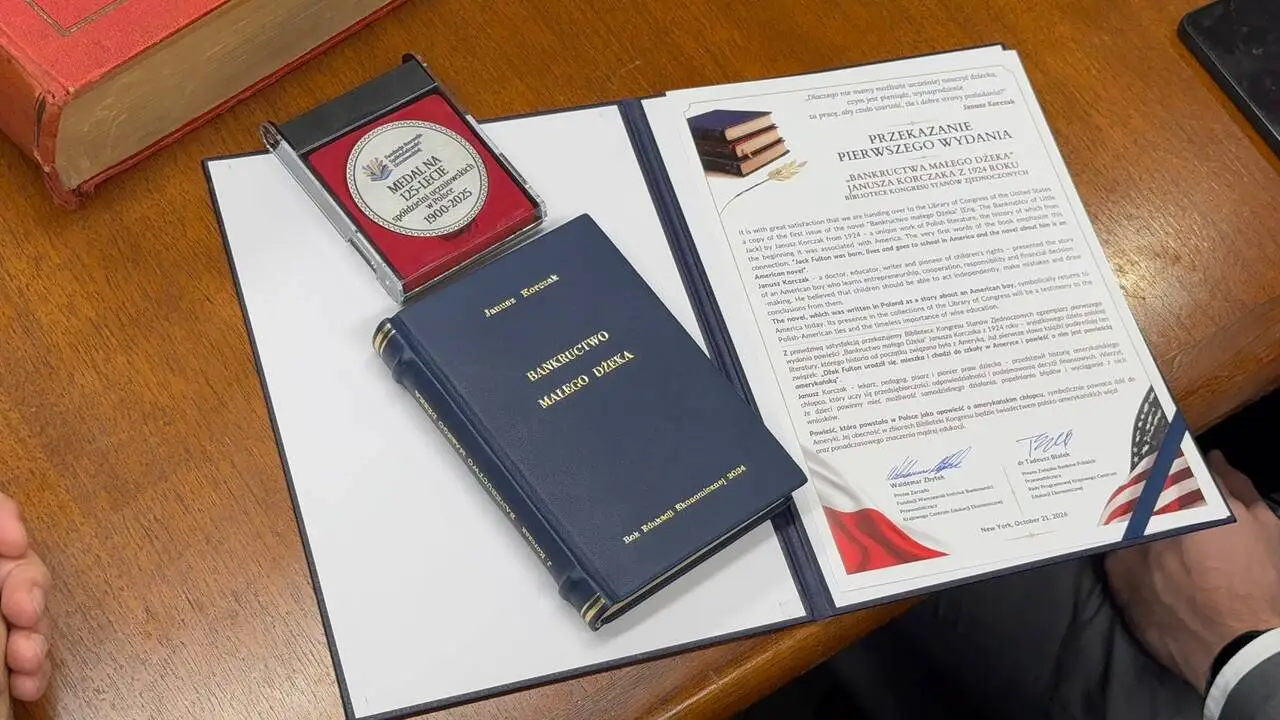
A first edition of a century-old Polish children’s novel by Janusz Korczak has reportedly been added to the collections of the United States Library of Congress in Washington, bringing a work about an enterprising American schoolboy into one of the world’s largest libraries more than 100 years after it was written.
The book, Bankructwo małego Dżeka (The Bankruptcy of Little Jack), was first published in Poland in 1924. Its acquisition by the Library of Congress was reported by TVP Info on Wednesday, 21 October.
The development represents another international milestone for the literary legacy of Korczak, the Polish-Jewish doctor, educator and children’s rights pioneer who was murdered by Nazi Germany at the Treblinka extermination camp in 1942.
- Find more news from Poland on our Homepage .
The acquisition is particularly fitting because Korczak chose the United States as the setting for his novel, using the adventures of a young American boy to teach children about business, financial responsibility and working together.
A Polish story about an American schoolboy
Published in 1924, Bankructwo małego Dżeka follows Dżek Fulton, a young American pupil who develops an interest in business after witnessing the failure of a neighbourhood shop.
Dżek begins by managing his classroom’s small library before establishing a cooperative business with his classmates.
The children pool resources, buy and sell school supplies, and eventually expand their activities to include more expensive purchases.
As the enterprise develops, Dżek encounters the challenges familiar to real businesses: keeping accounts, dealing with customers, borrowing money, managing risk and deciding whom to trust.
The story explores what happens when the cooperative runs into serious difficulties, including the theft of bicycles that threatens its finances.
But the novel is about more than earning money.
Through Dżek’s experiences, Korczak examines honesty, responsibility, cooperation, fairness and the consequences of decisions made by both children and adults.
The book also reflects his belief that children should be taken seriously as people capable of understanding complicated subjects.
An accessible digital edition of the complete original Polish text is available through the Wolne Lektury online literary library.
Why the Library of Congress acquisition matters
The Library of Congress is the national library of the United States and the research institution serving the US Congress.
Established in 1800, it maintains an extensive international collection of books, manuscripts, photographs, maps, recordings and other historical and cultural materials.
Its collection includes works published in hundreds of languages, reflecting the institution’s role in documenting intellectual and cultural history beyond the United States.
The reported addition of Korczak’s first edition means that a physical copy of the original 1924 publication has entered this major American research collection.
It does not mean that Congress itself has formally honoured the novel, designated it a national treasure or selected it for a special literary register.
The significance lies in the preservation of an early edition of an important Polish literary work, particularly one whose fictional setting and subject matter are so closely connected to American life.
The Library of Congress’s acquisitions programme obtains material through purchases, donations, exchanges and other channels.


The precise circumstances under which this particular copy was acquired have not yet been independently established.
A book that crossed borders long before 2026
Although Bankructwo małego Dżeka was written in Polish, it has an earlier connection with English-language readers.
In 1939, an English translation by Cyrus Brooks appeared in London under the title Big Business Billy, published by Minerva Publishing.
Research by Polish translation scholar Michał Borodo describes how the English adaptation altered some names and cultural references to make them more familiar to its intended readership.
The 1939 translation demonstrates that Korczak’s work was reaching audiences beyond Poland even before the Second World War.
His books have since appeared in numerous translations, with Król Maciuś Pierwszy (King Matt the First) among his internationally recognised works.
The life and legacy of Janusz Korczak
Born Henryk Goldszmit in Warsaw, Korczak became one of Poland’s most influential thinkers on childhood, education and the relationship between adults and children.
A trained physician and writer, he helped run a Jewish orphanage in Warsaw, where he introduced practices designed to give children a greater voice in decisions affecting their daily lives.
His educational philosophy emphasised dignity, mutual respect, honesty and children’s participation in the communities to which they belonged.
These principles were reflected both in his nonfiction writings and in novels such as The Bankruptcy of Little Jack.
Korczak’s life ended during the Holocaust.
After Nazi Germany established the Warsaw Ghetto, he continued caring for the children in his orphanage alongside other members of staff.
In August 1942, German authorities deported Korczak, his colleagues and the children to the Treblinka extermination camp.
According to the United States Holocaust Memorial Museum’s biography, Korczak remained with the children rather than abandoning them as they faced deportation and death.
His work has subsequently become an important reference point in discussions of children’s rights and humane approaches to education.
A century-old novel returns to Polish classrooms
The international development comes at a time when Korczak’s book has also attracted renewed attention in Poland.
In 2024, exactly 100 years after its original publication, Bankructwo małego Dżeka was restored to the list of supplementary reading options for Polish primary schools.
The change was included in the Education Ministry’s amended national curriculum, which took effect in September 2024.
The novel’s return was supported by organisations involved in financial education, which promoted its potential to introduce children to practical economic concepts through storytelling.
The Warsaw Banking Institute Foundation has also supported educational initiatives inspired by the book, including the Przygody przedsiębiorczego Dżeka (Adventures of Enterprising Jack) project.
Its materials include new editions, classroom activities and resources designed to encourage discussions about money and entrepreneurship.
The novel continues to find audiences beyond schools.
Kraków’s National Stary Theatre has developed a stage adaptation directed by Maciej Podstawny, using Dżek’s story to explore financial choices, responsibility and cooperation. Performances are scheduled during the theatre’s 2026–27 season.
A Polish literary legacy with international relevance
More than a century after its publication, The Bankruptcy of Little Jack remains unusual in its approach to explaining economics through the experiences of a child.
Rather than treating money as a subject reserved for adults, Korczak placed financial decisions within a story about friendship, responsibility and community.
The reported acquisition by the Library of Congress creates another connection between the Polish writer and the American setting he chose for his novel.
It also offers an opportunity to rediscover a less internationally familiar part of Korczak’s writing, alongside his widely recognised contribution to children’s rights and his wartime legacy.