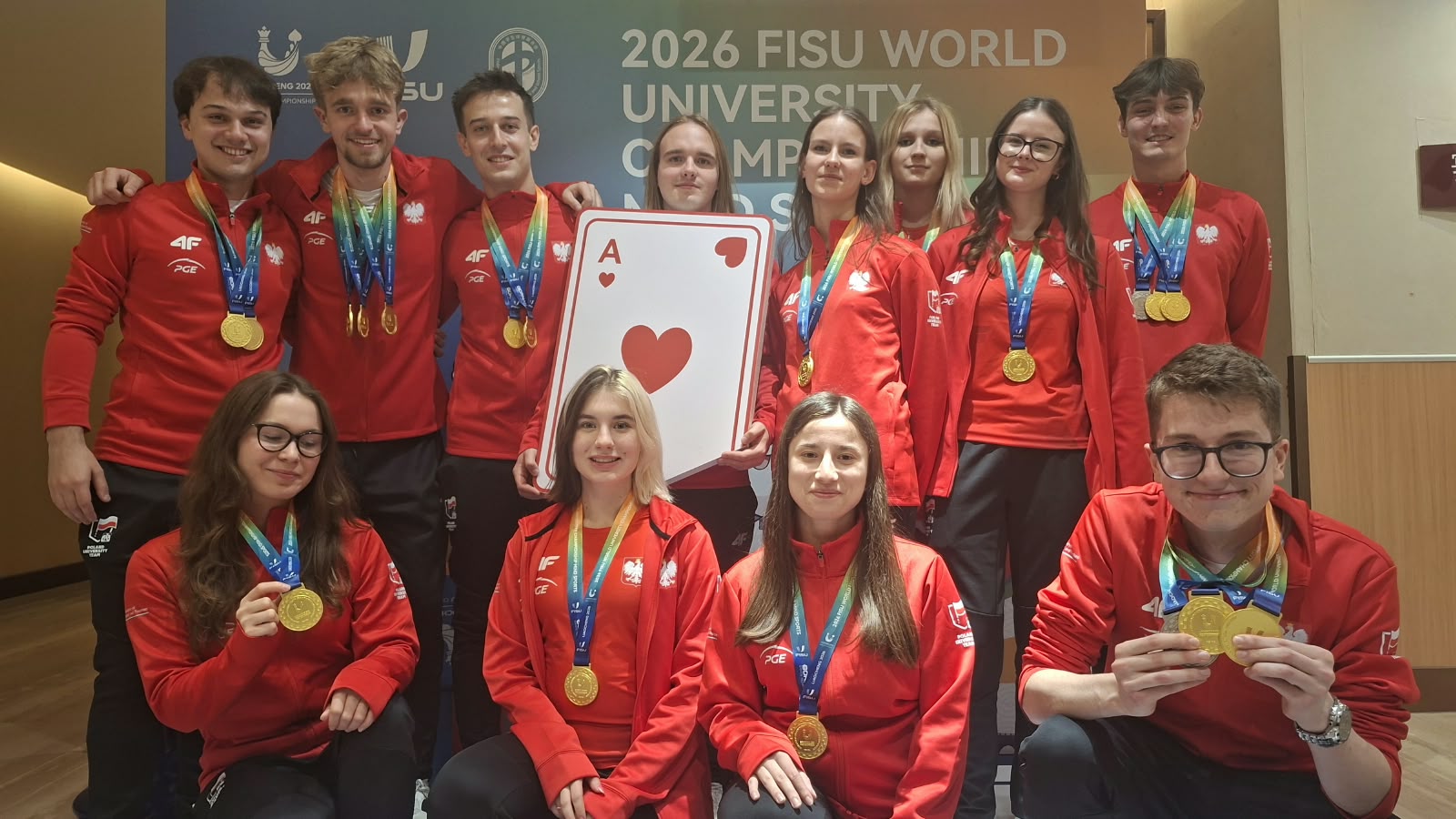
Polish university students have returned from China with eight world championship medals, including four golds, after an outstanding performance in chess and bridge.
Competing at the 2026 FISU World University Championship Mind Sports in Liaocheng, Poland’s academic team claimed four gold medals, one silver and three bronze during the 11–16 October championships.
The strongest results came from the bridge players, who won five medals, including all four golds. Poland’s chess representatives added three bronze medals, with University of Warsaw student Liwia Jarocka among the standout performers.
- Find more news from Poland on our Homepage .
The competition, organised by the International University Sports Federation (FISU), brought together more than 200 student athletes representing 21 countries.
For Poland, it was another successful chapter in a discipline where its university competitors have established a strong international record.
Poland’s bridge players dominate the world championships
The biggest achievement came from Poland’s six-man bridge squad: Krzysztof Cichy, Wojciech Bąk, Franciszek Kurlit, Kacper Kopka, Kacper Kuflowski and Aleks Bukat.
The team won both the men’s and open-team classifications, collecting two gold medals through a performance that left their closest rivals well behind.
According to the official FISU championship report, the Polish men’s team finished with 270.05 victory points, comfortably ahead of Hungary on 228.25 and Hong Kong on 227.13.
Their dominance was such that the overall victory was secured before the final match had even been played.
The team lost only once during the competition, against France, while recording victories over opponents including South Korea, Chinese Taipei, Thailand, Czechia, Germany and Hungary.
Cichy, a student at Kozminski University in Warsaw, told Poland’s Academic Sports Association (AZS) that the result had exceeded the team’s expectations.
He also highlighted the challenges presented by Asian opponents, whose different approaches to the game could make matches unpredictable.
The success continued in the pairs classification.
Aleks Bukat and Kacper Kuflowski secured another gold medal for Poland, while Wojciech Bąk and Franciszek Kurlit took silver.
Poland’s women’s bridge team also delivered an impressive performance.
Zofia Trojan, Milena Gryzło, Matylda Brzyzka, Magdalena Kapała, Natalia Suszanowicz and Łucja Ciborowska won gold in the women’s classification, finishing ahead of China and Thailand.
The Polish women also placed eighth in the overall team standings, competing against teams from across the championship.
The five bridge medals therefore reflected success across several classifications, although the men’s and open-team golds were awarded to the same six players rather than being victories in two entirely separate tournaments.
Liwia Jarocka leads Poland’s chess medal winners
Poland’s chess team contributed the remaining three bronze medals.
The most notable individual result belonged to Liwia Jarocka, a University of Warsaw student who claimed bronze in the women’s classical chess competition.


Jarocka had remained close to the leading positions throughout the tournament. A victory over Czech player Lada Zelbová in the final round secured her place on the podium.
She finished behind Germany’s Jana Schneider, who won gold with 7.5 points, and Slovakia’s Lucia Ševčíková, who took silver.
It was another significant result for Jarocka, who had previously won a world university title in blitz chess.
Poland also claimed bronze in the classical chess team classification, with Radosław Psyk, Jarocka and Barbara Goraj contributing to the result.
A third bronze followed in the blitz team standings, through the performances of Jarocka, Martyna Wikar and Psyk.
There were several near misses.
Psyk finished fifth in the men’s individual classical tournament, while Jarocka came fourth in the women’s blitz competition.
Polish chess coach Krystian Kuźmicz described the three bronze medals as a success, although he acknowledged that the team had hoped to secure at least one gold.
The results also highlighted the strength of the wider international field. Germany topped both chess team classifications, while competitors from China, France and other countries claimed individual titles.
Building on Poland’s university sporting success
The championships represented another strong international showing for Poland’s university mind sports competitors.
At the previous edition, held in Uganda in 2024, Polish students won nine medals.
This year’s eight-medal total demonstrates a continuation of that success, particularly in bridge, where Poland secured three team-classification golds and dominated the pairs standings.
The Academic Sports Association’s detailed account of the championships also illustrates the breadth of universities represented.
Medallists came from institutions including the University of Warsaw, Kozminski University, the Jagiellonian University, AGH University of Krakow, Warsaw University of Technology, the Wrocław University of Economics and Business, and Opole University of Technology.
The achievements underline the importance of university sport beyond the more familiar competitions in athletics, swimming and team games.
Chess and competitive bridge demand concentration, strategic planning, mathematical reasoning and the ability to make difficult decisions under pressure.
At the highest level, they also require years of preparation and experience against international opponents.
For the Polish students competing in Liaocheng, that preparation resulted in eight world championship medals.
And for the bridge team, the final achievement was particularly memorable: they had already secured the title before sitting down to play their last match.