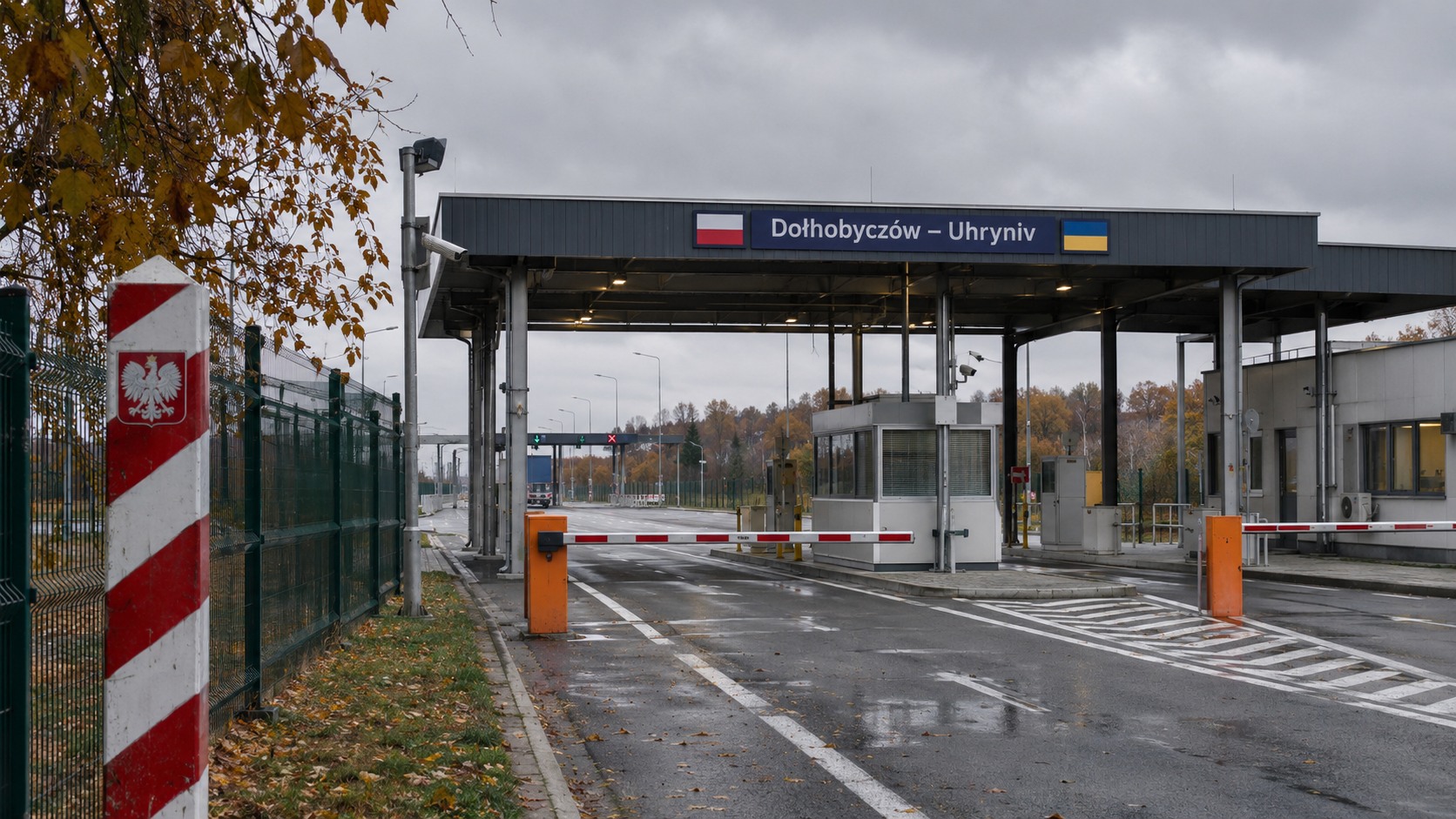
Polish journalist and commentator Łukasz Warzecha was refused entry to Ukraine on Monday, 2 November, and informed that he had received a three-year ban from entering the country. The decision, attributed to Ukraine’s Security Service (SBU), came while he was travelling to Kyiv as part of an officially organised visit for Polish journalists, arranged jointly by institutions in Poland and Ukraine. The organisers say Ukrainian authorities had been informed of the participants in advance and raised no objections before the trip.
Warzecha, a columnist associated with the Polish weekly Do Rzeczy, was stopped by Ukrainian border guards at the Dołhobyczów–Uhryniv crossing.
He was travelling with a group of journalists invited to Ukraine by the Mieroszewski Centre, a Polish public institution promoting dialogue with Eastern European countries, and the Ukrainian Institute, which operates under Ukraine’s Ministry of Foreign Affairs.
- Find more news from Poland on our Homepage .
According to Warzecha, Ukrainian officials retained his passport, questioned him about his journey and instructed him to wait in a separate room.
After more than seven hours, he was informed that he would not be permitted to enter Ukraine.
The reported reason was national security.
However, the Ukrainian authorities have not publicly disclosed what specific concerns prompted the decision.
Journalist held at border for more than seven hours
Warzecha began describing the situation on social media on Monday afternoon.
In an initial account, he said Ukrainian border guards had taken his passport while other members of the group were preparing to continue their journey.
He reported being questioned about the purpose of his visit before being directed to a room inside the border facility.
As the afternoon turned into evening, he published further updates indicating that he was still waiting for a decision.
According to the journalist’s account, the situation continued for more than seven hours.
Shortly before 21:00 Polish time, he announced that he had received a decision attributed to the SBU imposing a three-year entry ban.
Warzecha said the document referred to security considerations but provided no further publicly disclosed explanation.
The journalist’s account was subsequently supported by statements from the organisation responsible for arranging the visit.
In a report published by Rzeczpospolita, Warzecha was described as having been held at the crossing for several hours before being informed of the decision.
He was then returned to the Polish side of the border.
Speaking after returning to Warsaw, Warzecha said that the border officers had behaved calmly and that he had not been subjected to threats or physical mistreatment.
He nevertheless questioned the justification for preventing him from entering the country.
Visit was organised by Polish and Ukrainian institutions
A significant element of the case is the official character of the planned visit.
The trip was arranged by the Mieroszewski Centre in cooperation with the Ukrainian Institute, a Ukrainian state institution responsible for international cultural and public diplomacy.
Its purpose was to provide Polish journalists with opportunities to meet Ukrainian officials, analysts and representatives of different social and political groups.
The organisers intended the visit to encourage a better understanding of developments in Ukraine and the challenges facing the country during Russia’s ongoing invasion.
According to the Mieroszewski Centre, the list of participating journalists had been agreed between the two institutions and forwarded to the relevant Ukrainian authorities before the trip.
No objections were raised during those preparations.
Łukasz Adamski, representing the Mieroszewski Centre, confirmed that Warzecha was travelling as part of the organised delegation.
In its statement reported by the media industry publication Wirtualne Media, the Centre expressed concern about the decision and the circumstances in which it was communicated.
The organisation said it had immediately notified the foreign ministries of Poland and Ukraine, as well as its Ukrainian partners, when difficulties arose at the border.
There were initially indications that the case might be reconsidered.
However, those efforts did not lead to Warzecha being permitted to enter.
The Centre arranged his return to Warsaw, while the remaining participants continued their visit following consultations with the group.
Organisers express concern over restrictions on journalists
The Mieroszewski Centre acknowledged that Ukraine has the sovereign authority to determine who may enter its territory.
However, it warned that preventing journalists from participating in organised visits, particularly when justified by national security considerations, could generate controversy and damage efforts to improve relations between neighbouring countries.
The Centre said it deliberately included journalists representing different publications and perspectives in its programmes.
The organisation also confirmed that the interrupted trip was its sixth joint study visit organised with the Ukrainian Institute.
Such visits are intended to expose journalists to a range of opinions rather than limit participation to commentators who already support a particular political position.
That context makes the decision especially sensitive.
Warzecha is known for expressing criticism of some Ukrainian government policies and for questioning aspects of Poland’s approach to supporting Ukraine.
However, there is no independently verified evidence that his published opinions were the reason for the entry ban.
The Ukrainian authorities have not publicly explained whether the decision was connected to his journalism, previous statements or any other specific security concern.
Ukrainian news agency Interfax-Ukraine reported on 3 November that it had not received official confirmation of the case from the SBU.
The available information therefore establishes the refusal of entry and the organisers’ account of the circumstances, but does not independently establish the authorities’ underlying reasoning.
Polish politicians call for an explanation
The decision prompted reactions from Polish opposition politicians, some of whom urged Warsaw to seek clarification from Kyiv.
Sławomir Mentzen, a leading figure in Poland’s right-wing Confederation party, criticised the ban and called on the Polish Ministry of Foreign Affairs to intervene.
Janusz Kowalski, a parliamentarian associated with the opposition Law and Justice party, also demanded a response from the ministry.
Andrzej Śliwka, another Law and Justice politician, announced that he intended to pursue a parliamentary intervention concerning the incident.
The politicians argued that a Polish journalist should not be prevented from entering Ukraine without an adequate explanation.
Their comments, however, reflect political reactions to the decision rather than independent evidence about why it was issued.
Separately, Warzecha suggested that elements within Ukraine’s security apparatus might be undermining efforts to improve Polish-Ukrainian relations.
That remains his interpretation of the events.
There has been no publicly established evidence of an internal dispute within the Ukrainian authorities over his case.
What does the case mean for Polish-Ukrainian relations?
Poland has been one of Ukraine’s most significant European partners since Russia launched its full-scale invasion in February 2022.
Warsaw has provided military equipment, humanitarian assistance and extensive logistical support, while millions of Ukrainians have travelled through or sought refuge in Poland.
The two countries nevertheless continue to experience disagreements over several issues, including historical memory, trade and political relations.
The refusal of entry to a Polish journalist at the border, during a visit arranged in cooperation with a Ukrainian state institution, introduces another potentially sensitive issue.
The case also raises a wider question about how security decisions affecting journalists should be communicated when they occur in the context of official international exchange programmes.
Countries generally retain the right to refuse entry to foreign nationals, including journalists.
But the Mieroszewski Centre has argued that restrictions affecting journalistic work deserve particular scrutiny because of their potential consequences for public debate and international understanding.
The circumstances do not establish that Ukraine has adopted a general policy of excluding Polish journalists or critics of its government.
The available evidence concerns one specific individual and one reported security decision.
What happens next?
As of 3 November, Warzecha had returned to Poland, while the planned media visit continued without him.
The three-year entry ban remained in force according to the journalist and the Mieroszewski Centre.
The organisation’s interventions with the Polish and Ukrainian foreign ministries had not produced a reversal of the decision.
Whether the restriction will be reviewed or formally challenged remains unclear.
The SBU has not publicly supplied a detailed justification, and the Polish government has not announced a successful resolution of the case.
For the organisers, the immediate issue is the refusal to admit a participant whose attendance had been arranged in advance.
For Warzecha, the decision means he cannot enter Ukraine for the specified period unless the relevant authorities alter or overturn the restriction.
The unanswered question is why the Ukrainian security authorities considered his entry a risk despite the officially organised nature of the visit.
Until further information becomes available, that question remains unresolved.