Polish and Croatian archaeologists have discovered a rare lead seal bearing the name of an otherwise unknown early Christian bishop on a small island in the Adriatic Sea, potentially providing new evidence about the organisation of the Church around 1,400 years ago.
The object was uncovered on Lukovac, a rocky islet near Croatia’s island of Rab, during archaeological investigations involving researchers from Cardinal Stefan Wyszyński University in Warsaw and the Institute of Archaeology in Zagreb.
Measuring just 22 by 19 millimetres, approximately the size of a one-euro coin, the seal carries the name STEPHANVS, or Stephen, on one side and the abbreviation EPISC on the other.
- Find more news from Poland on our Homepage .
Researchers interpret the inscription as identifying its owner as Bishop Stephen.
The seal has been provisionally dated to the sixth or seventh century, placing it near the transition between late antiquity and the early Middle Ages.
According to the archaeologists, it could be one of the oldest known episcopal seals from the eastern Adriatic region.
However, the bishop’s identity remains a mystery, and researchers have not yet established whether he served the nearby diocese of Rab or another Christian community.
The discovery was publicly reported on 29 October 2026, with further details released by the Polish Press Agency’s Science in Poland service on 1 November.
A tiny seal with a 1,400-year-old inscription
The discovery centres on a small, roughly circular piece of lead known as a bulla.
Although the term is commonly associated with papal documents, lead bullae were also used by other religious and administrative authorities to authenticate correspondence.
The Lukovac object bears two short Latin inscriptions.
On one side, the name STEPHANVS is arranged across three lines. The opposite side carries EPISC, an abbreviated form of episcopus, the Latin word for bishop.
Decorative wreaths surround the inscriptions, while two four-petalled rosettes appear above and below the bishop’s name.
A narrow channel passes through the lead, providing evidence of how the object was originally attached to a document.
Professor Fabian Welc, who leads the Polish part of the archaeological project, explained that such seals were used to authenticate official correspondence and make interference with a document detectable.
In his account published by Polish historical news service Dzieje.pl, Welc described how a cord would be threaded through the lead before the metal was pressed around it using specialised tools.
Opening a sealed document would generally damage the seal or its attachment, leaving evidence that it had been disturbed.
This made the device both a marker of the sender’s authority and a practical method of securing correspondence.
For the researchers, the discovery represents a rare surviving trace of official communication between Christian institutions in the early medieval Adriatic.
The original document has not survived, and its contents remain unknown.


Why archaeologists consider the discovery important
The seal is particularly interesting because researchers know exactly where it was discovered.
Many ancient seals held in museums or private collections were acquired through the antiquities trade, sometimes without reliable records of their original locations.
That can make it difficult to determine how the objects were used or what they reveal about the communities that possessed them.
The Lukovac seal, by contrast, was recovered from a documented archaeological layer.
This allows researchers to study it alongside the pottery, architecture and other materials associated with the settlement.
Welc emphasised this distinction when speaking to the Polish Press Agency.
“Ours has an archaeological context,” he said, referring to the documented site and excavation layer.
That context is important for assessing the seal’s age.
The preliminary sixth- or seventh-century dating is based on the shape of the object, the characteristics of its inscription and comparisons with other known seals.
Researchers say the dating of the archaeological layer where it was found is consistent with that assessment.
Its inscription also provides an unusual source of evidence.
Although Byzantine seals are often associated with Greek-language inscriptions, Latin continued to be used in parts of the western Mediterranean and on the western fringes of the Byzantine world.
Comparable seals bearing the names of bishops and other Christian officials are known from Italy.
Welc and Croatian archaeologist Ana Konestra say they have not identified an equivalent from the eastern Adriatic in the comparative material examined so far.
That raises the possibility that the Lukovac object belongs among the earliest surviving examples from the region.
The claim remains provisional. Further comparative research is needed before its precise place among early episcopal seals can be established.
Who was Bishop Stephen?
Perhaps the most intriguing aspect of the discovery is the identity of the bishop whose name appears on the lead.
The inscription identifies a man called Stephen and indicates his episcopal office.
However, researchers have not been able to match him with an individual recorded in surviving historical documents from the region.
One possibility is that he served the diocese of Rab.
The islet of Lukovac lies in the Rab archipelago, where a Christian community existed during late antiquity.
Historical lists of bishops from Rab contain a substantial gap.
A bishop named Titianus is documented in the sixth century, while another known as Peter I appears in records dating to 986.
Between them, several centuries of the diocese’s leadership remain poorly documented.
If further research were to establish that Stephen served as bishop of Rab, the discovery could help fill part of that gap.
However, the connection has not been demonstrated.
Stephen may instead have belonged to another Adriatic diocese, including Osor or Krk.
The seal’s presence on Lukovac does not necessarily mean its owner ever visited the islet.
It could have arrived attached to a letter or legal document sent from elsewhere.
Likewise, the location of the discovery does not establish whether the document was intended for an individual living on Lukovac or was subsequently brought there.
The archaeologists are therefore treating the association with Rab as a possibility rather than a confirmed historical identification.
For now, the object preserves the name and title of a bishop who remains otherwise unknown.
A fortified island with an early Christian church
The seal was found at a site that has already produced significant evidence of life in the centuries following the decline of Roman power in the western Mediterranean.
Lukovac is a small, currently uninhabited rocky islet near Lopar, in the northern part of the Rab archipelago.
Its limited size contrasts with the scale and complexity of the structures discovered beneath its surface.
Archaeologists have identified the remains of a fortified settlement occupied during the sixth to eighth centuries.
Stone walls enclosed much of the islet, while buildings occupied a substantial proportion of the available land.
At the centre stood an early Christian church.
A 2024 peer-reviewed study published in Saeculum Christianum, written by members of the Polish-Croatian research team and their collaborators, describes a single-nave church with a semicircular apse.
The study also documents extensive stone architecture and evidence of buildings associated with residential, storage and potentially administrative functions.
A cistern collected water for the settlement’s inhabitants.
The researchers have suggested that Lukovac may have served as a fortified refuge for people living in the surrounding area.
Another possibility is that it supported Byzantine military activities and maritime logistics.
The substantial church raises further questions about whether the settlement held a wider religious or administrative role.
The newly identified bishop’s seal adds evidence relevant to those possibilities.
However, it does not prove that the islet was a bishop’s residence or an established diocesan centre.
Evidence of connections across the Mediterranean
The seal is not the only discovery suggesting that Lukovac was connected to communities far beyond its immediate surroundings.
Excavations have also revealed fragments of Egyptian porphyry, decorated bronze belt buckles dating to the seventh century and amphorae associated with Byzantine Egypt.
These materials are significant because they indicate access to goods, materials or exchange networks connecting the northern Adriatic with other parts of the Mediterranean.
Porphyry was a valued decorative stone, while amphorae were widely used to transport goods by sea.
The archaeological evidence suggests that the settlement was not simply an isolated coastal refuge.
Its inhabitants participated, directly or indirectly, in a broader Mediterranean economy.
The findings also provide a useful context for interpreting the bishop’s seal.
Official correspondence, imported materials and substantial religious architecture could all be consistent with the presence of people connected to wider ecclesiastical or administrative networks.
Nevertheless, each interpretation requires caution.
Imported objects do not establish the identity of the people who used them or prove that the settlement was continuously occupied by senior church officials.
Konestra, who leads the Croatian side of the project, said the seal provides evidence of “early medieval ecclesiastical administration”.
She suggested that the settlement’s importance may have extended beyond its defensive and religious functions, potentially including connections with church, military or secular elites.
Polish and Croatian researchers reconstruct a forgotten settlement
The discovery forms part of a wider international archaeological collaboration examining the historical development of Rab and its surrounding islands.
The research involves the Institute of Archaeology at Cardinal Stefan Wyszyński University in Warsaw and Croatia’s Institute of Archaeology in Zagreb.
Welc leads the Polish research contribution, while Konestra directs the Croatian side.
The broader Archaeological Topography of Rab Island project began in 2013, with Polish institutional collaboration developing during the following years.
Researchers have been investigating Lukovac within that wider programme since at least 2019.
Their work combines conventional excavation with geophysical surveys, archaeological recording, environmental studies and other methods used to reconstruct historical landscapes.
The project has also produced research into settlement patterns, building materials and the movement of goods around the Adriatic.
The Croatian Institute of Archaeology confirms that related investigations now form part of the Re:Set research programme, funded by the Croatian Science Foundation and examining changes in settlement organisation during late antiquity.
That programme runs from December 2024 to December 2027.
The collaboration is another example of Polish archaeologists contributing to research beyond Poland’s borders.
Poland-24 has recently reported on Polish archaeological work in East Africa, where researchers uncovered ancient human remains and a fossil giraffe skull in the Serengeti.
Such projects combine Polish scientific expertise with local institutions and international research teams.
At Lukovac, the partnership is helping reconstruct the history of a small settlement that played a part in the wider transformation of the Adriatic world.
What remains to be discovered?
Although the inscription provides a rare surviving name, several important questions remain unanswered.
Researchers still need to establish whether Bishop Stephen can be associated with a known Christian community or diocese.
They must also determine how the seal reached Lukovac, what kind of document it secured and what the object reveals about the settlement’s position within regional church administration.
Further comparison with early medieval seals from Italy, the Adriatic and other Mediterranean regions could help refine its dating and assess its rarity.
The sixth- or seventh-century chronology is currently provisional.
The discovery has been described in interviews with the research team, but a dedicated peer-reviewed analysis of the seal has not yet been independently located.
The exact date on which it was excavated also remains unconfirmed.
Even with those uncertainties, the find provides direct material evidence of communication involving an identifiable ecclesiastical office during a period for which local written records are incomplete.
A small piece of lead has preserved a bishop’s name for approximately fourteen centuries. Whether further research can establish who Stephen was — and why his correspondence reached this tiny Adriatic settlement — remains an open question.
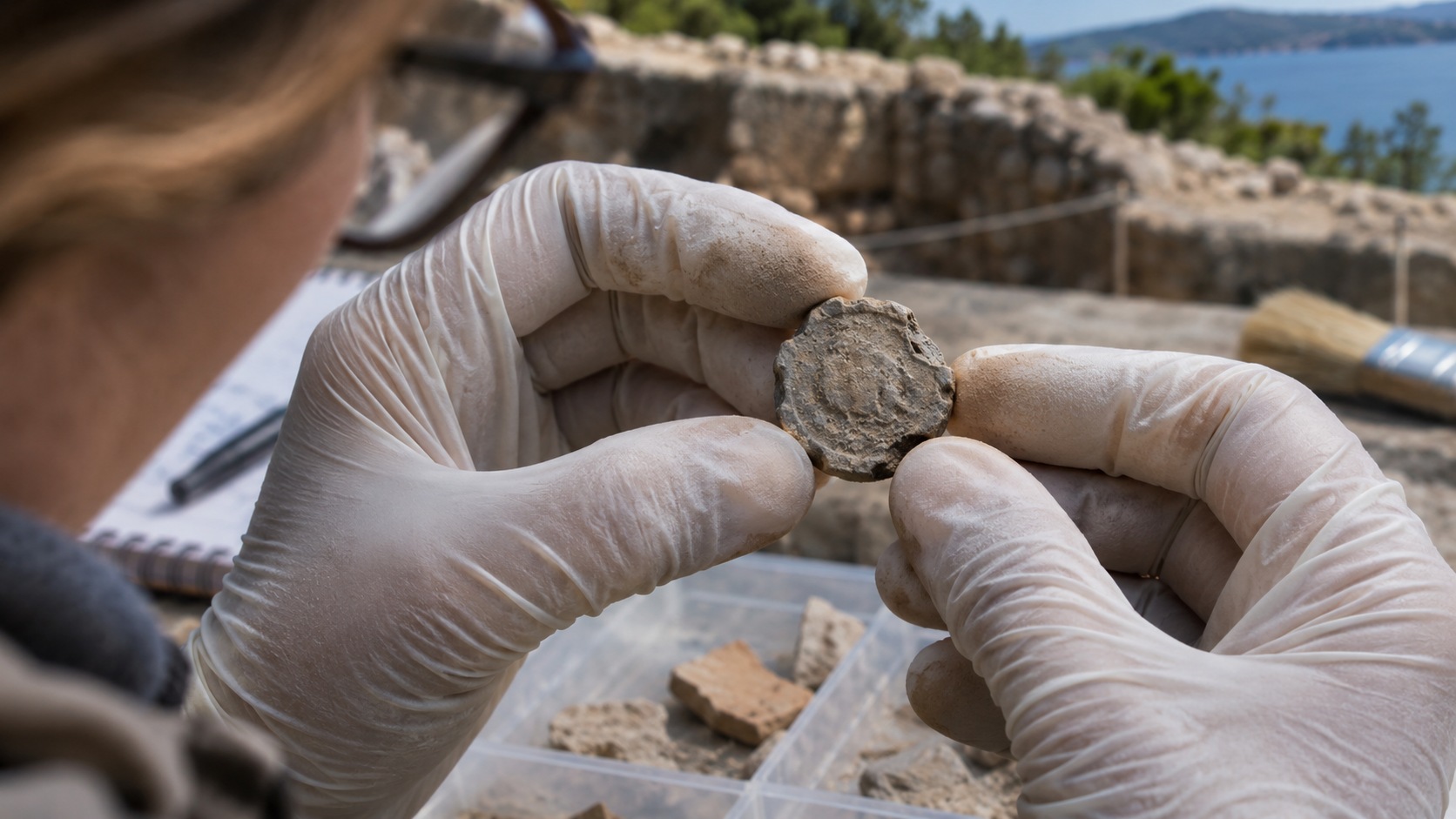
Featured image: Image created digitally for illustrative purposes. The scene is a conceptual depiction of archaeological examination, not a photograph of the actual Lukovac bishop’s seal or its discovery.