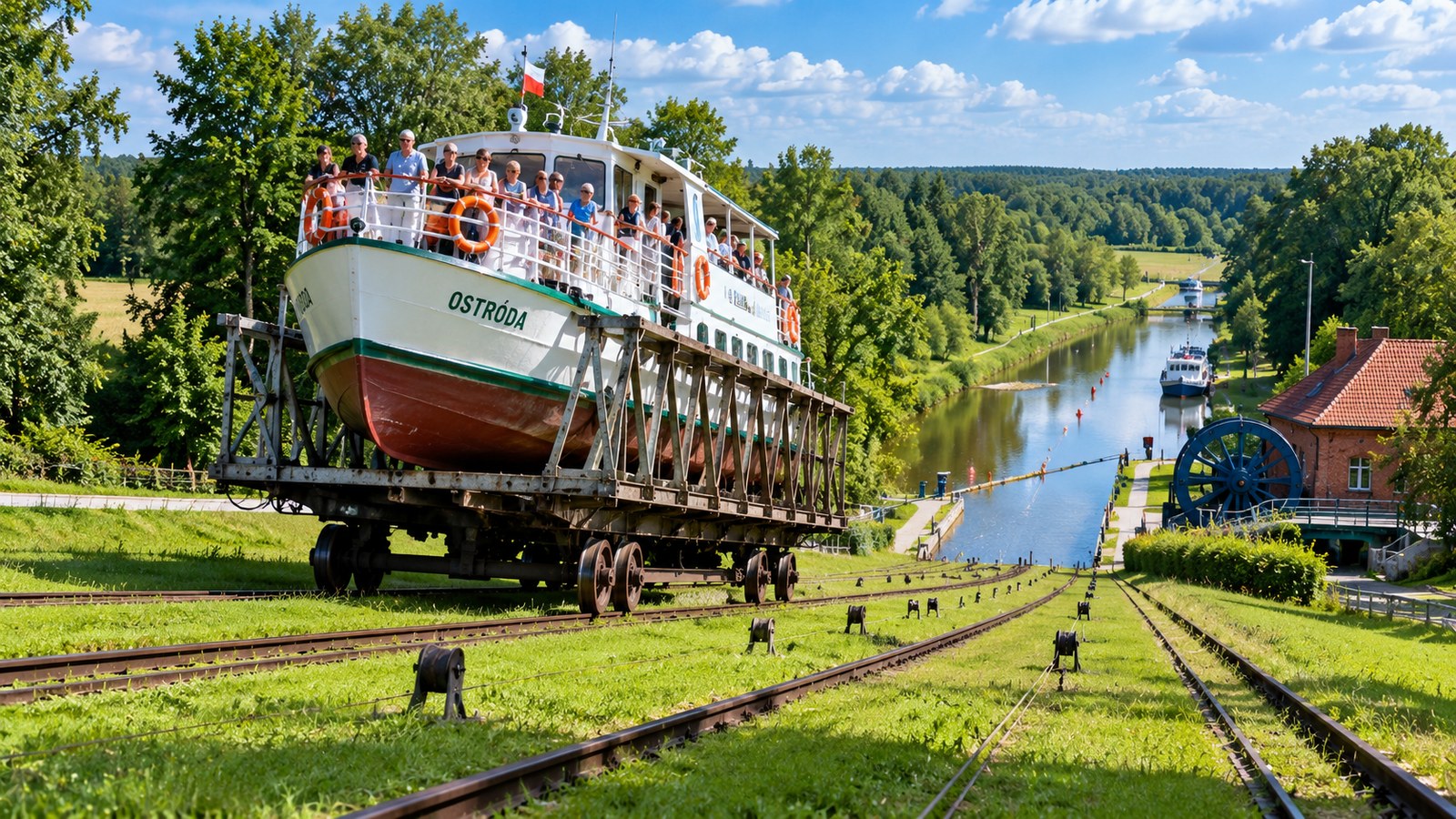
Imagine travelling along a peaceful canal in northern Poland when your boat suddenly leaves the water, climbs onto railway tracks and begins travelling across dry land.
There is no crane lifting it out. Passengers can remain aboard as the vessel moves uphill on a wheeled platform, passing grassy slopes before returning to the water at a different elevation.
This extraordinary journey is possible on the Elbląg Canal, one of Poland’s most remarkable surviving engineering landmarks.
- Find more news from Poland on our Homepage .
Built in the nineteenth century, the canal uses five inclined planes to transport boats between waterways separated by almost 100 metres in height.
Even more surprisingly, the machinery is powered by flowing water.
The system has survived for more than 160 years and remains an important part of northern Poland’s tourism and industrial heritage.
Why engineers decided to move boats over land
The Elbląg Canal runs through the lake districts of northern Poland, connecting waterways around Ostróda, Iława and Elbląg.
Its builders faced an enormous practical problem.
Between Buczyniec and Jelenie, the waterways differed in elevation by approximately 99.5 metres over a distance of around nine kilometres.
Conventional canal locks could overcome such a difference, but a series of locks would have required considerable infrastructure and large quantities of water.
The engineers developed another solution.
Instead of keeping boats afloat throughout the journey, they would transport them across land on specially designed railway-like carriages.
The system became known as a series of pochylnie, or inclined planes.
According to the Polish Waters authority’s technical description, the arrangement required substantially less water than an equivalent series of conventional locks.
Its five inclined planes are Buczyniec, Kąty, Oleśnica, Jelenie and Całuny.
Together, they allow boats to cross a section of terrain that would otherwise be an enormous obstacle to navigation.
How does a boat travel uphill without an engine?
The process is deceptively simple to watch.
A vessel approaches an inclined plane and enters a specially constructed carriage positioned on rails beneath the water.
Once the boat is properly secured, the carriage begins moving.
The rails emerge from the water, continue over the grassy slope and descend towards the next section of canal.


As the carriage travels, the boat appears to be moving across a field on a small railway.
Each inclined plane has two parallel tracks, with a carriage operating on each.
Steel cables connect the moving equipment to machinery driven by the force of flowing water.
On four of the inclined planes, waterwheels provide the necessary power. The fifth, Całuny, uses a Francis water turbine.
The carriages are drawn along the rails and back into the water at the opposite end, allowing the boats to float away and resume their journey.
There is no need for the boats’ own engines to propel them up the hillside.
Polish Waters says this solution uses approximately five times less water than the locks that might otherwise have been constructed.
It remains a striking example of engineers using the physical properties of water to solve a difficult transport problem.
A nineteenth-century invention inspired by America
The canal’s history begins when the surrounding territory formed part of the Kingdom of Prussia.
Improving transport links between the inland lakes and the Baltic trading routes was considered economically important.
The engineer responsible for developing the canal’s unusual inclined-plane system was Georg Jacob Steenke.
Steenke studied engineering solutions used elsewhere, including the Morris Canal in the United States, which also employed inclined planes to move boats between elevations.
He adapted the concept to the particular geography and water conditions of the Elbląg region.
Construction of the wider canal began in 1844.
Four inclined planes — Jelenie, Oleśnica, Kąty and Buczyniec — were completed by around 1860–1861.
The fifth, Całuny, was completed in 1883.
The project helped connect inland communities with wider commercial transport networks, allowing goods to move more efficiently through a region of lakes and difficult terrain.
Today, the canal lies within Poland, but its Prussian origins remain an important part of its engineering history.
A historic monument that still carries boats
The canal’s importance extends beyond its unusual appearance.
In January 2011, Poland formally designated the Elbląg Canal a Pomnik Historii, or Historic Monument — one of the country’s highest forms of recognition for nationally significant heritage sites.
A major restoration followed between 2011 and 2015, preserving the historic machinery while maintaining its navigational function.
Today, the canal is primarily associated with tourism.
Passenger boats and privately operated vessels use the inclined planes during the navigation season, offering visitors the unusual experience of travelling over land while remaining aboard a boat.
In 2025, Polish Waters recorded approximately 12,500 vessel transfers across the inclined planes, demonstrating that the historic equipment continues to play an active role in regional tourism.
The canal also remains the focus of investment.
In September 2026, a financing agreement was signed for a project worth approximately PLN 6.58 million, including PLN 5.92 million in European funding, to improve visitor facilities, signage and access around the canal’s historic sites.
The project is intended to support the canal’s cultural and tourism infrastructure; it should not be confused with the earlier restoration of its mechanical system.
For prospective visitors, one practical detail matters: the inclined planes operate seasonally. The 2026 navigation season has now ended, with the five planes closed for ordinary navigation until after 23 April 2027 under the current official notice.
But the canal’s most extraordinary feature remains unchanged.
More than a century and a half after engineers devised a way to move boats across hills using rails, cables and flowing water, the same basic principle still works.
In a country celebrated for medieval towns, castles and natural landscapes, the Elbląg Canal offers something different: a place where a boat can leave the water, cross a grassy hillside and continue its voyage on the other side.