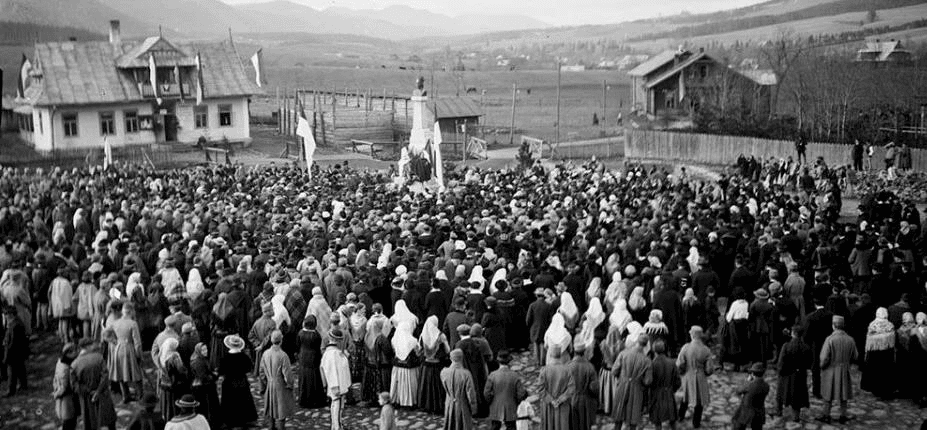
When people think of Polish independence in 1918, they usually think first of 11 November. But Poland’s return to the map did not happen everywhere at once.
In different towns and regions, local communities began taking power, rejecting the authority of the partitioning empires and acting as if an independent Polish state already existed. One of the most striking examples came in Zakopane, where a public assembly on 13 October 1918 declared its participants citizens of a free and united Poland.
That moment did not yet create a stable, sovereign state in the modern sense. But it did show how Polish independence emerged through a chain of local political initiatives as imperial rule across Central Europe began to collapse in the closing weeks of the First World War.
- Find more news from Poland on our Homepage .
A mountain resort with political energy
By the early twentieth century, Zakopane was far more than a quiet Podhale settlement.
It had become one of the best-known cultural centres in the Polish lands: a mountain resort, a gathering place for artists and writers, and a town with strong civic life. Polish intellectuals, social activists and political figures were already well established there long before 1918.
That mattered in October 1918, when the Austro-Hungarian monarchy was visibly weakening. The international situation was changing quickly, and on 7 October 1918 the Regency Council in Warsaw proclaimed the creation of an independent Polish state. In Austrian Galicia, including Zakopane, this encouraged local elites and residents to begin thinking not simply about reform, but about taking practical steps towards Polish self-government.
The assembly of 13 October
The key meeting was convened by Wincenty Regieć, the head of the Zakopane commune.
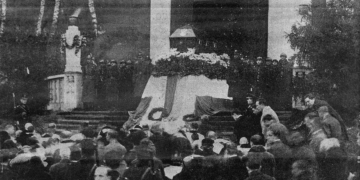
Accounts differ on the precise size of the gathering, but it clearly drew a broad cross-section of local society. The Museum of Polish History says the assembly was led by figures including Stefan Żeromski, Mariusz Zaruski and Wincenty Szymborski. Other local historical accounts also describe the gathering as an unusually broad civic mobilisation.
What mattered most was the resolution adopted there.
Its wording was explicit. Those present declared that, in light of the acceptance of President Woodrow Wilson’s peace principles by the partitioning powers, they regarded themselves from that moment onward as citizens of a free, independent and united Poland. They pledged loyalty and obedience to that Poland and rejected any bonds contrary to those duties.
This was not yet the same as a fully worked-out state administration. But politically, it was a clear statement that continued allegiance to the partitioning power was no longer accepted.
Stefan Żeromski and the making of a local republic
The 13 October assembly also established an Organizacja Narodowa, or National Organisation, with Stefan Żeromski as its head.
Żeromski is best known today as one of the major figures of modern Polish literature, but in Zakopane he also became a political symbol of the independence moment. His local authority came not from formal national office, but from personal prestige, civic involvement and the trust he inspired across sections of the community.
The new organisation was intended to take control of local affairs and guide Zakopane through the transition out of imperial rule. Among those involved were representatives of different political tendencies, which reflected both the energy and the fragility of the moment.
The sequence of events is important. The assembly of 13 October was the first key step. The formal local declaration of independence came later, on 30 October 1918. Then, on 1 November, the National Organisation transformed itself into the Rada Narodowa, or National Council, whose president became Żeromski.
For a brief period, Zakopane was therefore governed by its own local Polish authority — the entity remembered as the Republic of Zakopane.
Why Zakopane moved early
Zakopane’s action made sense in the political atmosphere of autumn 1918.
Austria-Hungary was disintegrating. Imperial legitimacy was collapsing. Across the region, communities and political movements were trying to act before others decided their future for them.
Zakopane’s local activists did not want to wait passively for the final collapse of the old order or for every Polish institution elsewhere to settle its own status. Instead, they moved early and publicly aligned the town with an independent Poland.
That helps explain why the episode remains so memorable. The phrase “Republic of Zakopane” sounds almost romantic, and in some ways it was. But it was also a serious act of local politics: an attempt to replace imperial authority with Polish civic authority before the national picture was fully settled.

A short-lived republic
The Republic of Zakopane did not last long.
Its existence belonged to the fluid and transitional weeks in which the old empires were falling and new national institutions were being formed. According to the Museum of Polish History, it ceased to exist on 16 November 1918, when control passed to the Polish Liquidation Commission, the body established in Kraków to take over former Austrian territories in the name of the restored Polish state.
That short lifespan should not make the episode seem trivial. On the contrary, it illustrates how independence in 1918 was built from the ground up as well as from the top down.
National leaders and central institutions mattered, but so did towns, cities and local assemblies that began acting as Polish before the final national settlement was complete.
Independence as a process, not a single moment
That is why Zakopane matters in the story of 1918.
The town did not “become Poland” in isolation, and its local republic was never a separate long-term state project. It was part of the broader Polish independence movement and quickly folded into the institutions of the restored republic.
But the episode shows that Polish independence was not a single instant that descended on the whole country at the same time.
It was a process.
In Zakopane, that process began publicly on 13 October 1918, when residents gathered and declared themselves citizens of a free Poland. The formal local declaration followed on 30 October, and within weeks the town became part of the new Polish state.
That makes the Republic of Zakopane one of the most intriguing local chapters in the history of Poland’s return to independence — and a reminder that the road to 11 November was more complicated, and more locally driven, than a single commemorative date can fully capture.