


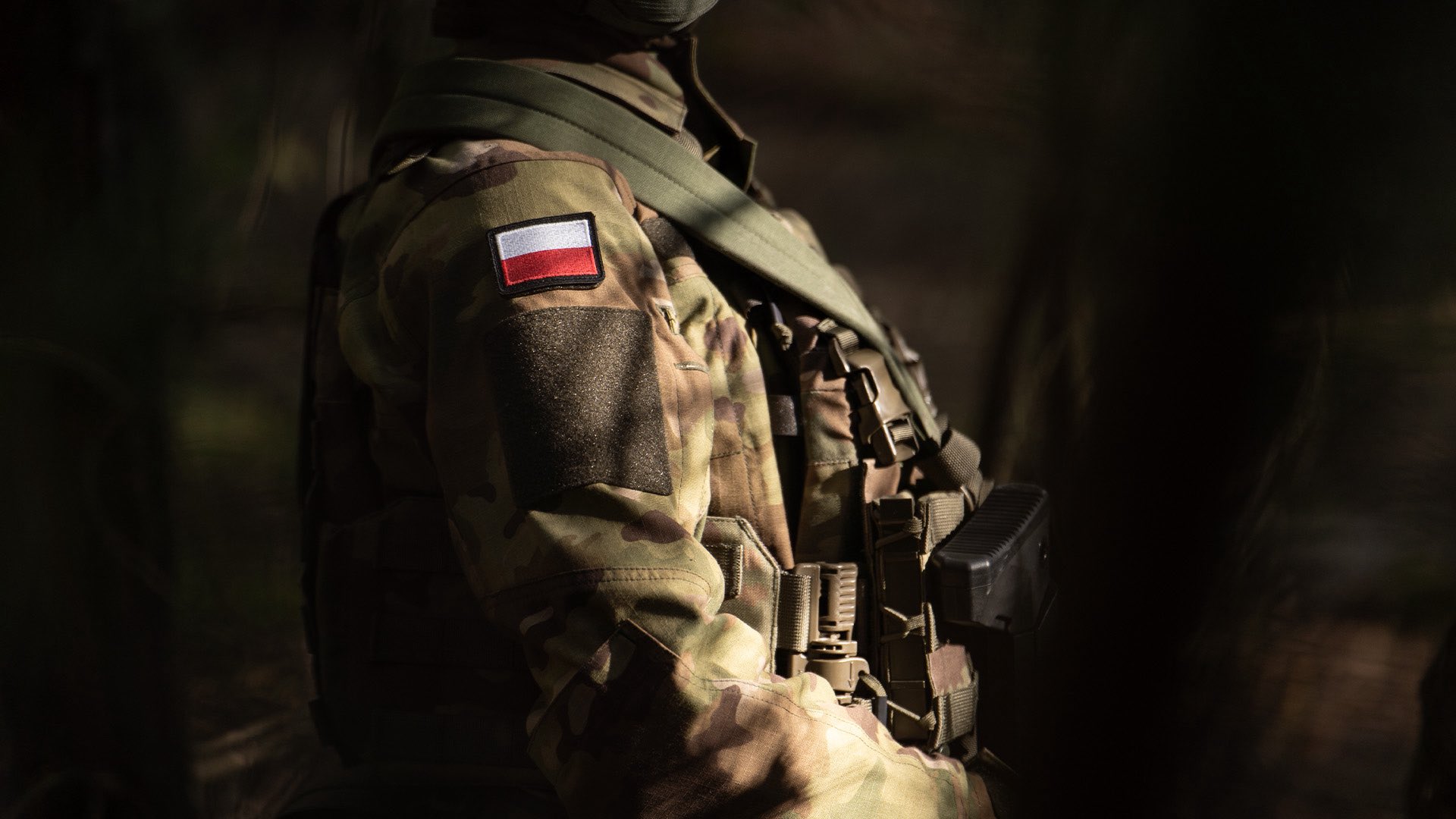
Poland has unveiled a new generation of military uniforms and a completely redesigned camouflage pattern, marking the biggest change to the appearance of Polish soldiers in more than three decades. The K-03 “Ryś” system is intended to replace the wz. 93 “Pantera” camouflage used since the early 1990s, with the Defence Ministry promising lighter and tougher materials, improved concealment and, for the first time, a version specifically cut for female soldiers.
The new equipment was formally presented on Monday at the headquarters of the 1st Legions Infantry Division in Ciechanów, attended by Defence Minister Władysław Kosiniak-Kamysz, senior ministry officials and military commanders.
The ministry says 7,500 of the new uniforms are expected to reach soldiers before the end of 2026, with the transition expanding over the following two years. Deputy Defence Minister Cezary Tomczyk said the goal is for every professional soldier to have the new tactical uniform in Ryś camouflage by the end of 2028.
- Find more news from Poland on our Homepage .
‘Pantera’ gives way to ‘Ryś’
The familiar wz. 93 “Pantera” pattern has been associated with the Polish Armed Forces for 33 years.
Its replacement is not simply a change in the shape or colour of the camouflage.
According to the Defence Ministry, the new uniform incorporates changes to its cut, fabric, ergonomics and camouflage performance, after testing involving serving soldiers and military specialists.
The new K-03 Ryś camouflage uses five colours selected to reflect tones found in the Polish landscape.
🇵🇱 After more than 30 years, soldiers of the Polish Army will receive a new field uniform. https://t.co/yzCv9liRU8
— Poland 24 🇵🇱 (@poland24com) October 5, 2026
Its irregular shapes and tonal transitions are designed to break up the outline of a soldier rather than create an easily recognisable repeating pattern.
Military testing presented during Monday’s launch suggests the new camouflage performs around 30% better than the existing Pantera pattern in concealment trials. That figure comes from tests presented by the military and should therefore be understood as a Defence Ministry assessment rather than an independently established battlefield measurement.
The pattern was evaluated in different terrain and seasons, including woodland and built-up environments, as well as under different observation methods.
Tougher fabric and a separate women’s cut
The changes also extend to the fabric itself.
Data presented during the launch indicate that the new material has around 30% greater tear resistance, approximately seven times greater abrasion resistance and more than double the air permeability of the previous material.
The fabric combines four materials and is intended to remain lighter and more flexible while coping better with prolonged field use.
Another significant change is the introduction of a dedicated cut for female soldiers rather than relying principally on uniforms designed around male body proportions.
Kosiniak-Kamysz presented that as part of a broader effort to improve conditions for women serving in the armed forces.
The new uniforms are expected to be used across most branches of the Polish military rather than being limited to a single formation.
Poland plans to produce the uniforms domestically
The Defence Ministry says the new uniform was designed in Poland and is intended to be manufactured entirely in the country.
Officials have also taken the unusual step of seeking legal protection for the new camouflage pattern in Poland and across the European Union. Previous Polish military camouflage patterns were not protected in the same way.
The ministry argues that domestic manufacturing should provide greater control over supplies as Poland rapidly expands and modernises its armed forces.
Kosiniak-Kamysz said the government intends to spend at least PLN 1 billion on new uniforms in 2027, making the programme considerably more than a cosmetic redesign.


Designed alongside other modern equipment
The Ciechanów presentation also showed the new camouflage alongside other equipment being introduced or developed for Polish troops.
That included integrated body armour, modern helmets and individual weapons, demonstrating how the uniform is intended to work as part of a broader soldier equipment system rather than as a standalone item.
Poland has been investing heavily in military expansion since Russia’s full-scale invasion of Ukraine, purchasing new tanks, artillery, aircraft, air-defence systems and other equipment while increasing troop numbers.
The new uniforms represent a less spectacular but highly visible part of that wider modernisation programme.
For soldiers, however, the practical changes — durability, ventilation, fit and compatibility with body armour — may matter more day to day than the new appearance.
Change will be gradual
Monday’s unveiling does not mean that every Polish soldier will immediately exchange Pantera for Ryś.
The first 7,500 uniforms are expected this year, followed by a much larger procurement programme in 2027 and 2028.
Existing uniforms will therefore continue to be seen during the transition.
Polish regulations already provide for some older field-uniform items to remain in use for several years, meaning different generations of equipment can coexist while stocks are replaced.
But after more than three decades in which Pantera became one of the most recognisable features of the Polish soldier, the Defence Ministry has now made clear what is intended to replace it.
If the rollout proceeds as planned, Ryś will become the standard visual identity of Poland’s rapidly modernising armed forces before the end of the decade.