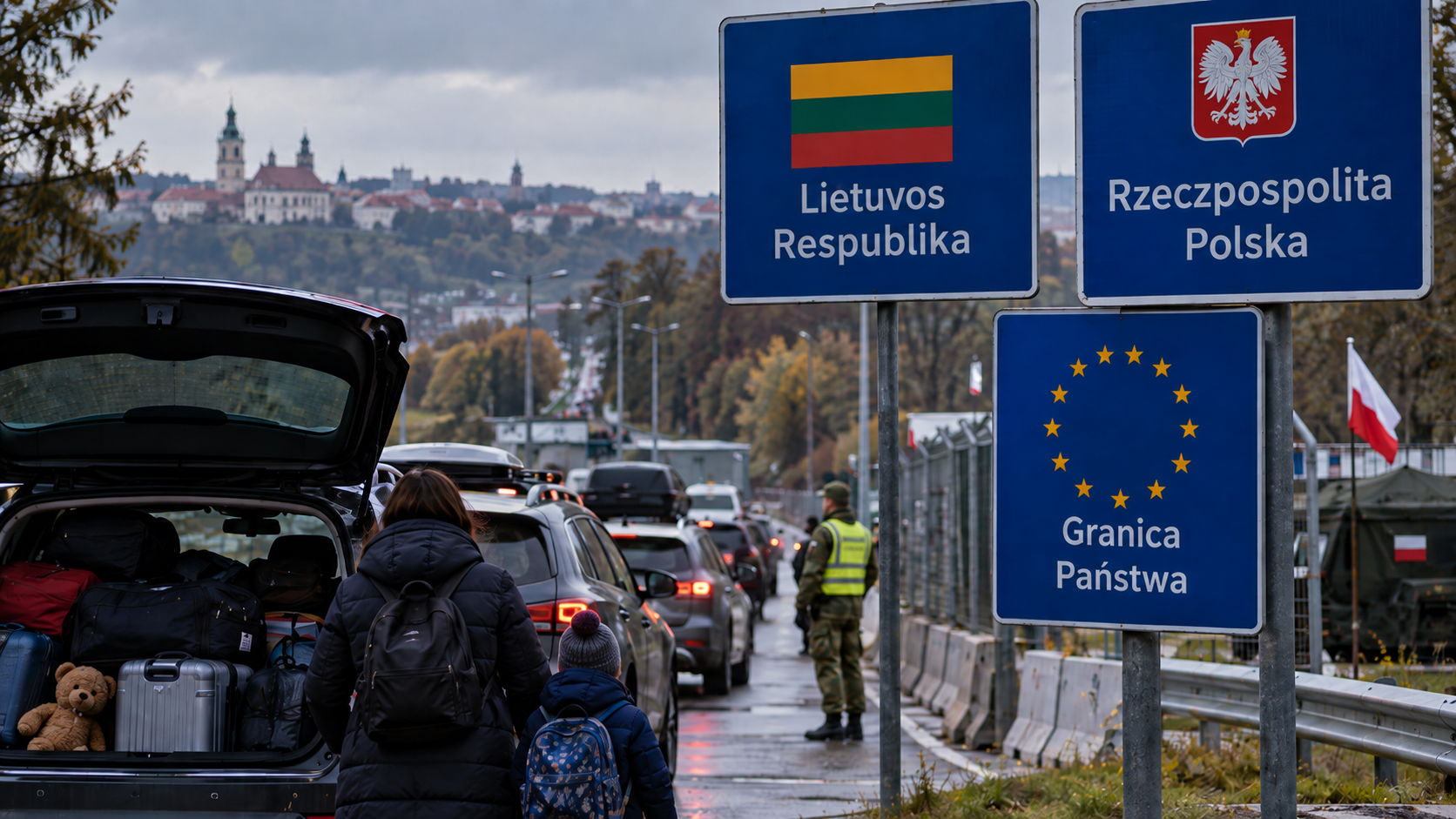
Lithuania has incorporated a route towards Poland into emergency evacuation planning for Vilnius, while authorities on the Polish side prepare for the possibility that civilians from Lithuania and the other Baltic states could need to move through north-eastern Poland during a major crisis.
The plan does not mean Lithuania is currently evacuating its capital or expects an attack to be imminent. It forms part of wider civil-defence preparations being developed across the region in response to military and hybrid threats.
Žygimantas Solovjovas, head of the Civil Protection Department at Vilnius city government, told Polish Radio that Poland is one of three principal evacuation directions envisaged for residents of the Lithuanian capital.
- Find more news from Poland on our Homepage .
The other routes would lead north towards Panevėžys and Šiauliai and west towards Kaunas and Klaipėda, according to reporting by InfoSecurity24.
Vilnius lies around 40 kilometres from Belarus, giving evacuation planning particular importance in Lithuanian civil-defence preparations.
Which routes would actually be used would depend on the location and nature of a threat.
People with their own vehicles would be directed along designated routes, while municipal authorities would organise transport for residents unable to leave independently.
Solovjovas stressed that evacuation would need to begin before an area came under direct attack.
Residents should not assume they could simply leave Vilnius along evacuation routes while the city was being shelled, he said. In such circumstances, the immediate instruction would instead be to seek shelter.
The objective, he said, is to make evacuation a controlled process rather than allow large numbers of people to leave simultaneously without coordination.
Poland prepares Podlaskie as a transit corridor
The Lithuanian planning has a direct Polish dimension.
Authorities in Podlaskie, the Polish region bordering Lithuania and Belarus, say they have begun working on preparations for the area to serve as a transit corridor for people leaving Lithuania, Latvia and Estonia during a large-scale emergency.
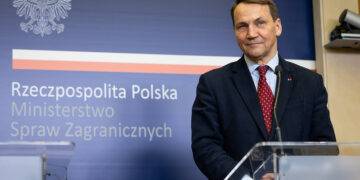
Paweł Krutul, first deputy governor of Podlaskie province, told Polish Radio Białystok this week that the region already has plans for the mass evacuation of its own residents but is now confronting the additional challenge of handling people arriving from the Baltic states.
He described the cross-border transit issue as relatively new and said officials wanted contingency plans developed quickly.
“This is still a fresh issue and we are only beginning to work on it,” Krutul said. “Hopefully it will never happen, but we have to be prepared for these worst-case scenarios as quickly as possible.”
All local authorities in Podlaskie are currently being involved in the contingency work, according to Krutul.
The planning does not mean Poland has announced preparations to permanently accommodate the entire population of Vilnius or the Baltic states.
The intended role described for Podlaskie is primarily that of a transit corridor through which evacuees could move farther into Poland or potentially elsewhere in Europe.
Lithuania adopts national evacuation plan
The Vilnius arrangements sit within a much broader Lithuanian civil-defence system.
In July, Lithuania formally approved a detailed national population evacuation plan establishing a single framework for evacuations during military or civilian emergencies.


The plan covers decisions to evacuate, public warnings, transport, temporary accommodation, registration of evacuees and the provision of medical, social and humanitarian assistance.
🇱🇹 🇵🇱 Lithuania has prepared routes for a potential mass evacuation of Vilnius in the event of a military threat — including one toward Poland.
— Poland 24 🇵🇱 (@poland24com) September 18, 2026
The capital lies just 30 km from Belarus. Authorities say evacuations would begin before an immediate threat reached the city; during…
Responsibilities are distributed across the Interior Ministry, Fire and Rescue Department, police, transport, health and social authorities, local governments and other agencies.
Lithuanian authorities have also made coordination between civilian evacuation and military movements a central part of the system.
Municipal evacuation routes are to be coordinated with military commandants, the Lithuanian armed forces and police so civilian movement does not obstruct military mobility during a crisis.
Lithuania has separately allocated €6 million to municipalities for evacuation preparedness. The projects are intended to give local authorities capacity to temporarily house around 50,000 evacuees, equip more than 1,000 evacuation-point staff and train over 200 volunteers.
Baltic states and Poland coordinate evacuation planning
Cross-border planning has also moved beyond individual national preparations.
In May, Lithuanian, Latvian, Estonian and Polish representatives met in Vilnius to discuss civil protection, crisis management and potential mass-evacuation scenarios.
Lithuania’s Interior Ministry said the talks covered evacuation corridors, transport capacity, accommodation and mechanisms for exchanging information between governments.
The discussions followed a memorandum of understanding between Poland and the Baltic states aimed at improving cooperation in civil protection.
Officials agreed that national systems needed to be connected because a large-scale emergency could rapidly become a regional problem.
Lithuanian Deputy Interior Minister Ana Burkovskienė said the security environment required governments to move from political agreements towards practical measures, including coordinated procedures and exercises.
“Threats don’t respect borders, so our response must be regional,” she said.
The participating countries also discussed holding joint tabletop exercises that could eventually develop into larger cross-border evacuation drills.
Why Poland matters to Baltic evacuation planning
Geography makes Poland crucial to almost any large-scale overland movement from Lithuania towards the rest of NATO and the European Union.
Lithuania shares borders with Latvia, Belarus, Poland and Russia’s Kaliningrad exclave.
The relatively narrow Polish-Lithuanian frontier forms the land connection between the Baltic states and the remainder of NATO territory — an area widely known as the Suwałki Gap.
That corridor has long been regarded as strategically important for moving allied forces northwards in a military crisis.
Civil-defence planning demonstrates the other side of the same geography: in an emergency, large numbers of civilians could potentially need to move south through the same region while NATO forces and equipment travel in the opposite direction.
That is one reason Lithuanian authorities stress coordination between military mobility and civilian evacuation.
For Poland, it means Podlaskie could have to manage not only its own population during a crisis but also large flows of people arriving from neighbouring NATO countries.
No evacuation has been ordered and the preparations do not indicate that Lithuanian or Polish authorities believe conflict is inevitable.
They are instead part of an increasingly detailed regional effort to prepare civilian systems for contingencies that, before Russia’s full-scale invasion of Ukraine, received considerably less attention across much of Europe.