

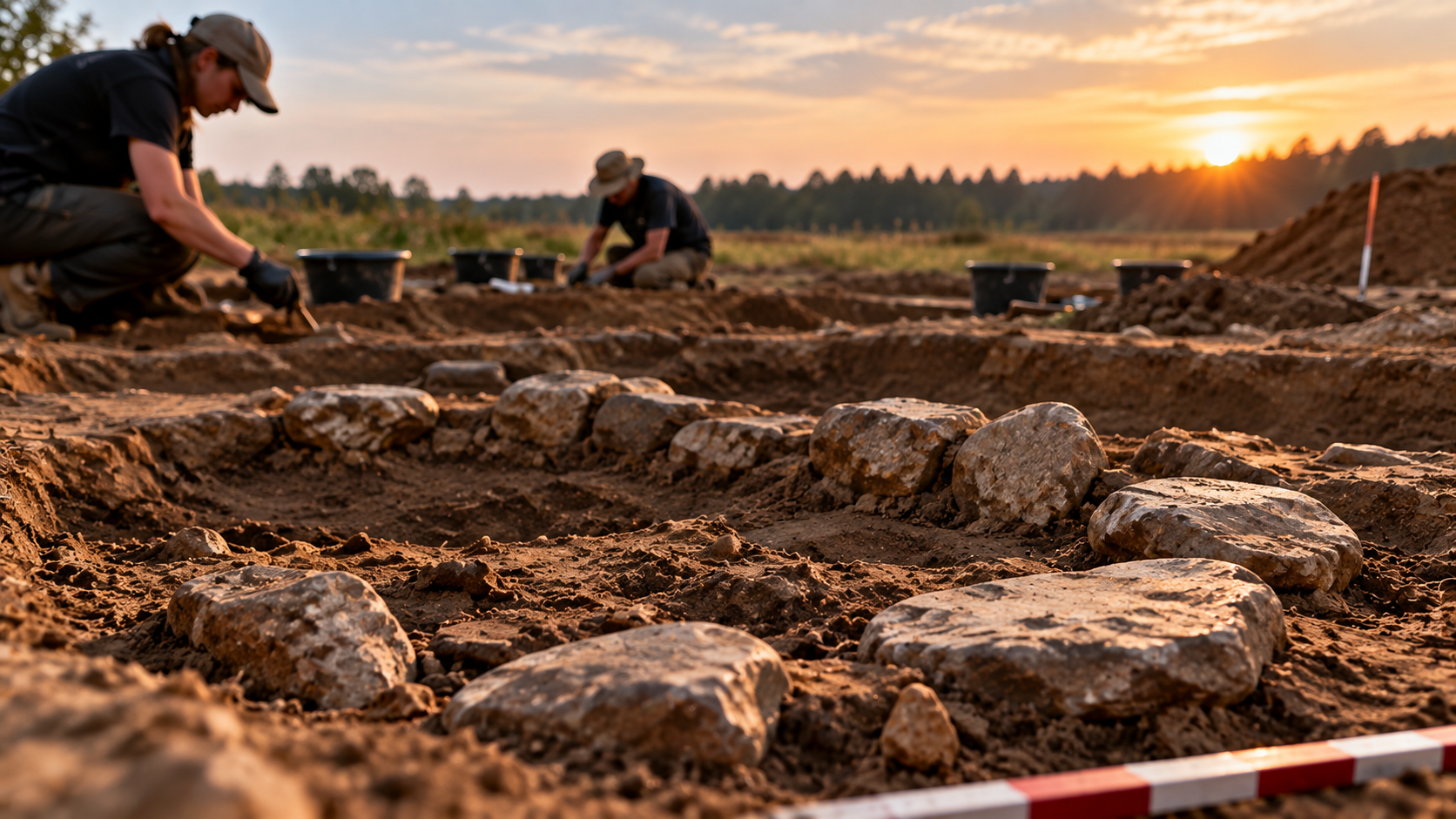
A thousand years ago, people living in what is now central Poland buried their dead with weapons, jewellery, tools and carefully arranged stone structures. This summer, archaeologists opened another ten of those graves.
The discoveries were made at an early medieval cemetery in Kwiatkowice, around 25 kilometres west of Łódź, where a Polish research team has just completed its third season of excavation. The cemetery dates to the 11th century, a period closely associated with the consolidation of the early Piast state.
Among the finds are elements of weaponry, everyday tools and personal ornaments. Female burials contained necklaces made from glass and silver beads, together with temple rings — characteristic early medieval ornaments normally worn beside the head and attached to a band or headdress. Some graves also contain substantial stone arrangements whose precise significance remains under investigation.
- Find more news from Poland on our Homepage .
The site gives researchers something more valuable than a collection of individual objects. Taken together, the graves provide evidence of how communities in central Poland treated their dead at a time when social structures, customs and religious practices were changing.
Different ways of burying the dead
Kwiatkowice is described by researchers as a biritual cemetery because more than one type of burial practice is represented there.
Most of the graves uncovered so far contain inhumations, in which the body was buried without being cremated. Earlier excavation seasons, however, also revealed cremation burials. Archaeologists caution against interpreting that difference as a simple division between “Christian” and “pagan” graves. Burial customs could change gradually and different traditions could continue alongside one another.
There were rules within the cemetery too. In the graves examined by researchers, women were buried with their heads towards the west, while men were orientated towards the east — a pattern suggesting that the placement of the dead followed established conventions.
After three seasons, around 30 burials have been uncovered, but researchers still do not know the full extent of the cemetery. Bone preservation is poor, limiting the amount specialists can learn directly about the age, health and biological characteristics of the people buried there. Soil conditions and centuries of farming are thought to have contributed to the deterioration.
That makes the surviving objects and structures particularly important.
A sword led archaeologists back to the site
The story of the excavation itself stretches back decades.
Before the Second World War, the director of a nearby school passed a sword to the State Archaeological Museum in Warsaw and other objects, including a spearhead, to a museum in Łódź. Records said the artefacts had been found in a field belonging to a Kwiatkowice resident, but the location was not precise enough for archaeologists to identify the site.
Researchers returned to the puzzle many decades later. Around 2022 they located descendants of the former landowner, secured the necessary permissions and began surveying the suspected field. Early searches produced silver ornaments and pieces of weaponry, helping confirm the presence of the medieval site. Systematic excavation followed.
The present project brings together the Archaeological and Ethnographic Museum in Łódź, the University of Łódź’s Institute of Archaeology and the Institute of Archaeology and Ethnology of the Polish Academy of Sciences. Students from the University of Łódź also participate in the fieldwork.
This year the team complemented excavation with non-invasive geophysical surveying led by Tomasz Herbich of the Polish Academy of Sciences. The technique can detect differences beneath the ground without excavating it, helping researchers identify potential structures and plan where future trenches should be placed.
Further work is expected to refine the cemetery’s chronology, establish its boundaries and reveal more about differences between individual burials.
A sword found in a field before the Second World War provided one of the earliest clues. Nearly a century later, the soil at Kwiatkowice is still revealing the community that left it behind — grave by grave.