

On 26 September 1920, Soviet commander Mikhail Tukhachevsky ordered his forces to retreat as a Polish offensive threatened to outflank and encircle his Western Front. It was the decisive moment in the Battle of the Niemen — the major Polish victory that followed the better-known Battle of Warsaw and helped determine the military outcome of the Polish-Soviet War.
The date requires some precision. The Institute of National Remembrance dates the wider Battle of the Niemen to 20–28 September 1920, and fighting and pursuit continued after Tukhachevsky’s retreat order. But by 26 September the central contest had been decided: the Soviet commander was no longer preparing to resume his advance westwards but trying to save his forces from destruction.
A war over the shape of Eastern Europe
Poland had returned to the map of Europe only in November 1918, after more than a century in which its territory had been divided between the Russian, German and Austro-Hungarian empires. Independence did not immediately produce settled borders. Across Central and Eastern Europe, the collapse of the old empires and the Russian Revolution had left competing states and political movements fighting over territory and the political order that would replace them.
- Find more news from Poland on our Homepage .
The Polish-Soviet conflict developed against this background in 1919. It was not simply a conventional border dispute. The Bolshevik leadership in Moscow hoped revolutionary governments would spread westwards, while Józef Piłsudski pursued his own vision of an Eastern Europe in which independent states, including Ukraine, would stand between Poland and Russia. Polish and Soviet forces therefore fought across territories inhabited by mixed Polish, Belarusian, Ukrainian, Lithuanian and Jewish populations, many of which today lie outside Poland.
In spring 1920, Poland and the forces of Ukrainian leader Symon Petliura launched an offensive that captured Kyiv. The success proved temporary. Soviet forces counter-attacked, the Polish armies retreated hundreds of kilometres, and by the summer the Red Army was advancing rapidly towards central Poland. The survival of the recently restored Polish state appeared to be in question.
Warsaw stopped the advance — but did not end the war
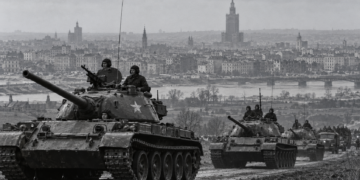
The crisis culminated in the Battle of Warsaw in August 1920. Fighting around the Polish capital was accompanied by a major counter-offensive launched from the Wieprz River on 16 August, striking the exposed flank and rear of Tukhachevsky’s Western Front. The Red Army was forced into a rapid retreat.
Warsaw transformed the strategic situation. A Soviet offensive that had carried the Red Army deep into Poland had been broken, and the immediate danger to the capital and Polish statehood had passed.
But the victory did not end the war.
Tukhachevsky withdrew eastwards and rebuilt his forces along a new defensive line centred on the Niemen, Szczara and Świsłocz rivers. Reinforcements arrived, units were reorganised and Soviet commanders considered renewed offensive operations. The Institute of National Remembrance notes that Tukhachevsky did not regard the war as lost and intended to restore the combat strength of his Western Front before attacking again.
This is why the Battle of the Niemen matters to understanding what happened after Warsaw. Warsaw had reversed the Soviet advance. Niemen would determine whether that reversal was temporary.
Piłsudski moves before Tukhachevsky can recover
The Polish high command decided not to give the Soviet armies time to regain the initiative.
On 19 September, Piłsudski issued orders for another major offensive. Polish forces attacked the following day, initially putting pressure on the Soviet centre around Grodno — today Hrodna in Belarus — and the Niemen River. Tukhachevsky interpreted the fighting there as the principal Polish effort and moved reserves towards the area.
The central attacks, however, were only part of the plan.
Polish troops also carried out a wide northern manoeuvre through territory contested with Lithuania, aiming to move around the Soviet flank and reach the rear of Tukhachevsky’s armies. The operation involved territory whose political status was itself disputed during the unsettled post-First World War years, making the military geography of the campaign inseparable from the wider Polish-Lithuanian territorial conflict.
Heavy fighting continued around Grodno while the flanking force advanced. The Soviet command increasingly faced the danger that Polish troops would sever communications and block withdrawal routes to the east.
By the evening of 25 September, Polish successes around Lida — today in western Belarus — had shifted the balance decisively. The following day, with his forces threatened by encirclement, Tukhachevsky ordered a general withdrawal.
From Warsaw to Niemen
The relationship between the two battles is central to the campaign.
At Warsaw, Poland had broken a Soviet offensive that had reached the approaches to the capital. At the Niemen, Polish forces faced an enemy that had survived that defeat, regrouped and still possessed significant forces capable of continuing the war.
The second victory denied the Red Army the opportunity to rebuild the strategic position it had lost in August. Instead of preparing another advance towards Poland, Soviet forces were again retreating eastwards.
The distinction is useful: Warsaw saved Poland from the immediate Soviet offensive; Niemen helped ensure that the Red Army could not simply regroup and try again.


The pursuit continued
The battle did not end abruptly on 26 September. Polish troops pursued retreating Soviet formations into the final days of September and early October.
The Soviet Western Front had escaped complete encirclement, but it had again suffered a major operational defeat. Polish forces continued advancing eastwards, while allied Ukrainian formations also remained in the field. By early October the Polish army had recovered much of the ground lost during the Soviet summer offensive.
Yet Poland was not preparing for an unlimited march into Soviet territory. After years of conflict beginning with the First World War and continuing through struggles over the borders of the restored state, both the Polish political establishment and wider society were increasingly exhausted by war.
Peace negotiations were already under way in Riga, Latvia, where Polish and Soviet representatives had begun talks on 21 September — while the Battle of the Niemen itself was still being fought. Military operations and diplomacy were therefore unfolding simultaneously, with events on the battlefield directly influencing the bargaining position of both sides.
The armistice and the Treaty of Riga
The military situation after the Niemen strengthened Poland’s position, while the Soviet leadership had compelling reasons to bring the conflict to an end. On 12 October 1920, the two sides signed preliminary peace terms and an armistice in Riga.
The ceasefire took effect on 18 October. Fighting continued until the deadline, meaning the end of the Battle of the Niemen should not be confused with the end of the Polish-Soviet War itself.
Five months later, on 18 March 1921, Poland, Soviet Russia and Soviet Ukraine signed the Treaty of Riga, formally ending the war and establishing Poland’s eastern frontier for most of the interwar period. The agreement also dealt with citizenship, repatriation, property and cultural assets, although important provisions — including some Soviet financial obligations — were never fully implemented.
The settlement did not realise Piłsudski’s ambition of constructing a federation of independent states between Poland and Russia. Large parts of Belarus and Ukraine remained under Soviet rule, while their western territories became part of the Second Polish Republic. Poland’s Ukrainian allies under Petliura were left outside the settlement; after continuing the struggle without Polish military support, their forces were defeated and many crossed into Poland, where they were interned.
A second decisive victory
The Battle of Warsaw understandably dominates the memory of 1920. It was fought at the moment when the danger to Poland was most immediate, with Soviet armies approaching the capital and the survival of the newly restored state at stake.
The Niemen was different. It was the battle that came after the apparent turning point — when the defeated Soviet armies had regrouped and the question remained whether Warsaw represented the end of their offensive power or merely an interruption.
The answer emerged in the fighting from Grodno to Lida in September 1920. Tukhachevsky’s armies were forced eastwards once again, Poland retained the strategic initiative, and within weeks an armistice had been signed.
That is why the Battle of the Niemen belongs beside Warsaw in the history of the Polish-Soviet War. One stopped the advance on the Polish capital. The other helped ensure that it would not be resumed.