

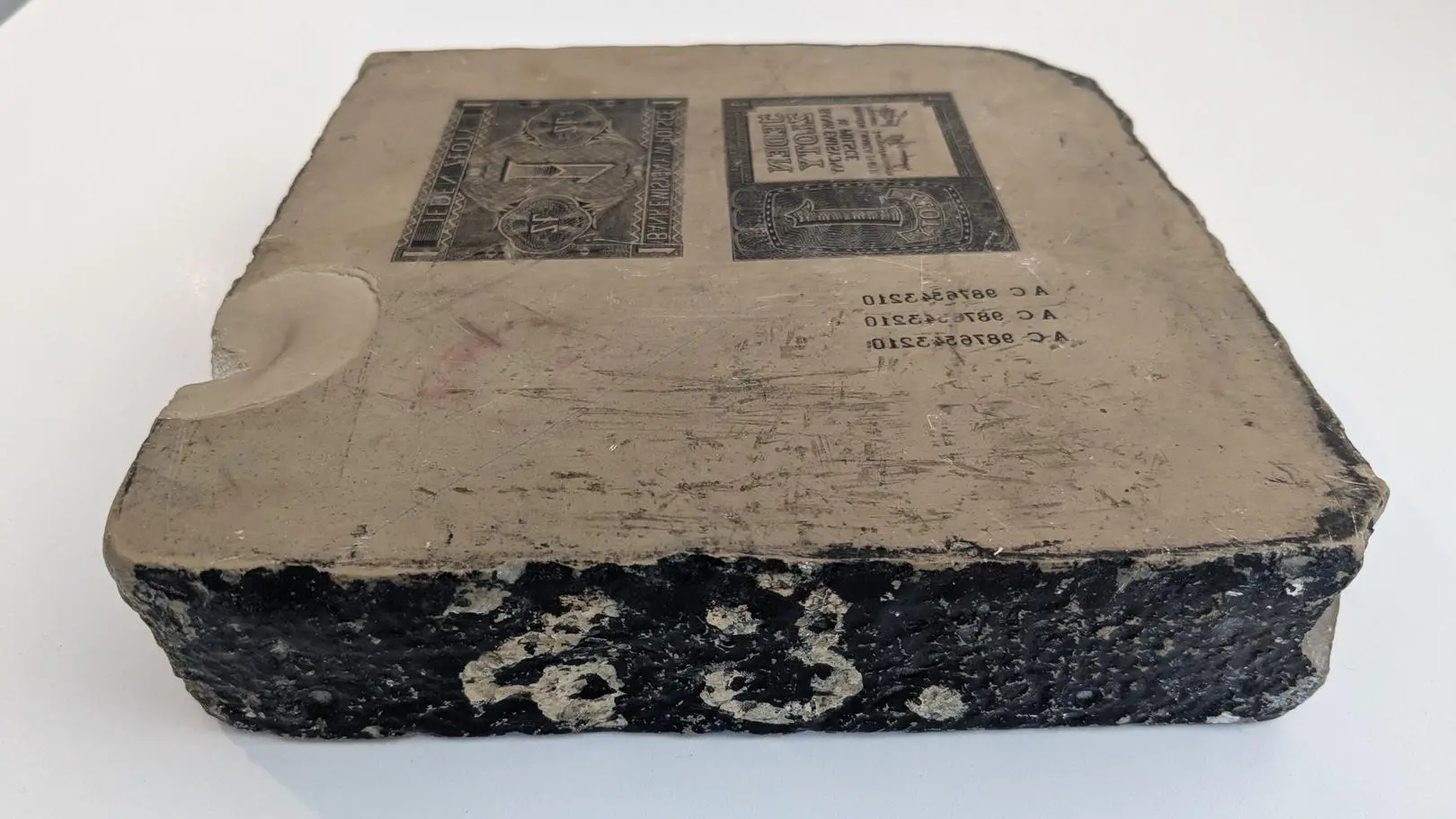
A renovation project in the heart of Poland’s capital has yielded a startling historical discovery: a stone plate used by resistance fighters during World War II to counterfeit German-controlled currency.
The artifact, known as a lithographic matrix, was uncovered beneath wooden flooring inside the headquarters of Bank Gospodarstwa Krajowego (BGK), Poland’s national development bank. Located in a landmark building at the intersection of Aleje Jerozolimskie and Nowy Świat, the site has stood as a financial and historical cornerstone of Warsaw for nearly a century.
“This is an extremely rare find,” said Radosław Milczarski, the bank’s historian. “It’s not just a printing tool — it’s a relic of resistance, innovation, and survival under occupation.”
- Find more news from Poland on our Homepage .
Printing Against Oppression
The stone matrix, measuring roughly 18 by 19 centimeters (7 by 7.5 inches), features the mirror image of a one-złoty banknote from the WWII era. Visible inscriptions include “BANK EMISYJNY W POLSCE” — the so-called “Issue Bank in Poland” set up by Nazi authorities — and “JEDEN ZŁOTY,” or “one złoty.”
The banknote’s design corresponds with the German-controlled currency used in the General Government — the area of Poland occupied by Nazi forces during WWII. Polish experts believe the plate was created by underground printers to forge small-denomination banknotes and support clandestine economic operations.
The plate was found in excellent condition, despite being hidden under floorboards for more than 80 years. It was discovered during a restoration project leading up to the bank’s centennial celebration in 2024. While the project encountered delays, its detailed preservation work ultimately led to the find.
The Art of Resistance
Historical and technical experts from the Warsaw Uprising Museum and the Polish Security Printing Works confirmed the matrix was used for producing counterfeit notes. These notes, known as młynarki, were named after Feliks Młynarski, the prewar head of Poland’s national bank. Though repurposed by Nazi authorities, the notes were based on prewar Polish currency.
The lithographic process involved drawing a banknote’s design in reverse on the stone plate using greasy ink or crayon. Ink would cling only to those areas during printing, allowing for high-quality reproductions.
“This method was both elegant and accessible,” said Milczarski. “But it also required precision, and coordination across a network of brave individuals willing to risk everything.”
The matrix lacks certain anti-counterfeiting features, such as background guilloche patterns. Experts believe forgers may have used pre-printed paper or separate printing layers to complete the illusion — evidence of a complex and organized operation.
More Than Money
According to Milczarski, small banknotes were ideal for forgeries because they drew less scrutiny in everyday transactions. “A high-value note might be checked, but a one-złoty bill? It passed through hands quickly, feeding the resistance economy without raising eyebrows.”
The plate also offers fresh insights into Poland’s lesser-known economic resistance during the war. While many countries focus on armed uprisings or espionage, Poland’s underground included a financial front — with secret operations printing money, identity papers, and ration cards to outmaneuver the occupiers.
BGK itself played a subtle yet vital role during the occupation. Though officially under German administration, loyal employees smuggled funds, documented resistance activities, and maintained covert archives. It’s unknown exactly how the matrix ended up beneath the floor, but many speculate it may have been hidden in anticipation of Nazi inspections or post-war purges.
A Silent Witness
The artifact arrives at a time when surviving witnesses of World War II are quickly disappearing. One of the last known veterans of Poland’s underground printing operations, Juliusz “Julek” Kulesza, passed away earlier this year — on the very day the matrix was discovered.
“There’s a poetic symmetry to it,” said Milczarski. “As one chapter ends, we’re finding new pages to study.”
Background for International Readers
During World War II, Nazi Germany established the General Government in occupied Poland and imposed its own administrative structures — including the Bank Emisyjny, which controlled local currency. Polish resistance groups like the Home Army (Armia Krajowa) carried out not only armed operations but also information warfare and counterfeiting to fund and protect their activities.
The Polish Security Printing Works (PWPW), a state-run institution responsible for producing passports and money, was infiltrated by resistance fighters who operated a clandestine print shop — codenamed PWB/17 — under German noses. Their mission: to supply the resistance with forged documents and currency without detection.
Bank Gospodarstwa Krajowego (BGK), founded in 1924, has been a key financial institution in Polish history. During the war, its employees risked their lives by aiding the underground movement from within.