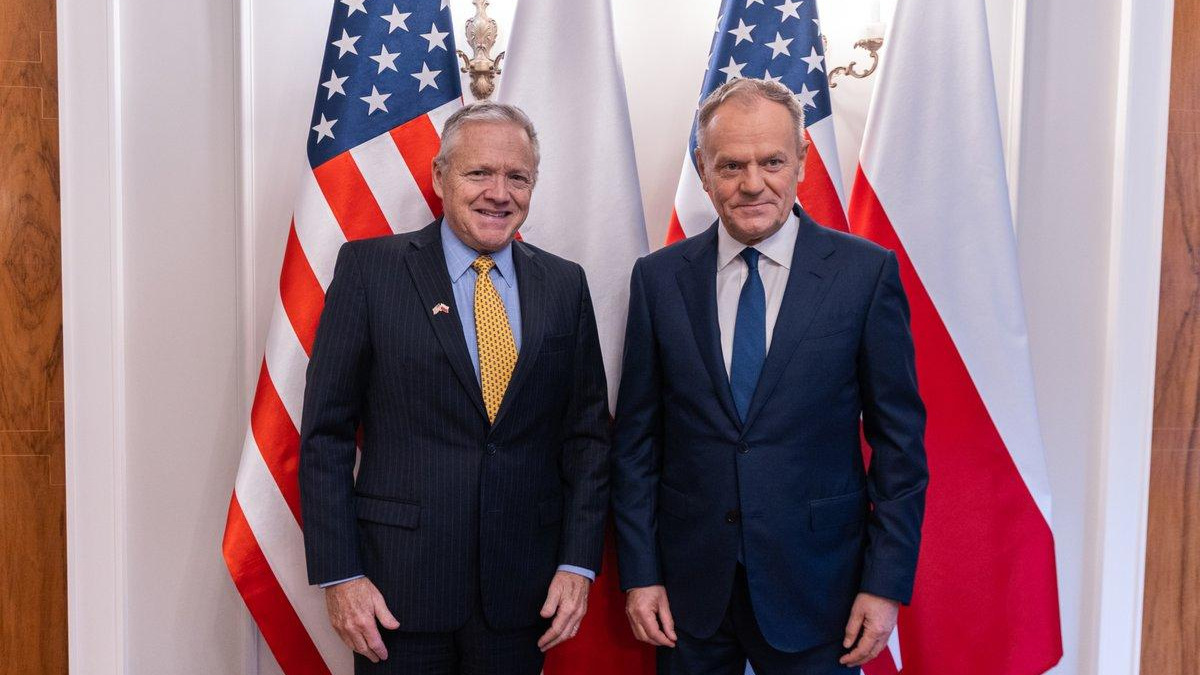
The United States ambassador to Poland, Thomas Rose, has praised Warsaw while accusing other European leaders of expecting America to shoulder the burden of confronting Russia and supporting Ukraine. In a sharply worded statement published on Friday, 23 October, Rose singled out Poland as a positive example and defended President Donald Trump’s attempts to negotiate an end to Russia’s war against Ukraine. His comments come amid continuing disagreements over European defence responsibilities, military assistance to Kyiv and the terms of a possible peace agreement.
Rose made the remarks on his personal X account, using the hashtag #belikePoland in a message that contrasted Poland’s approach to security with that of other European countries.
He argued that some European governments regard Russia as a fundamental threat to their security but nevertheless expect Washington to provide the money, weapons and military commitment needed to respond.
- Find more news from Poland on our Homepage .
The ambassador did not identify the European leaders or countries he was criticising.
His comments, subsequently reported by the Polish news agency PAP and several national news outlets, add to the debate about the future of the transatlantic alliance and Europe’s responsibility for its own defence.
Ambassador singles out Poland in criticism of European leaders
Rose began by acknowledging that European governments have legitimate reasons to regard Russia as a serious security threat.
He then accused an unspecified group of leaders of expecting the United States to address that threat on their behalf, invoking American financial resources, military equipment and the potential risk to American lives.
The ambassador distinguished Poland from those governments, presenting Warsaw as an example of a European ally prepared to invest heavily in its own security.
His remarks were reported by Rzeczpospolita, citing PAP, and by other Polish outlets on Friday evening and Saturday.
Rose went further than criticising the distribution of defence costs. He also accused European politicians of demanding that the war continue while condemning Trump for pursuing negotiations.
In the ambassador’s assessment, calls to maintain Ukraine’s resistance would achieve little without a credible strategy for bringing the conflict to an end.
He presented a negotiated settlement as a possible means of preserving Ukraine’s independence, while suggesting that continuing the war could leave Kyiv facing an increasingly difficult military position.
Those assessments are Rose’s political arguments, rather than independently established conclusions about the war’s likely outcome or the intentions of European governments.
Why Poland is treated as an example
Poland has become one of NATO’s most prominent advocates of increased defence spending following Russia’s full-scale invasion of Ukraine in February 2022.
Warsaw has expanded military procurement, strengthened its armed forces and invested heavily in equipment intended to improve its ability to defend NATO’s eastern flank.
According to figures published by the Polish Foreign Ministry, the country’s defence expenditure exceeded PLN 186.5 billion in 2025, equivalent to approximately 4.7% of gross domestic product.
For 2026, Poland planned approximately PLN 200 billion in military expenditure, including financing through the Armed Forces Support Fund. The planned total represented roughly 4.8% of GDP.
These are Polish government budget figures, and actual spending may differ from the allocations initially planned.
The scale of the commitment helps explain why Poland is frequently cited in American discussions about European allies contributing more to their own security.
Poland has also provided military assistance to Ukraine, supported the transport of international aid and advocated stronger European security measures in response to Russian aggression.

However, Warsaw continues to regard American military involvement in Europe as fundamental to regional security.
Foreign Minister Radosław Sikorski has repeatedly argued that maintaining a substantial US military presence in Europe, particularly in Poland, remains in the country’s strategic interest.
Poland’s approach therefore combines higher national military expenditure with a continued commitment to the transatlantic alliance rather than an attempt to replace American security guarantees.
Is Europe really leaving America to support Ukraine?
Rose’s argument raises a broader question about how responsibility for supporting Ukraine is actually divided between the United States and European countries.
The available figures do not support a general conclusion that European governments have left the United States to finance Ukraine’s defence on its own.
According to a European Parliament Research Service briefing updated on 14 October 2026, the European Union and its member states had mobilised approximately €224.5 billion in financial, military and humanitarian assistance for Ukraine since February 2022.
That figure includes several different types of support, much of it provided through loans. It should not be interpreted as the amount of military equipment already delivered.
Nevertheless, the scale of European assistance has increased substantially as governments have sought to compensate for changes in American policy.
Using data from the Kiel Institute’s Ukraine Support Tracker, the European Parliament briefing reported that EU member states and institutions had allocated approximately €85.7 billion in military assistance by the end of June 2026.
The equivalent total for the United States stood at approximately €64.6 billion under the same tracking methodology.
European military assistance had therefore overtaken American allocations within that dataset, although comparisons can differ depending on whether they measure money committed, equipment delivered, procurement contracts or wider financial support.
The Kiel Institute’s August assessment nevertheless identified an important continuing dependency: European governments still rely significantly on American defence manufacturers and US weapons stockpiles.
Between January and June 2026, European donors purchased military assistance worth at least €3 billion from American defence companies, according to the institute.
That distinction matters. European countries can finance military assistance to Ukraine while still depending on the United States to manufacture or supply some of the equipment Kyiv requires.
Rose’s criticism reflects one interpretation of this relationship, but the financial evidence points to a more complicated division of responsibilities.
Ambassador defends Trump’s approach to peace negotiations
Rose’s statement also defended Trump’s attempts to negotiate an end to the war, criticising European politicians who question the American president’s approach.
In a rhetorical challenge to his critics, the ambassador contrasted the continuation of fighting with the possibility of a diplomatic settlement that would allow Ukraine to remain independent.
He also compared Europe’s response to the war in Ukraine with its position towards American military operations involving Iran, arguing that some European governments apply different standards when American and European interests are at stake.
The statement came during another period of diplomatic activity involving Washington, Kyiv and Moscow.
On 23 October, Reuters reported on preparations for renewed negotiations following an agreement for a temporary humanitarian ceasefire in the Russian-occupied Ukrainian town of Oleshky.
The limited ceasefire was scheduled to begin on 27 October, allowing humanitarian supplies to enter and civilians to leave through designated corridors.
Ukrainian President Volodymyr Zelenskyy also said negotiators from Ukraine, Russia and the United States were preparing for further talks in November.
Kyiv has expressed willingness to pursue negotiations while maintaining that any settlement must provide credible security guarantees and protect Ukraine’s independence.
Russia, meanwhile, continues to demand Ukrainian territorial concessions, including areas of the Donbas region that Russian forces do not control.
These unresolved differences remain fundamental obstacles to a comprehensive peace agreement.
Rose’s suggestion that a negotiated peace offers the better course is therefore part of a wider political debate over the terms, enforcement and durability of any future settlement.
What the remarks mean for US-Polish relations
Rose’s decision to single out Poland illustrates the favourable position Warsaw occupies in parts of the American debate about NATO burden-sharing.
The ambassador, who was nominated by Trump and sworn into office in October 2025, is the administration’s official diplomatic representative in Poland.
His public statements consequently carry diplomatic significance, even when issued through a personal social-media account.
However, the 23 October post was not accompanied by a separately announced US government policy decision, and the ambassador did not identify any specific European government as the target of his criticism.
Nor does his praise for Poland mean that Warsaw and Washington share identical positions on every aspect of the war or the negotiations intended to end it.
The Polish Foreign Ministry reaffirmed earlier in October that Poland would continue supporting Ukraine’s independence and territorial integrity while working with allies to increase pressure on Russia.
That policy position provides useful context for interpreting Rose’s remarks without treating his assessment as a joint Polish-American declaration.
No specific public response from the Polish Foreign Ministry to the ambassador’s 23 October statement was identified during this review.
A continuing debate over Europe’s security
The ambassador’s intervention comes as NATO governments confront the longer-term challenge of financing Europe’s defence while maintaining close cooperation with Washington.
The alliance’s defence investment commitments call for substantially higher expenditure by 2035, reflecting concerns about military readiness, deterrence and the ability of European forces to operate effectively.
Poland’s military spending places it in a prominent position in that debate, but its security policy also demonstrates the continuing importance of American military capabilities and NATO cooperation.
Rose’s remarks place Warsaw on one side of his comparison with unnamed European leaders. They do not, however, settle the wider disagreement about how much the United States and individual European countries contribute to Ukraine’s defence.
The central questions remain how NATO allies divide financial and military responsibilities, how long-term support for Ukraine is maintained, and whether diplomacy can produce an agreement that both ends the fighting and provides lasting security.