Polish Prime Minister Donald Tusk has announced additional financial assistance for Łukasz Schön, a former police officer who suffered a serious brain injury while helping rescue 17 residents from a burning apartment building in Chorzów. The officer developed a rare neurological disorder following the August 2025 rescue and has since been forced to leave police service. Tusk’s intervention, announced on Thursday, 22 October, follows growing public attention to Schön’s condition and his need for continued treatment and rehabilitation.
Tusk announced the decision on X, saying that the officer had sacrificed his health while helping to save others.
The prime minister said Schön would receive an additional benefit from funds at his disposal. The amount, duration and payment timetable were not specified in the publicly available announcement.
- Find more news from Poland on our Homepage .
Earlier the same day, Interior Minister Marcin Kierwiński confirmed that the former officer had also been awarded a disability pension with a supplement, alongside compensation provided through the Silesian police command.
These are three separate forms of support: a benefit announced by the prime minister, a disability pension and supplement, and police compensation. Their amounts have not been independently established.
The government announcements were detailed by the Polish Press Agency in its reporting on Thursday.
Tusk intervenes as former officer seeks support
Tusk’s announcement followed fresh reporting about Schön’s life since the fire, including the difficulties posed by his neurological condition and the ongoing costs of treatment and rehabilitation.
Earlier on Thursday, Wirtualna Polska published an interview with Schön in which he discussed his illness, the end of his police career and uncertainty about his financial situation.
The timing is important: that interview described the officer as still awaiting formal confirmation of his disability pension, but Kierwiński subsequently announced that the pension had been awarded in October.
The interior minister also confirmed compensation from the regional police authorities in Katowice.
Tusk’s newly announced assistance is additional to those payments. A decision to grant a benefit should not be confused with independent confirmation that the recipient has already received the money.
Policeman helped rescue 17 people from a burning building
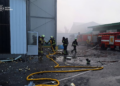
The incident took place in the early hours of 9 August 2025 in an apartment building on Morcinka Street in Chorzów, near Katowice in southern Poland.
Schön and fellow officer Patryk Niedziółka were among the first emergency responders to arrive.
They repeatedly entered smoke-filled parts of the five-storey building to help residents escape.
According to the contemporary account published by Chorzów police, a total of 17 people were evacuated during the operation.
One man died in the fire. A 68-year-old woman suffered a leg injury after jumping from a second-floor window, while another woman required hospital treatment for smoke inhalation.
Both officers were also treated in hospital after exposure to smoke.
Schön’s health later deteriorated, with consequences that would end his career in policing.
Rare neurological condition ends his police career
Following the rescue, Schön developed Lance–Adams syndrome, a rare neurological disorder associated with brain injury caused by a lack of oxygen.
The condition, also called chronic post-hypoxic myoclonus, can cause sudden involuntary muscle movements, particularly when a person attempts to move.


Its effects can interfere with coordination, balance and everyday activities.
The Silesian Police confirmed Schön’s diagnosis in an official account of his departure from the force. Police also reported that he had developed post-traumatic stress disorder.
Schön requires ongoing neurological treatment and rehabilitation, and has described difficulties controlling his movements and coping with memories of the fire.
In his interview with Wirtualna Polska, he said police work had been central to his life and described the emotional toll of having to give it up.
He had joined the police in April 2024, after previously working in municipal enforcement.
On 6 October 2026, colleagues gathered at Police Station II in Chorzów to thank him for his service and mark his departure into disability retirement.
The official police report of the farewell ceremony described the circumstances of his departure and the support offered by colleagues.
Police honours and public fundraising
Schön and Niedziółka have received official recognition for their actions during the Chorzów fire.
In June 2026, they were awarded the Honorary Police Merit Badge named after Major Jan Piwnik, a Polish wartime resistance figure known as Ponury.
The Silesian Police announcement about the honours said the recognition related to the officers’ conduct during the rescue.
Schön has also received the Andrzej Struj Medal, awarded in recognition of courage and commitment to duty.
Police colleagues and members of the public have organised charitable initiatives to support his recovery, including a fundraising concert in Jaworzno.
A separate fundraising campaign established for Schön’s rehabilitation describes continuing needs for specialist consultations, therapy and equipment.
These voluntary donations are distinct from the official payments announced by Tusk and Kierwiński.
What happens next?
Schön continues to need specialist care. His condition is serious, but the longer-term course of rehabilitation cannot be predicted from the publicly available information.
Research into Lance–Adams syndrome shows that treatments can help some patients manage involuntary movements, although individual responses and recovery differ. A systematic review published in Brain Communications discusses available treatments and their limitations.
The prime minister’s announcement adds another source of financial support, but the exact value and payment terms of his additional benefit remain to be clarified.
For the former officer, the practical priorities remain continuing rehabilitation and adapting to daily life after an emergency response that helped save residents but caused lasting harm to his health.