

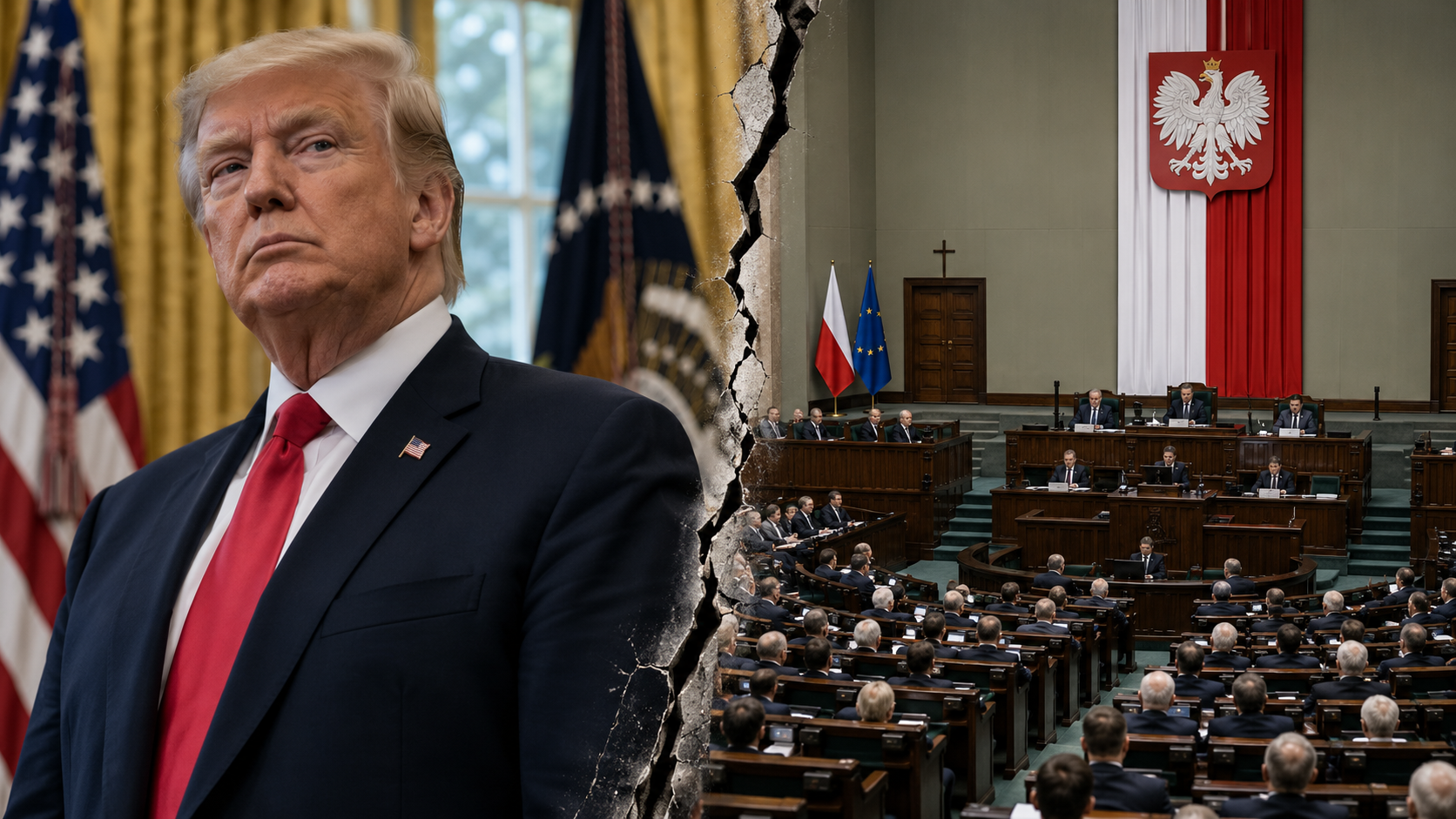
A political dispute has erupted in Poland over an unconfirmed report that US President Donald Trump encouraged Deputy Prime Minister and Defence Minister Władysław Kosiniak-Kamysz to leave Donald Tusk’s governing coalition and form a new government with Poland’s right-wing opposition. The White House meeting itself is confirmed, as is the fact that Kosiniak-Kamysz subsequently briefed Tusk, but neither Trump nor the Polish defence minister has publicly confirmed that such a proposal was made.
The allegation was reported by journalist Dominika Wielowieyska of Gazeta Wyborcza and TOK FM, who said unnamed sources had told her that Trump suggested Kosiniak-Kamysz should form a coalition with Poland’s political right. According to her account, such a government was told it could expect “100% support” from the United States and favourable access to Washington.
That remains an unverified account of a confidential conversation. There is no publicly available transcript or official record confirming that Trump made the proposal, and the White House has not publicly substantiated it.
- Find more news from Poland on our Homepage .
What is established is that Kosiniak-Kamysz met Trump at the White House on 2 March 2026, when the Polish minister was in Washington for a ceremony honouring US Army Staff Sergeant Michael Ollis. Ollis was killed in Afghanistan in 2013 after shielding Polish officer Karol Cierpica from a suicide bomber. Poland’s Defence Ministry recorded the White House ceremony and award, while photographs taken that day show Kosiniak-Kamysz speaking outside the White House afterwards.
Kosiniak-Kamysz later acknowledged that he had an opportunity to speak directly with Trump and credited President Karol Nawrocki’s office with helping arrange the contact. He has described the exchange as informal and said he informed Prime Minister Tusk immediately afterwards.
Tusk says conversation concerned Polish domestic affairs
The controversy intensified when Tusk confirmed that Kosiniak-Kamysz had briefed him on the meeting in March.
Asked by TVN24 what Trump and his defence minister discussed, the prime minister declined to disclose the details but said the conversation was confidential and concerned “rather the internal situation in Poland”. Tusk also explicitly rejected the suggestion that the subject had been negotiations over a permanent US military base in Poland.
That statement has given additional weight to questions about the political content of the meeting, but it still does not independently verify Wielowieyska’s specific allegation that Trump urged Kosiniak-Kamysz to leave the coalition.
Kosiniak-Kamysz leads the centre-right Polish People’s Party, PSL, one of the parties underpinning Tusk’s parliamentary majority. Were PSL to withdraw its support, it could fundamentally change the arithmetic sustaining the government, although creating an alternative cabinet would still require sufficient support in the 460-seat Sejm.
No evidence has emerged that Kosiniak-Kamysz subsequently entered negotiations to replace Tusk’s government on the basis described in the report.
Bielan rejects account of ultimatum
Law and Justice MEP Adam Bielan has confirmed that he helped arrange Kosiniak-Kamysz’s access to Trump. In an interview with RMF24, Bielan said the discussion lasted several dozen minutes and was not an accidental encounter.
He gives a different account of its purpose.
Bielan says the meeting was intended to help unblock talks over establishing a permanent US military presence in Poland. Appearing on TVP Info this week, he dismissed suggestions that Trump had issued an ultimatum requiring Kosiniak-Kamysz to leave Tusk’s coalition, calling that narrative absurd.
PSL politician Krzysztof Hetman has likewise described claims that the meeting involved attempts to change Poland’s government as “nonsense”.
Those denials themselves do not settle what Trump actually said, because Bielan has acknowledged that he was not present for the private conversation between the US president and Kosiniak-Kamysz. The defence minister has also said Bielan was not inside the room.
Dispute over missing official note
The absence of an official diplomatic record has become a second controversy around the meeting.
Foreign Minister Radosław Sikorski has questioned why his ministry did not receive a written note describing such a politically significant conversation. He argued that whoever organised the meeting should have produced a record and publicly questioned whether its absence was connected to an attempt to involve a foreign government in Polish domestic politics.
President Nawrocki has also said that he did not receive a note setting out what was discussed, despite members of his office helping facilitate the contact.
Speaking on 6 October, Nawrocki said both he and Sikorski should receive a record from Kosiniak-Kamysz and stressed that he personally did not know what was said during the conversation.
The President’s Office has rejected suggestions that its involvement amounted to a political effort against Tusk’s government. Presidential spokesman Rafał Leśkiewicz said the meeting formed part of attempts to strengthen Poland’s security relationship with Washington and advance the goal of a permanent American military base.
Who arranged the meeting?
Bielan has openly acknowledged helping arrange the conversation, saying associates of Kosiniak-Kamysz had sought assistance in establishing direct contact with Trump.
Wielowieyska’s reporting, however, alleges that Bielan and Nikodem Rachoń, an adviser in President Nawrocki’s office, played a broader role and had encouraged the American side to consider a political realignment in Warsaw.
That claim has not been independently verified.
The exact length of the Trump-Kosiniak-Kamysz discussion is also disputed. Bielan has described a conversation lasting several dozen minutes, whereas Kosiniak-Kamysz has characterised it more modestly as an informal opportunity to speak with the US president.
Potentially serious — if confirmed
The allegation is politically sensitive because direct encouragement by a foreign head of state to change the composition of Poland’s government would represent an extraordinary intervention in the country’s domestic politics.
Paweł Kowal, a Civic Coalition MP who chairs the Sejm’s Foreign Affairs Committee, said that if it were established that Polish opposition figures had discussed the composition of Poland’s government with a foreign power, it would amount to a major political scandal.
For now, however, the evidence supports a narrower set of conclusions.
Trump and Kosiniak-Kamysz did meet privately. The meeting was assisted by figures connected to PiS and the Presidential Palace. Kosiniak-Kamysz informed Tusk afterwards. Tusk says the conversation concerned Poland’s internal situation rather than a US base. No official note describing the substance of the meeting has emerged.
The much more explosive claim — that Trump explicitly urged the PSL leader to abandon Tusk and create a new government with the right — remains based on reporting from unnamed sources and has not been publicly confirmed by either participant.