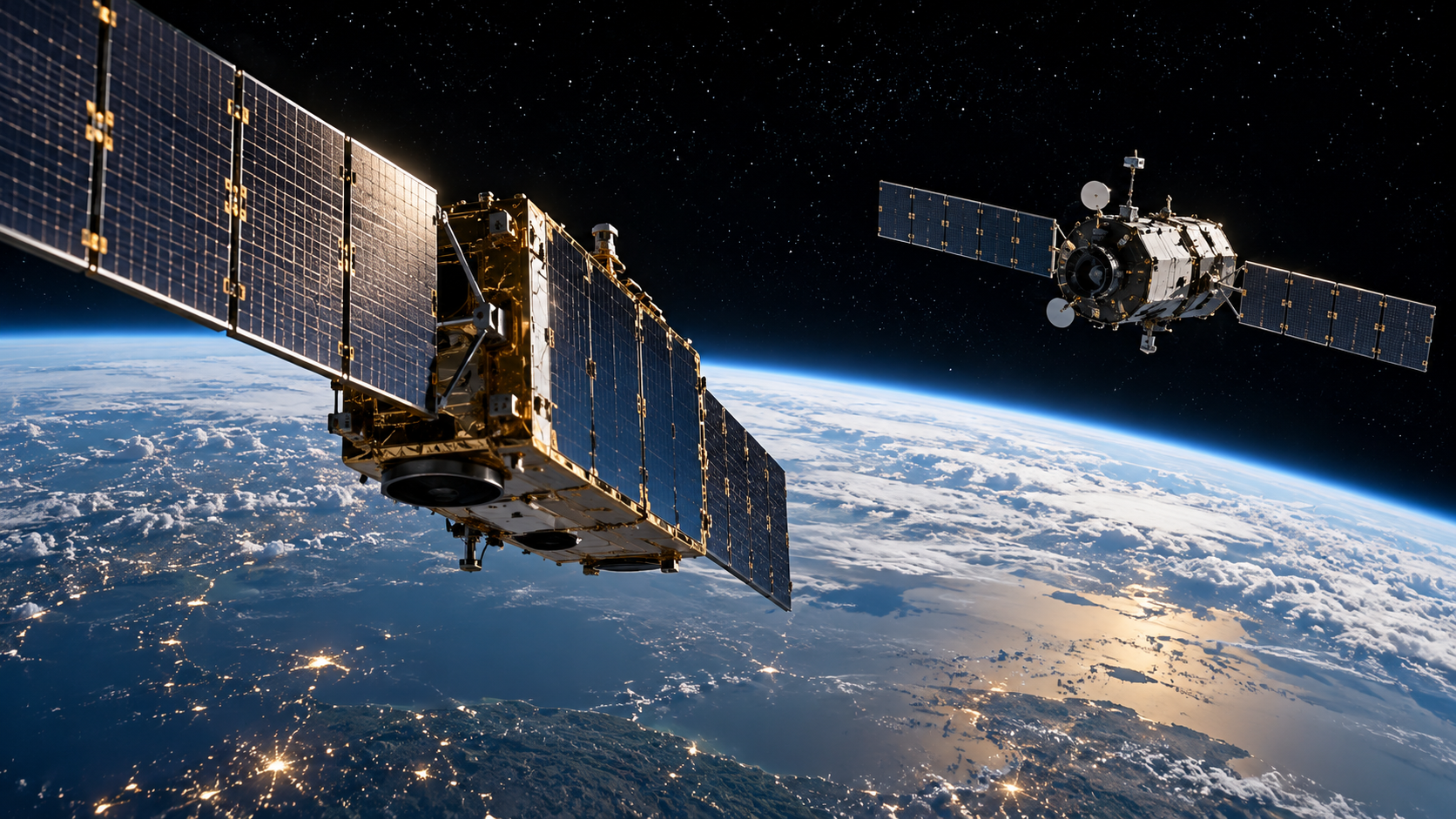
A Russian military satellite has carried out a series of manoeuvres bringing it into almost the same orbit as a commercial reconnaissance spacecraft operated by ICEYE, a Finnish-founded satellite company with major Polish connections that supplies radar imagery to Ukraine. US space intelligence analysts estimate that the Russian satellite was approximately 475 kilometres behind the ICEYE spacecraft on 13 October and warn that it could move substantially closer in the coming weeks.
The Russian satellite, identified as Cosmos 2612, made its latest manoeuvre on 12 October, according to orbital analysis published by US-based intelligence consultancy Integrity ISR.
The manoeuvre brought Cosmos 2612 into near alignment with ICEYE-X36, a commercial synthetic-aperture radar (SAR) satellite capable of producing detailed images of the Earth’s surface in darkness and through cloud cover.
- Find more news from Poland on our Homepage .
Analysts believe the sequence of movements indicates an intentional attempt to position the Russian spacecraft near ICEYE-X36, although the precise purpose of the operation remains unknown.
There is no confirmed attack, collision or physical interference with the ICEYE satellite, and the available observations do not establish that Russia intends to damage it.
The developments have particular significance for Poland, whose armed forces operate a separate ICEYE-built satellite reconnaissance system and whose defence industry has become closely involved in the company’s technology.
Russian satellite follows a series of calculated orbital manoeuvres
According to Integrity ISR, Cosmos 2612 spent approximately two weeks adjusting its orbit before moving back towards ICEYE-X36’s orbital altitude.
On 30 September, the Russian spacecraft raised its orbit by around 46.5 kilometres, reaching approximately 590 kilometres above Earth.
It then made a smaller adjustment on 7 October before carrying out a substantially larger manoeuvre on 12 October.
That final adjustment lowered the spacecraft’s orbit, bringing it to approximately 555 kilometres above Earth, compared with ICEYE-X36’s altitude of around 556 kilometres.
It also brought the two satellites into closely aligned orbital planes, meaning they were travelling around Earth along nearly the same path, although separated by hundreds of kilometres.
Integrity ISR calculated that Cosmos 2612 was trailing ICEYE-X36 by approximately 475 kilometres on 13 October and was gradually reducing the distance.
The consultancy’s detailed analysis, published on 14 October, draws on commercial space-tracking data and reporting associated with the US-led Joint Commercial Operations initiative.
Its analysts interpret the sequence as preparation for a possible rendezvous or proximity operation, in which one spacecraft intentionally approaches another.
However, the orbital data alone cannot reveal what Russia ultimately intends to do.
Analysts warn of possible closer encounter
Integrity ISR believes the Russian spacecraft has already completed some of the more demanding orbital adjustments needed to approach ICEYE-X36.
Once two satellites are travelling at almost the same altitude and within closely aligned orbital planes, further manoeuvres can potentially bring them together using relatively small amounts of propellant.
In a statement released on 13 October, the consultancy said Cosmos 2612 could potentially move much closer as early as 29 October.
Its more detailed orbital assessment projected that, without additional manoeuvres, the Russian satellite could reduce its distance from ICEYE-X36 to approximately 90 kilometres by 8 November.
These are different, conditional projections rather than confirmed dates for an encounter. Both depend on how the spacecraft continue to move.


Greg Gillinger, Integrity ISR’s senior vice-president for strategy and development, described the Russian manoeuvres as a carefully executed approach.
He argued that the October adjustments strongly suggested the Russian spacecraft was seeking proximity to ICEYE-X36.
The consultancy says possible operations at close range could include observing the commercial satellite, gathering intelligence about its systems or attempting some form of interference.
Physical damage is also among the theoretical possibilities, but there is no verified evidence that Cosmos 2612 is equipped to carry out an attack.
The Russian satellite’s precise capabilities have not been publicly established.
Earlier Russian movements concerned Western military officials
The October manoeuvres follow a series of unusual orbital movements involving Russian military satellites earlier this year.
In May, five Russian Cosmos spacecraft adjusted their orbital inclinations to align more closely with ICEYE-X36, according to Integrity ISR’s earlier analysis.
The US Space Force independently identified Russian military satellite activity near an ICEYE spacecraft during that period.
In a Reuters investigation published on 9 October, Major General Michael Traut, the head of Germany’s Space Command, expressed concern about the implications for commercial satellite constellations.
He described the Russian spacecraft as pursuing the ICEYE satellite and warned that similar techniques could potentially be used to disrupt large communications networks such as Starlink.
Traut suggested that interference would not necessarily require the physical destruction of a satellite. Manoeuvres forcing commercial spacecraft to expend additional fuel could, for example, shorten their operational lives.
ICEYE chief executive Rafał Modrzewski told Reuters that the company had previously manoeuvred its satellite in response to Russian activity, after which the Russian spacecraft made further adjustments.
The company’s response to the latest 12 October manoeuvre has not been independently established.
The earlier activity provides important context, but the October orbital calculations remain primarily supported by Integrity ISR’s newly published analysis rather than a separate public assessment from the US Space Force.
Why ICEYE’s satellites matter to Ukraine
ICEYE operates a constellation of commercial satellites equipped with synthetic-aperture radar, a technology that can generate detailed images of the Earth’s surface in almost any weather.
Unlike conventional optical satellites, radar satellites do not depend on daylight or clear skies.
They can therefore provide reconnaissance information during the night and through cloud cover, making them valuable for monitoring military positions, infrastructure and other strategically important locations.
The company has supplied imagery and satellite reconnaissance capabilities to Ukraine since 2022.
That year, ICEYE signed an agreement with the Serhiy Prytula Charity Foundation giving the Ukrainian government access to the capabilities of a satellite already in orbit, alongside imagery from ICEYE’s wider constellation.
Cooperation subsequently expanded.
In January 2026, ICEYE announced a new agreement with a customer within Ukraine’s Defence Ministry to increase access to high-resolution radar imagery, supporting Ukrainian military situational awareness and reconnaissance.
ICEYE’s technology can assist with detecting changes to military infrastructure, identifying equipment and monitoring areas of operational importance.
However, public information does not establish which individual satellite images have supported specific Ukrainian military operations.
The precise operational role of ICEYE-X36, including whether it has been directly involved in particular Ukrainian missions, cannot be independently confirmed from the available public evidence.
The Polish connection: ICEYE’s rapidly expanding military role
The incident has attracted particular attention in Poland because of ICEYE’s growing importance to the country’s defence capabilities.
ICEYE was founded in Finland in 2014 by Polish entrepreneur Rafał Modrzewski and Finnish engineer Pekka Laurila.
Although internationally based, the company has significant operations in Poland and has become one of the country’s most important industrial partners in satellite reconnaissance.
In May 2026, ICEYE officially handed over the MikroSAR system to the Polish Armed Forces, less than 12 months after signing its procurement contract.
The system, also known as POLSARIS, provides Poland with its own sovereign radar-satellite reconnaissance capability.
According to ICEYE, the programme includes four satellites delivered under the original contract and an exercised option, alongside ground infrastructure and training.
Polish military operators are responsible for controlling the system independently through the Geospatial Reconnaissance and Satellite Services Agency, known as ARGUS.
The satellites can support military reconnaissance, border monitoring and the observation of strategically important locations regardless of daylight or weather.
ICEYE-X36, the spacecraft involved in the reported Russian orbital approach, is not one of Poland’s dedicated MikroSAR military satellites.
It is a commercial ICEYE spacecraft described by Integrity ISR as registered through the company’s US operation.
The reported Russian movements therefore do not establish that Poland’s sovereign military satellite constellation is under direct threat.
Nevertheless, the developments highlight potential security risks affecting the wider satellite technologies and commercial services increasingly relied upon by Poland, Ukraine and other European countries.
Growing concern over security in orbit
The situation comes amid wider concern that space is becoming an increasingly contested part of modern military operations.
Commercial companies now provide capabilities that were once almost exclusively controlled by national governments, including reconnaissance imagery, secure communications and navigation support.
That creates new security challenges when the same civilian-owned infrastructure supports military operations.
Russia has previously warned that commercial space systems used to assist Western military activities could be regarded as legitimate military targets.
Such statements have heightened concern among Western governments about the vulnerability of privately operated satellites supporting Ukraine.
However, there is no publicly verified evidence that Russia has decided to attack ICEYE-X36.
The immediate question is whether Cosmos 2612 will continue closing the distance, remain at a safe separation or carry out additional manoeuvres that provide clearer evidence of its mission.
Further orbital observations, any response from ICEYE and statements from relevant military space-monitoring authorities will be important in determining whether the latest activity represents surveillance, a demonstration of capability or preparation for more intrusive interference.
For now, the evidence points to a deliberate pattern of orbital repositioning. What Russia intends to do next remains uncertain.